Decision Making in Dental Implantology
eBook - ePub

Decision Making in Dental Implantology

Atlas of Surgical and Restorative Approaches

  1. English
  2. ePUB (mobile friendly)
  3. Available on iOS & Android
eBook - ePub

Decision Making in Dental Implantology

Atlas of Surgical and Restorative Approaches

About this book

Decision Making in Dental Implantology: Atlas of Surgical and Restorative Approaches offers an image-based resource to both the surgical and restorative aspects of implant therapy, presenting more than 2,000 color images with an innovative case-by-case approach.

  • Takes a highly pictorial approach to all aspects of implant dentistry
  • Discusses both the surgical and restorative aspects of implant therapy in a single resource
  • Describes a wide range of clinical scenarios likely to be encountered in daily practice
  • Covers anterior, posterior, and full-mouth restorations
  • Presents more than 2,000 color images showing the basic concepts and clinical cases


Trusted by 375,005 students

Access to over 1.5 million titles for a fair monthly price.

Study more efficiently using our study tools.

Information

Year
2017
Print ISBN
9781119225942
eBook ISBN
9781119225966
Edition
1
Subtopic
Dentistry

Chapter 1
Current Status of Clinical Practice with Dental Implants: An Evidence-Based Decision Making Overview

Osseointegration and its Application to the Treatment of Completely or Partially Edentulous Patients in Clinical Practice

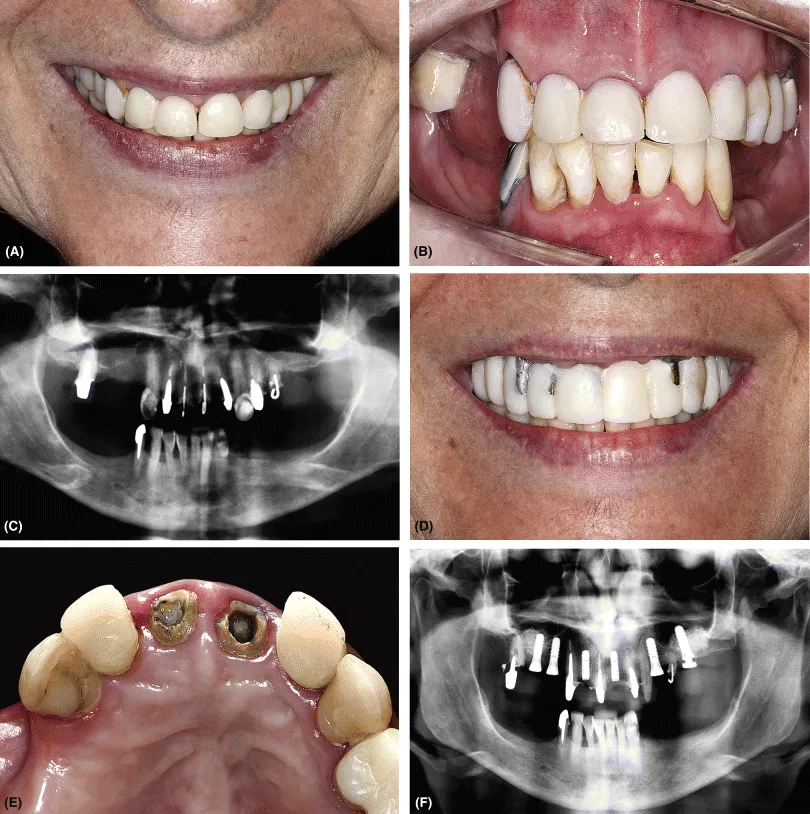
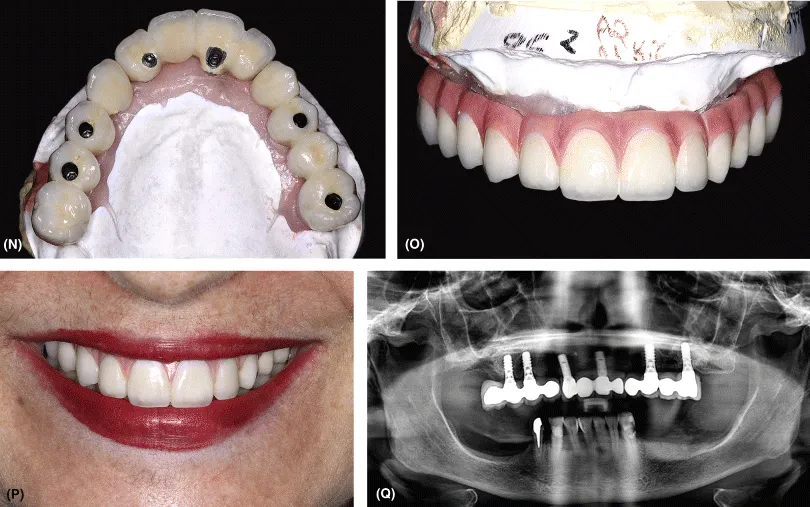
Since the first experimental study from the end of 1960s [1], the titanium implant has been used as a biocompatible feasible alternative in the treatment of completely or partially edentulous patients. Basically, the systematic use of dental implants in dentistry as a scientifically proven therapeutic approach occurred in the 1980s, while in the 1990s it strongly grew in terms of potential clinical applications (Figure 1.1 and 1.2).
Figure 1.1 (A) Initial clinical status with several missing teeth before the full-mouth reconstruction. (B) After osseointegration around six implants in the maxilla the remaining teeth were extracted. (C) The abutments and the three four-unit porcelain-fused-to-metal restorations: two posterior screw-retained restorations and one anterior cemented restoration. (D, E) Clinical view of the final rehabilitation in position – occlusal and buccal views. (F) Panoramic radiograph.
Figure 1.2 (A) Patient smile before treatment. (B) Initial clinical status with several missing teeth before the full-mouth reconstruction. (C) Initial panoramic radiograph. (D) First mockup shows the unfavorable position of teeth #6, 7, and 11 regarding the planning for restorative treatment. (E) Occlusal view of the anterior teeth. (F) Panoramic radiograph after the placement of six implants in the maxilla. (G, H) Clinical views after implant placement before and after teeth extraction. (I) The three four-unit porcelain-fused-to-metal restorations prior to installation. (J) Clinical try-in of the three four-unit screw-retained porcelain-fused-to-metal restorations. (K) Occlusal view of the abutments. (L) Right-side partial fixed restoration before the pink gingival application. (M) Pink gingival simulation with acrylic resin. (N, O) Restorations completed – occlusal and buccal views. (P) Patient smile after treatment. (Q) Panoramic radiograph.
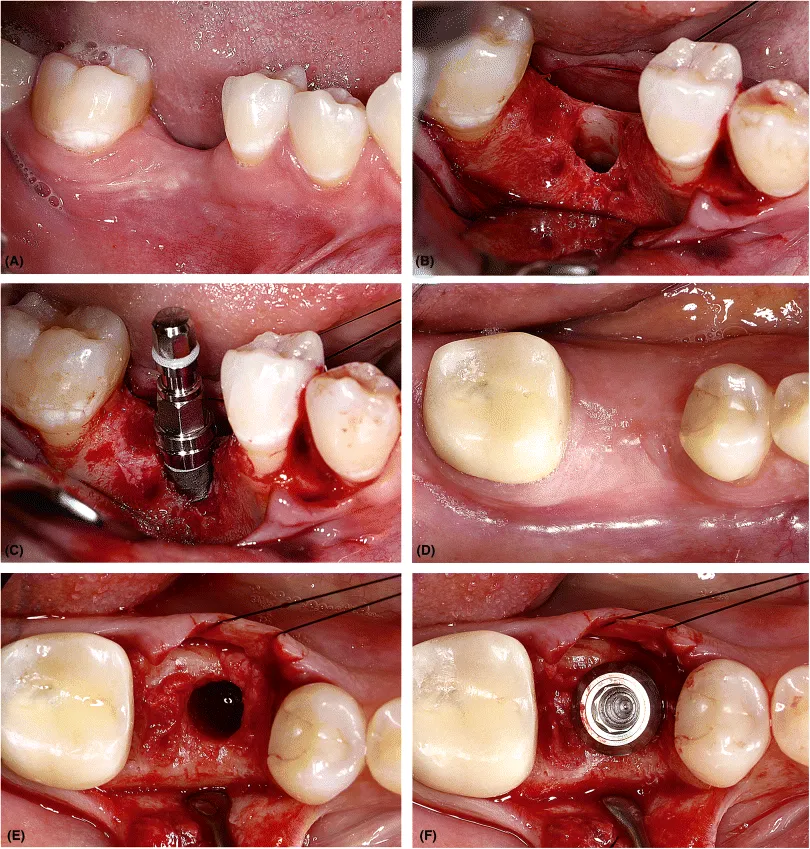
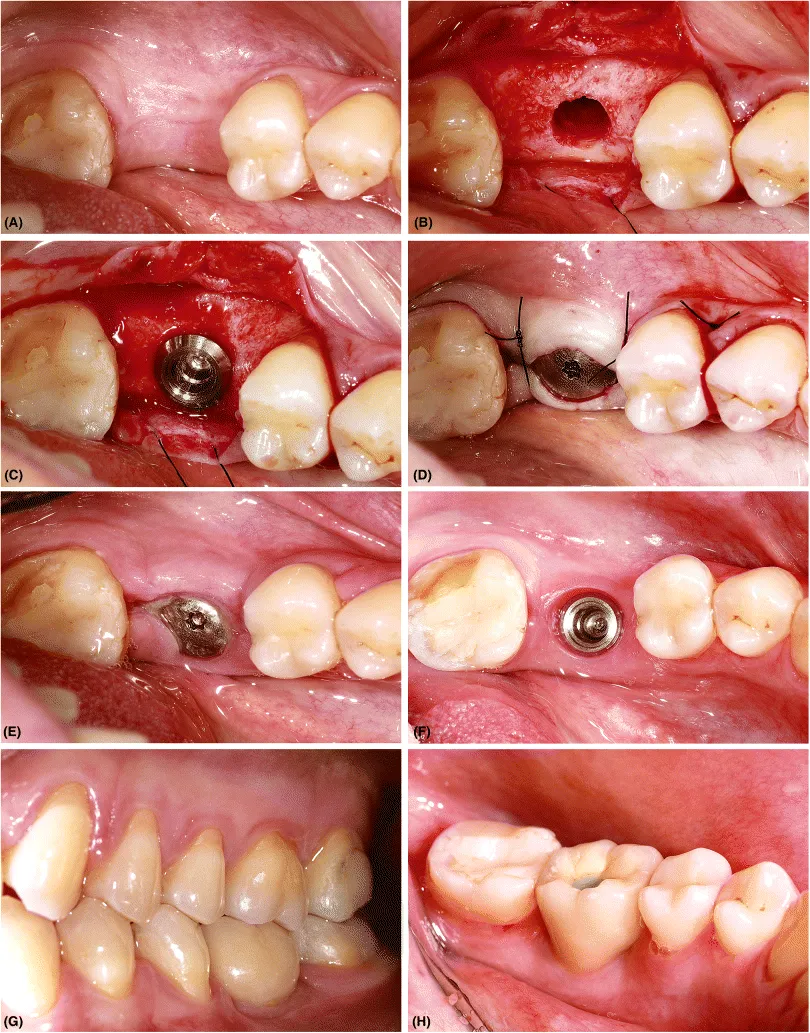
Currently, titanium implant-based procedures are seen as the gold standard for the replacement of teeth lost as a consequence of periodontitis, caries, endodontic pathology, and trauma. As a result, it can be argued with a high degree of certainty that implant-based therapies alone or in association with hard- and soft-tissue reconstructive procedures (most of them developed during the same period) are essential for the achievement of excellent clinical treatment in dentistry. These principles are grounded in the accomplishment of so-called osseointegration between the implant surface and living alveolar bone, (i.e. a direct bone deposition on implant surfaces at the light microscopic level) [2]. Additionally, others factors have influenced implant therapy among professionals over the last 20 years: the high success rates and the clinical/functional predictability of prosthetic restorations examined by long-term periodontal and implant dentistry research (Figure 1.3 and 1.4) [3–8].
Figure 1.3 Two implant sites in tooth #30 with different characteristics. (A) Tooth #30 is missing and a bone defect is present at the alveolar ridge. (B) Implant site with thin bone walls. (C) Implant in position (4.1 mm diameter). A dehiscence-type defect is present at the buccal aspect. (D) Tooth #30 is missing and the alveolar ridge contour is well preserved. (E) Implant site with thick bone walls (more than 2 mm of width). (F) A wide-diameter implant (4.8 mm diameter) in position.
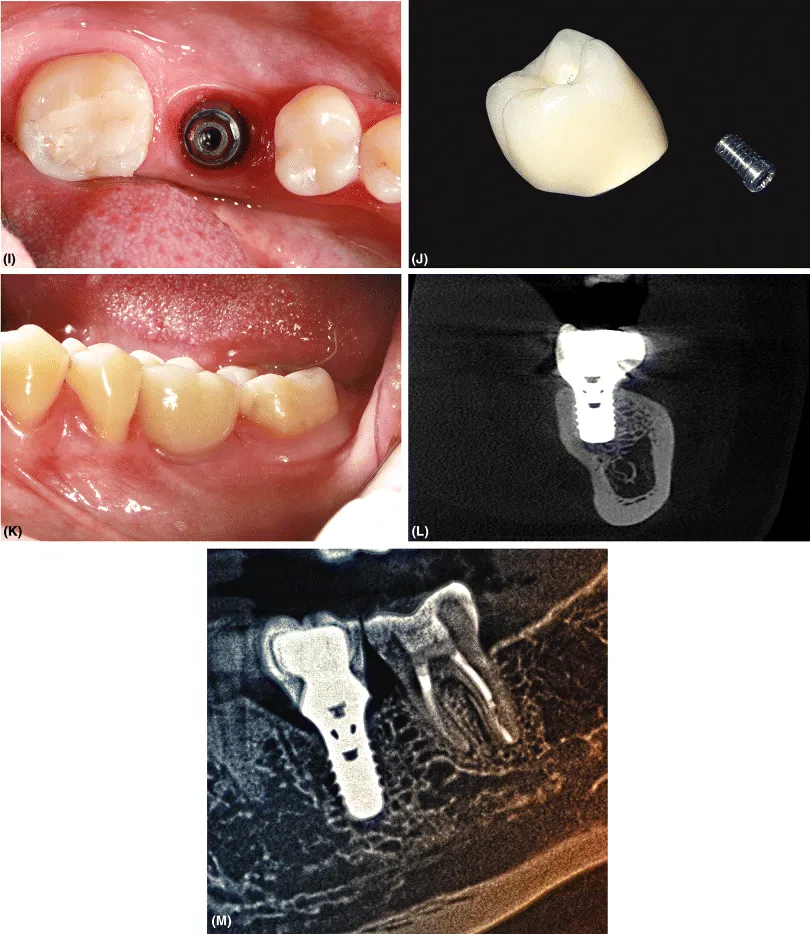
Figure 1.4 (A) Tooth #19 is missing. (B) Implant bed. (C) A wide-diameter implant (4.8 mm diameter) was placed. (D) Wound closure. Non-submerged healing. (E) Aspect one week after operation. (F) Aspect eight weeks after operation. (G, H) Porcelain-fused-to-metal screw-retained restoration in occlusion and lingual views. (I) Eight-year follow-up shows healthy peri-implant soft tissue. (J) Screw-retained restoration. (K) Restoration replaced in position. (L, M) Eight-year follow-up cone beam computerized tomography (CBCT) image shows excellent bone levels around the implant.

Anatomical Implications to Implant Therapy and the Current Impact of Guided Bone Regeneration

The success rate of this treatment modality has been influenced by many elements, such as the successful osseointegration of the dental implants, smoking, the relationship between the final restoration(s) and the adjacent teeth, occlusal loading, and the health of the surrounding soft and hard tissue [9–18]. However, and apart from them, the initial anatomical conditions of the site intended to receive an implant merit close attention as they will drive the initial treatment path.
The bone defects in the alveolar ridge have always been considered a major obstacle to clinical therapy with osseointegrated dental implants, especially in partially edentulous patients. Tooth loss leads to changes of the alveolar ridge anatomy (i.e. bone resorption in both height and thickness) and to the development of bone defects: (a) limited bone thickness, (b) reduced bone height, (c) vertical bone defects, (d) bone defects' combined height and thickness, (e) periodontal attachment loss of the teeth adjacent to the edentulous area, and (f) large bone loss resulting from infections/dentoalveolar trauma or previous surgical procedures (Figure 1.5 and 1.6) [19–24]. These features may not only significantly hinder the placement of implants but also affect the p...

Table of contents

  1. Cover
  2. Title Page
  3. Copyright
  4. Foreword
  5. Decision Making in Dental Implantology
  6. Preface
  7. About the Authors
  8. Chapter 1: Current Status of Clinical Practice with Dental Implants: An Evidence-Based Decision Making Overview
  9. Chapter 2: Treatment Planning for Bone Defects in the Alveolar Ridge
  10. Chapter 3: Treatment of Esthetic Areas
  11. Chapter 4: Treatment of Posterior Areas
  12. Chapter 5: Implant-Supported Rehabilitation of Completely and Partially Edentulous Patients
  13. Chapter 6: Multidisciplinary Decision Making: The Complexity of Some Potential “Real World” Clinical Scenarios
  14. Index
  15. End User License Agreement

Frequently asked questions

Yes, you can cancel anytime from the Subscription tab in your account settings on the Perlego website. Your subscription will stay active until the end of your current billing period. Learn how to cancel your subscription
No, books cannot be downloaded as external files, such as PDFs, for use outside of Perlego. However, you can download books within the Perlego app for offline reading on mobile or tablet. Learn how to download books offline
Perlego offers two plans: Essential and Complete
  • Essential is ideal for learners and professionals who enjoy exploring a wide range of subjects. Access the Essential Library with 800,000+ trusted titles and best-sellers across business, personal growth, and the humanities. Includes unlimited reading time and Standard Read Aloud voice.
  • Complete: Perfect for advanced learners and researchers needing full, unrestricted access. Unlock 1.5M+ books across hundreds of subjects, including academic and specialized titles. The Complete Plan also includes advanced features like Premium Read Aloud and Research Assistant.
Both plans are available with monthly, semester, or annual billing cycles.
We are an online textbook subscription service, where you can get access to an entire online library for less than the price of a single book per month. With over 1.5 million books across 990+ topics, we’ve got you covered! Learn about our mission
Look out for the read-aloud symbol on your next book to see if you can listen to it. The read-aloud tool reads text aloud for you, highlighting the text as it is being read. You can pause it, speed it up and slow it down. Learn more about Read Aloud
Yes! You can use the Perlego app on both iOS and Android devices to read anytime, anywhere — even offline. Perfect for commutes or when you’re on the go.
Please note we cannot support devices running on iOS 13 and Android 7 or earlier. Learn more about using the app
Yes, you can access Decision Making in Dental Implantology by Mauro Tosta,Gastão Soares de Moura Filho,Leandro Chambrone in PDF and/or ePUB format, as well as other popular books in Medicine & Dentistry. We have over 1.5 million books available in our catalogue for you to explore.