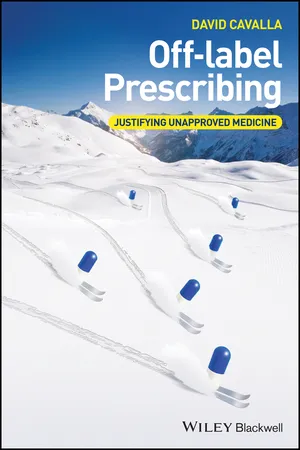
Today's medicines are regulated for their efficacy and safety and, once approved, they can be marketed for certain uses as justified by the data. Regulatory bodies in developed countries are constituted by legal statute and operate as parts of government, ostensibly in the interests of the people as patients.
But once approved, medicines can be used for any purpose the prescriber thinks fit and appropriate for the patient. One in five prescriptions is therefore written outside regulatory purview.
Off-label Prescribing looks into the corners of our medicated lives, where drug regulation runs up against medical practice, and concerns the use of a drug that has been approved for one use (in medical parlance, 'indication') being used for a different indication; alternatively, being used on a different set of patients from the ones it is approved for, or at a different dose. Usually the patient is unaware of what is going on, having not been informed by their doctor of this aspect of his or her prescribing choice.
The book examines how and why this occurs, what the various medical professions have to say about it, and how pharmaceutical companies benefit by moving into this poorly regulated area. Off-label Prescribing pulls these complex issues together in one volume, to highlight current practice, its advantages and weaknesses and how the author suggests practice should evolve in the future. It will therefore be of interest to all those who prescribe (and receive) medicines, combined with a greater objective to provide more transparency and discussion for professionals.
Chapter 1 What is off-label medication, and how prevalent is it?
The practice of medicine has been regulated since Hippocrates, who first told doctors (physicians, clinicians, general practitioners [GPs] and so on) how they should behave with regard to their patients. His Oath, written nearly 2500 years ago, is the most famous text in Western medicine. Though most people do not know exactly what it says, they believe it to say something along the lines of ‘Doctor, do no harm’. That is only partly true, as I shall now explain.
But before I do, there are actually many versions in the public mind of what Hippocrates said, including the view recounted by one UK doctor of an elderly patient who believed the Oath instructed doctors never to tell patients the truth. This book will describe circumstances in which this patient is often correct, namely, that GPs do not tell the truth to their patients, but of course incorrect in that Hippocratic Oath does not say that.
The Oath starts: ‘I swear by Apollo the physician and by Asclepius and Hygieia and Panacea… to bring the following oath to fulfilment’. According to Greek mythology, Apollo is the god of healing, Asclepius is his son and Hygieia and Panacea are his granddaughters. As with Zeus his father, Apollo had many love affairs with goddesses and mortals. One of his amours was Coronis, who was the daughter of the king of the Lapiths. Dwelling on a higher plane, Apollo was not able to be beside Coronis on earth, so he sent a white crow to look after her. Unfortunately, while she was pregnant by Apollo, Coronis fell in love with another man, and the crow informed Apollo of the affair. Appalled at her infidelity, in his anger, Apollo turned the crow black.
Artemis, Apollo’s twin sister, shot an arrow to kill Coronis. While Coronis’ body was burning on the funeral pyre, Apollo removed the unborn child, who was called Asclepius and became the god of medicine. When he grew up, Asclepius had two daughters, Hygieia, the goddess of health, and Panacea, the goddess of cures: medicine ran in the family. The words ‘hygiene’ and ‘panacea’ clearly have their etymological origins in these mythological figures.
According to legend, Hippocrates was a descendant of Asclepius; this gives more weight to Hippocrates’ proclamations, particularly when he pronounces on medical matters. Part of the Oath instructs the doctor to treat his teachers as his parents and to pass on the art of medicine to the next generation of healers. This is clearly relevant to Hippocrates’ ancestry, going all the way back to Apollo. But it is the next part of the Oath that is most relevant to this book and indeed to the practice of medicine.
It continues: ‘And I will use treatments for the benefit of the ill in accordance with my ability and my judgment, but from what is to their harm and injustice I will keep them’.
It is the two words, ‘harm’ and ‘injustice’ which I ask you to bear in mind as we go forwards.
What is ‘off-label’ medicine?
Today, medicines are regulated for their efficacy and safety, and once licensed for sale, they can be marketed for certain uses as justified by the data. Regulatory bodies in developed countries are constituted by legal statute and operate as parts of government, ostensibly in the interests of the people as patients. But once approved, medicines can be used for any purpose the prescriber sees fit and appropriate for the patient. In other words, regulatory authorities are the gatekeepers to prevent the medical use of unapproved products, but then leave the gate entirely wide open regarding unapproved indications or uses of approved products. To be succinct, medicinal products require regulatory approval, but the practice of medicine does not. There remain restrictions on the marketing of these products, but these are considerations for the producer, not the prescriber. Later on, I will explain the nuance that distinguishes between the marketing and the use of medicines and how, in my opinion, pharmaceutical companies game the system.
The ways in which medicines are prescribed, and administered, outside the terms of the marketing authorisation are called ‘off-label’ uses. They have not been justified by the regulatory authorities, which determine the label for the product, hence the title of this book. As was said, a ‘general off-label use of drugs is the death of the idea of regulation’ [3]. The importance of the regulatory justification is not merely because these public authorities spend a lot of time, money and manpower examining the evidence behind the safety and efficacy of the medicines we take: it is because these authorities are put in place to implement certain standards to which the patient expects his or her therapy to accord. The regulatory approval is also the patient’s approval, the basis for their consent to being treated with the prescribed medication. Drug regulation is a complex decision about the balance of safety and efficacy,1 benefit and risk – a world of shades of grey, not black and white. In the real world, the prescribing doctor has a lot of flexibility as to what s/he can prescribe; that flexibility can be put to good use, but patients are rarely aware that their off-label medicine has not been approved for their affliction, with consequences to the quality of their care.
So, off-label prescriptions are not illegal, and from the doctor’s perspective, they may not even be seen as unethical; in fact, according to the Hippocratic Oath, they may fulfil a doctor’s moral imperative, for instance, in situations of rare diseases where there is no approved product. However, the evidence behind off-label medicine rarely fulfils the patient’s expectations that a formal regulatory assessment of safety and efficacy has been performed, and this is the first sense in which I mean off-label medicine seems to be unjustified. Later, in Chapter 6, I shall deal with other consequences, such as who pays for the medicine, and what happens in cases where things go wrong. But before doing so, let us consider the scale of the issue.
There are lots of examples of secondary uses for existing drugs. The story of how a proposed treatment for angina and heart failure ended up as the world’s first treatment for erectile dysfunction is well known. The company behind the drug (Pfizer), now known as Viagra™, recorded that when the product, then known as UK-92480-10, or sildenafil, was first tried on male volunteers in a Welsh clinic, they reported physical excitation on seeing the nurses in the ward, requiring them to roll on their stomachs. In this case, the intended development for cardiovascular diseases was curtailed, and the product entered into medical practice for the treatment of erectile dysfunction instead (and in 2012, generated over $2 billion in revenue for Pfizer). Because the decision to develop for erectile dysfunction occurred before Viagra was approved for any use, this is not an example of off-label medication. However, even though this story is somewhat anecdotal, it does show that drugs often do more than one thing. In fact, there is a sequel to the first approval indication for sildenafil, in which it was subsequently developed for a second indication (or third, depending on how you look at it), as we shall see in Chapter 2.
I have strong interest in this area, having investigated this area of secondary uses for existing drugs, now called drug repurposing, for over 15 years. I have collated over 2300 proposed new uses for existing drugs, either marketed products or investigational compounds. This is freely accessible on the internet at http://www.drugrepur-posing.info. But the level of support for such new uses can vary enormously. In some cases, we have human data, such as clinical trials to support the effect. In many others, there is only information from experiments in vitro (literally ‘in glass’, this refers to test tube experiments) or in vivo (in animals). Some information even derives from a computer assessment of the shape similarity of drugs, but predictions like this based on in silico analysis are merely hypotheses, starting points for research programmes lasting years or even decades to deliver validation in regulatory studies that would be needed for market approval. As we shall discover in Chapter 4, most of the normal scientific hypotheses upon which drug discovery programmes are based turn out to be wrong.
We now realise that there are very few, if any, drugs with only one activity and/or only one conceivable therapeutic use. But even though there is vast promise from making better use of the drugs we currently have on hand, most of the early-stage predictions fail to be realised in practice. Sometimes this is for commercial reasons, but it is also for experimental reasons of safety or efficacy. As this area becomes more widely used as a means to discover new therapeutics, it is all the more likely that the current medicines that we all use will become increasingly investigated for new uses. New discoveries of this kind can be enormously helpful to the armoury of therapeutics available to the patient. However, it is unsafe to suppose that a theory deriving from an animal experiment, or anecdotal case report from one patient, really translates into a safe, efficacious treatment of general merit: it needs to be proven. Prescribers have enormous freedom to uncover whether the early science suggestive of a human benefit really works in a patient. As this book will show, the current legal framework, regulatory controls and ethical norms in medicine do not provide the best environment for delivering such new therapeutics to patients, and the consequences of its misapplication can be gravely injurious.
There are two main types of off-label medicine: use of drugs for unapproved diseases or conditions (which, in the medical profession, are called ‘indications’), and use of drugs for unapproved patient groups. Off-label use can also include prescribing different dosages, lengthening or shortening the interval between treatments or using different routes of administration from those indicated on the drug label.2
There are three main areas of therapy where off-label medicines are most widely used. The first is the use of products licensed for adults, on the basis of clinical trials in adults, for children. The second is of psychiatric medicines, and the third is in oncology treatment. We started with a broad statement that off-label use constitutes ‘20% of all prescriptions’, but the prevalence varies enormously, and among these broad classes lie salient examples where off-label use reaches staggering proportions. Getting consistent statistics can be difficult: a review of international studies in ambulatory care reports rates of 13.2% and 29%, in paediatric wards between 18% and 60% and in neonatal units between 14% and 63% [4]. Another international literature review reports that rates for off-label medicine use vary between 11% and 80% [5]. A study from the Netherlands reports that 44% of all prescriptions in a paediatric ward are off-label [6]. In Germany, around 40% of under 18s were prescribed at least one off-label medicine among a study of 17 000, with no significant differences according to region, urbanity, migrant background and social class [7].
To summarise these figures, one could say that higher rates are seen in younger patients and in hospital settings, and that a figure of 20% lies at the lower end of these reports. However, consistent estimates of the prevalence of off-label use are made more difficult because they are often not recorded in a patient’s notes; this in turn may reflect the fact that they are associated with increased liability for physicians. Thus, it is quite possible for an audit of physician practice to deliver a result indicating a falsely low rate of off-label prescriptions and, where there is a range of figures, to suspect the higher proportion to reflect more accurately the real situation [8].
In fact, in many areas, off-label use is more common than use according to the approved label, bringing to mind the point that in such circumstances the pharmaceutical regulatory system is not fit for purpose. But also, even though this is clearly a very large issue, getting hold of reliable statistics is something of a problem in itself. Off-label medicine is not universally shady, but it does have shady patches, and few practitioners will admit to having participated in the darker regions of the practice any more than they absolutely have to. So there are questions about the statistics, but if they are wrong, one would suspect them to be under- rather than overestimates. Very few doctors would voluntary admit to prescribing off-label when they have not. That also tells you something about the perceived ethics involved. Nevertheless, to avoid criticism, I have erred on the side of caution in my overall statement that it constitutes ‘20% of all prescriptions’. A widely referenced article looked in detail at the issue and came to a similar conclusion; they also assessed the proportion of off-label use by therapeutic class [9] (Figure 1.1).
Figure 1.1 Off-label mentions by therapeutic class. Graph drawn from data in Ref. [9].
To give you some simple examples, the prescription of antibiotics for colds and flu is almost entirely without patient benefit but at significant cost to the NHS in the United Kingdom (and equivalent payers in other countries) and raises concern in an era of increasing bacterial resistance; the prescription of antipsychotics to dementia patients without their consent and at their increased risk is a scandal that led to a recent UK government report and action; and the prescription of antidepressants to children and adolescents when they had only been licensed for adults revealed age-related increases in suicide risk, with increasing risk for young patients but not for old.
Off-label medication is not always a bad thing, and it would be a grave mistake to ban the practice entirely. I certainly would not advocate its prohibition, far from it. In my work on the area of secondary and tertiary uses for existing drugs, I have come to realise the huge potential of this area of study. A main purpose of this book is to ensure that the beneficial discoveries made by doctors in the privacy of their patient consultations are properly validated and widely disseminated. The advantages of this approach are shown clearly by the story that follows, representing one of the strangest examples of a bad drug made good through off-label prescription, coupled with a strong element of serendipity.
The drug is thalidomide, a name which connotes some of the worst aspects of pharmaceutical industry misbehaviour and patient harm. Thalidomide was first introduced in 1957 by the West German company Chemie Grünenthal GmbH with the trade name Contergan, a potent and apparently safe sleeping pill. In laboratory rodents, unlike barbiturates – with which it was compared at the time – thalidomide proved remarkably ‘safe’, insofar as it was almost impossible to administer a single lethal dose. As we know now, these tests were insufficiently broad to cover the full range of toxicological consequences of the drug’s long-term administration. Clinical testing in Germany was unsystematic, with pills distributed to employees and samples given to local doctors. With its apparent safety advantages compared to other sleeping pills like barbiturates, which can be lethal at small multiples of their therapeutic dose, thalidomide gained widespread popularity in Europe and Canada; it could even be purchased without a prescription. This was an era of burgeoning use of pharmaceuticals, and their use in psychiatric conditions, as the Rolling Stones recognised so acutely in ‘Mother's Little Helper’, a song about the widespread use of diazepam (Valium™). It was also an era of minimal regulatory supervision of the pharmaceutical industry. Later on, in addition to its use as a sleeping pill, thalidomide also became popular in the treatmen...
Table of contents
Cover
Title page
Copyright page
Dedication page
Foreword
Acknowledgement
Author’s note on the cover design
Introduction
Chapter 1: What is off-label medication, and how prevalent is it?
Chapter 2: Where it all went right: new uses for existing drugs supported by good evidence
Chapter 3: Shared decision making and consent
Chapter 4: Gaming the system: the role of the pharmaceutical industry
Chapter 5: Do no harm: Safety and efficacy
Chapter 6: Liability, injustice and reimbursement: who should pay?
Chapter 7: The role of regulation in off-label medicine
Chapter 8: Justifying unapproved medicine
References
Index
End User License Agreement
Trusted by 375,005 students
Access to over 1.5 million titles for a fair monthly price.
Study more efficiently using our study tools.
Frequently asked questions
Yes, you can cancel anytime from the Subscription tab in your account settings on the Perlego website. Your subscription will stay active until the end of your current billing period. Learn how to cancel your subscription
No, books cannot be downloaded as external files, such as PDFs, for use outside of Perlego. However, you can download books within the Perlego app for offline reading on mobile or tablet. Learn how to download books offline
Perlego offers two plans: Essential and Complete
Essential is ideal for learners and professionals who enjoy exploring a wide range of subjects. Access the Essential Library with 800,000+ trusted titles and best-sellers across business, personal growth, and the humanities. Includes unlimited reading time and Standard Read Aloud voice.
Complete: Perfect for advanced learners and researchers needing full, unrestricted access. Unlock 1.5M+ books across hundreds of subjects, including academic and specialized titles. The Complete Plan also includes advanced features like Premium Read Aloud and Research Assistant.
Both plans are available with monthly, semester, or annual billing cycles.
We are an online textbook subscription service, where you can get access to an entire online library for less than the price of a single book per month. With over 1.5 million books across 990+ topics, we’ve got you covered! Learn about our mission
Look out for the read-aloud symbol on your next book to see if you can listen to it. The read-aloud tool reads text aloud for you, highlighting the text as it is being read. You can pause it, speed it up and slow it down. Learn more about Read Aloud
Yes! You can use the Perlego app on both iOS and Android devices to read anytime, anywhere — even offline. Perfect for commutes or when you’re on the go. Please note we cannot support devices running on iOS 13 and Android 7 or earlier. Learn more about using the app
Yes, you can access Off-label Prescribing by David Cavalla in PDF and/or ePUB format, as well as other popular books in Sciences biologiques & Biologie moléculaire. We have over 1.5 million books available in our catalogue for you to explore.