Introduction to Pharmaceutical Analytical Chemistry
eBook - ePub

Introduction to Pharmaceutical Analytical Chemistry

  1. English
  2. ePUB (mobile friendly)
  3. Available on iOS & Android
eBook - ePub

Introduction to Pharmaceutical Analytical Chemistry

About this book

The definitive textbook on the chemical analysis of pharmaceutical drugs ­– fully revised and updated 

Introduction to Pharmaceutical Analytical Chemistry enables students to gain fundamental knowledge of the vital concepts, techniques and applications of the chemical analysis of pharmaceutical ingredients, final pharmaceutical products and drug substances in biological fluids. A unique emphasis on pharmaceutical laboratory practices, such as sample preparation and separation techniques, provides an efficient and practical educational framework for undergraduate studies in areas such as pharmaceutical sciences, analytical chemistry and forensic analysis. Suitable for foundational courses, this essential undergraduate text introduces the common analytical methods used in quantitative and qualitative chemical analysis of pharmaceuticals.

This extensively revised second edition includes a new chapter on chemical analysis of biopharmaceuticals, which includes discussions on identification, purity testing and assay of peptide and protein-based formulations. Also new to this edition are improved colour illustrations and tables, a streamlined chapter structure and text revised for increased clarity and comprehension.

  • Introduces the fundamental concepts of pharmaceutical analytical chemistry and statistics
  • Presents a systematic investigation of pharmaceutical applications absent from other textbooks on the subject
  • Examines various analytical techniques commonly used in pharmaceutical laboratories
  • Provides practice problems, up-to-date practical examples and detailed illustrations
  • Includes updated content aligned with the current European and United States Pharmacopeia regulations and guidelines 

Covering the analytical techniques and concepts necessary for pharmaceutical analytical chemistry, Introduction to Pharmaceutical Analytical Chemistry is ideally suited for students of chemical and pharmaceutical sciences as well as analytical chemists transitioning into the field of pharmaceutical analytical chemistry.
Frequently asked questions

Yes, you can cancel anytime from the Subscription tab in your account settings on the Perlego website. Your subscription will stay active until the end of your current billing period. Learn how to cancel your subscription.
No, books cannot be downloaded as external files, such as PDFs, for use outside of Perlego. However, you can download books within the Perlego app for offline reading on mobile or tablet. Learn more here.
Perlego offers two plans: Essential and Complete
  • Essential is ideal for learners and professionals who enjoy exploring a wide range of subjects. Access the Essential Library with 800,000+ trusted titles and best-sellers across business, personal growth, and the humanities. Includes unlimited reading time and Standard Read Aloud voice.
  • Complete: Perfect for advanced learners and researchers needing full, unrestricted access. Unlock 1.4M+ books across hundreds of subjects, including academic and specialized titles. The Complete Plan also includes advanced features like Premium Read Aloud and Research Assistant.
Both plans are available with monthly, semester, or annual billing cycles.
We are an online textbook subscription service, where you can get access to an entire online library for less than the price of a single book per month. With over 1 million books across 1000+ topics, we’ve got you covered! Learn more here.
Look out for the read-aloud symbol on your next book to see if you can listen to it. The read-aloud tool reads text aloud for you, highlighting the text as it is being read. You can pause it, speed it up and slow it down. Learn more here.
Yes! You can use the Perlego app on both iOS or Android devices to read anytime, anywhere — even offline. Perfect for commutes or when you’re on the go.
Please note we cannot support devices running on iOS 13 and Android 7 or earlier. Learn more about using the app.
Yes, you can access Introduction to Pharmaceutical Analytical Chemistry by Stig Pedersen-Bjergaard,Bente Gammelgaard,Trine G. Halvorsen in PDF and/or ePUB format, as well as other popular books in Physical Sciences & Analytic Chemistry. We have over one million books available in our catalogue for you to explore.

Information

Publisher
Wiley
Year
2019
Print ISBN
9781119362722
eBook ISBN
9781119362753

1
Introduction to Pharmaceutical Analytical Chemistry

  1. 1.1 Introduction
  2. 1.2 Pharmaceutical Analytical Chemistry
    1. 1.2.1 A Brief Definition
    2. 1.2.2 Manufacture of Pharmaceuticals
    3. 1.2.3 Development of New Drugs
    4. 1.2.4 Use of Pharmaceuticals
  3. 1.3 This Textbook

1.1 Introduction

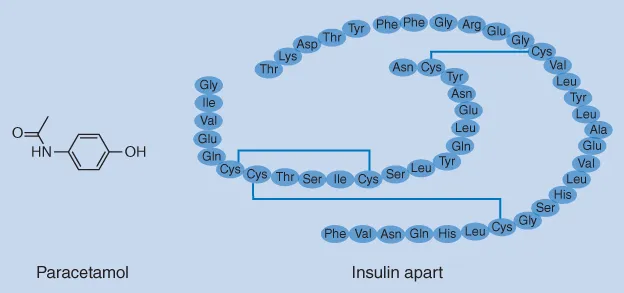
In daily conversation, words like pills and drugs are typically in use. However, when entering the pharmaceutical world, wording becomes very important and correct terms should be used. A pharmaceutical preparation contains a substance that is pharmacologically active, which is called the active pharmaceutical ingredient (or active ingredient). The active pharmaceutical ingredient is often abbreviated to API. A large number of APIs exists and two examples are shown in Figure 1.1, namely paracetamol (acetaminophen), which is used against pain, and insulin aspart, which is used in the treatment of diabetes. Paracetamol is a small molecule API (or small molecule drug) produced by organic synthesis and with a molecular mass of 151 Da. Insulin aspart, on the other hand, is a two‐chain peptide produced by recombinant DNA technology. It is a large molecule drug with a molecular mass of 5826 Da and is termed a biopharmaceutical due to its biological origin.
Skeletal formula of paracetamol (small molecule drug; left) and structure of insulin aspart (biopharmaceutical; right).
Figure 1.1 Paracetamol (small molecule drug) and insulin aspart (biopharmaceutical)
An active ingredient is not given (administered) to the patient as a pure substance, but is combined with excipients (synonymous with inactive ingredients) into a dosage form in order to be able to give an exact dose to the patient. The excipients are not pharmacologically active. The dosage form can be a tablet, a capsule, or a syrup for oral administration, an injection for parenteral administration, or an ointment for topical administration. The excipients used in pharmaceutical preparations serve several functions, and these can be summarized as follows:
  • Ensure that the dosage form has a shape and size that is easy to use for the patient.
  • Ensure that the API is released and delivered to the patient in the correct amount.
  • Ensure that the pharmaceutical preparation has an acceptable stability.
  • Ensure that the pharmaceutical preparation does not have an unpleasant taste or odour.
  • Facilitate production of the pharmaceutical preparation.
The excipients vary widely for different preparations. To exemplify this, Table 1.1 shows the excipients of tablets and syrup containing paracetamol as the active ingredient. Paracetamol has both an analgesic and an antipyretic effect, which means that it is used against pain and fever. Each paracetamol tablet has a total mass of 285 mg. Paracetamol constitutes 250 mg, while the remaining 35 mg is made up of excipients. The excipients include a disintegrating agent, a lubricant, a glidant, and a binder. Binders, lubricating agents, and gliding agents are added to facilitate manufacture. The disintegrating agent ensures rapid disintegration of the tablet in the stomach of the patient and rapid release of paracetamol.
Table 1.1 Excipients in paracetamol tablets and paracetamol syrup (example)
Content Amount (mg) Function
Tablet (mass 285 mg)
Paracetamol 250 Active ingredient
Hydroxypropyl cellulose Binder
Maize starch Disintegrant
Talcum Glidant
Magnesium stearate Lubricant
Syrup (volume 1 mL)
Paracetamol 24 Active ingredient
Sorbitol Sweetener
Glycerol Sweetener
Polyvinylpyrrolidone Thickening agent
Saccharine sodium salt Sweetener
Methylparaben Preservative
Ethylparaben Preservative
Propylparaben Preservative
Sodium metabisulfite Antioxidant
Citric acid pH regulator
Sodium citrate pH regulator
Strawberry aroma Flavouring agent
Water Solvent
Paracetamol syrup (liquid preparation) is a 24 mg/ mL solution of paracetamol in water. In addition, several excipients are added. Sweetening and fl...

Table of contents

  1. Table of Contents
  2. Preface to the Second Edition
  3. Abbreviations
  4. Symbols and Units
  5. 1 Introduction to Pharmaceutical Analytical Chemistry
  6. 2 Marketing Authorizations, Pharmaceutical Manufacturing, and International Pharmacopoeias
  7. 3 Fundamentals of Bases, Acids, Solubility, Polarity, Partition, and Stereochemistry
  8. 4 Fundamentals of Pharmaceutical Analytical Chemistry
  9. 5 Titration
  10. 6 Introduction to Spectroscopic Methods
  11. 7 UV‐Vis Spectrophotometry
  12. 8 IR Spectrophotometry
  13. 9 Atomic Spectrometry
  14. 10 Introduction to Chromatography
  15. 11 Separation Principles in Liquid Chromatography
  16. 12 High Performance Liquid Chromatography
  17. 13 Gas Chromatography
  18. 14 Electrophoretic Methods
  19. 15 Mass Spectrometry
  20. 16 Sample Preparation
  21. 17 Quality of Analytical Data and Validation
  22. 18 Chemical Analysis of Pharmaceutical Ingredients
  23. 19 Chemical Analysis of Pharmaceutical Preparations
  24. 20 Bioanalysis Chemical Analysis of Pharmaceuticals in Biological Fluids
  25. 21 Chemical Analysis of Biopharmaceuticals
  26. Index
  27. End User License Agreement