Designing Embedded Systems and the Internet of Things (IoT) with the ARM mbed
eBook - ePub

Designing Embedded Systems and the Internet of Things (IoT) with the ARM mbed

  1. English
  2. ePUB (mobile friendly)
  3. Available on iOS & Android
eBook - ePub

Designing Embedded Systems and the Internet of Things (IoT) with the ARM mbed

About this book

A comprehensive and accessible introduction to the development of embedded systems and Internet of Things devices using ARM mbed

Designing Embedded Systems and the Internet of Things (IoT) with the ARM mbed offers an accessible guide to the development of ARM mbed and includes a range of topics on the subject from the basic to the advanced. ARM mbed is a platform and operating system based on 32-bit ARM Cortex-M microcontrollers. This important resource puts the focus on ARM mbed NXP LPC1768 and FRDM-K64F evaluation boards. NXP LPC1768 has powerful features such as a fast microcontroller, various digital and analog I/Os, various serial communication interfaces and a very easy to use Web based compiler. It is one of the most popular kits that are used to study and create projects. FRDM-K64F is relatively new and largely compatible with NXP LPC1768 but with even more powerful features.

This approachable text is an ideal guide that is divided into four sections; Getting Started with the ARM mbed, Covering the Basics, Advanced Topics and Case Studies. This getting started guide:

  • Offers a clear introduction to the topic
  • Contains a wealth of original and illustrative case studies
  • Includes a practical guide to the development of projects with the ARM mbed platform
  • Presents timely coverage of how to develop IoT applications

Designing Embedded Systems and the Internet of Things (IoT) with the ARM mbed offers students and R&D engineers a resource for understanding the ARM mbed NXP LPC1768 evaluation board.Ā 

Frequently asked questions

Yes, you can cancel anytime from the Subscription tab in your account settings on the Perlego website. Your subscription will stay active until the end of your current billing period. Learn how to cancel your subscription.
No, books cannot be downloaded as external files, such as PDFs, for use outside of Perlego. However, you can download books within the Perlego app for offline reading on mobile or tablet. Learn more here.
Perlego offers two plans: Essential and Complete
  • Essential is ideal for learners and professionals who enjoy exploring a wide range of subjects. Access the Essential Library with 800,000+ trusted titles and best-sellers across business, personal growth, and the humanities. Includes unlimited reading time and Standard Read Aloud voice.
  • Complete: Perfect for advanced learners and researchers needing full, unrestricted access. Unlock 1.4M+ books across hundreds of subjects, including academic and specialized titles. The Complete Plan also includes advanced features like Premium Read Aloud and Research Assistant.
Both plans are available with monthly, semester, or annual billing cycles.
We are an online textbook subscription service, where you can get access to an entire online library for less than the price of a single book per month. With over 1 million books across 1000+ topics, we’ve got you covered! Learn more here.
Look out for the read-aloud symbol on your next book to see if you can listen to it. The read-aloud tool reads text aloud for you, highlighting the text as it is being read. You can pause it, speed it up and slow it down. Learn more here.
Yes! You can use the Perlego app on both iOS or Android devices to read anytime, anywhere — even offline. Perfect for commutes or when you’re on the go.
Please note we cannot support devices running on iOS 13 and Android 7 or earlier. Learn more about using the app.
Yes, you can access Designing Embedded Systems and the Internet of Things (IoT) with the ARM mbed by Perry Xiao in PDF and/or ePUB format, as well as other popular books in Technology & Engineering & Microelectronics. We have over one million books available in our catalogue for you to explore.

Information

Part I
Introduction to ArmĀ® Mbedā„¢ and IoT

In this part:

  • Chapter 1: Introduction to ArmĀ® Mbedā„¢
  • Chapter 2: Introduction to the Internet of Things (IoT)
  • Chapter 3: IoT Enabling Technologies

1
Introduction to ArmĀ® Mbedā„¢

Isn't it a pleasure to study and practice what you have learned?
‐ Confucius

1.1 What is an Embedded System?

An embedded system is a small‐scale computer system that is part of a machine or a larger electrical/mechanical system. It is often designed to perform certain dedicated tasks and often a real‐time system. It is called embedded because the computer system is embedded within a hardware device. Embedded systems are important, as they are getting increasingly used in many daily appliances, such as digital watches, cameras, microwave ovens, washing machines, boilers, fridges, smart TVs, and cars. Embedded systems also often need to be small in size, low in cost, and have low power consumption.
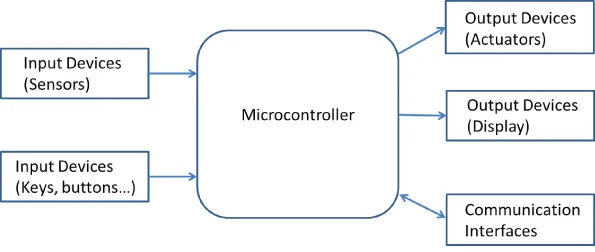
Schematic diagram of a typical embedded system.
Figure 1.1 Schematic diagram of a typical embedded system.
Figure 1.1 shows the schematic diagram of a typical embedded system that includes a microcontroller, inputs/outputs, and communication interfaces.

Microcontroller

Microcontroller is the brain of an embedded system, which orchestrates all the operations. A microcontroller is a computer processor with memory and all input/output peripherals on it. More details about microcontrollers will be illustrated in the next section.

Inputs

An embedded system interacts with the outside world through its inputs and outputs. Inputs can be digital inputs or analog inputs. Inputs are typically used for reading data from sensors (temperature sensor, light sensor, ultrasound sensor, etc.) or other types of input devices (keys, buttons, etc.).

Outputs

Outputs can also be digital outputs or analog outputs. Outputs are typically used for display, driving motors, or other devices (actuators).

Communication Interfaces

An embedded system communicates with other devices using communication interfaces, which includes Ethernet, USB (Universal Serial Bus), CAN (Controller Area Network), Infrared, ZigBee, WiFi and Bluetooth, for example.

1.2 Microcontrollers and Microprocessors

At the heart of embedded systems are microcontrollers. Although there are embedded systems built on microprocessors, modern embedded systems are largely based on microcontrollers. A typical microcontroller contains a central processing unit (CPU), interrupts, timer/counter, memory, and other peripherals, all in a single integrated circuit (IC). A microcontroller is a true computer on a chip or system‐on‐a‐chip (SoC). Microcontrollers are ideal for control applications because you can use them to build an embedded system with little additional circuitry.
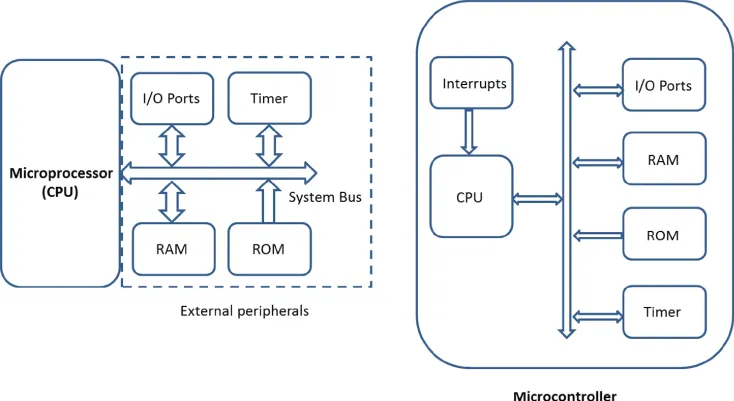
Microcontrollers (MCU or μC) are different from microprocessors (MPU). A microprocessor is a single IC with only a central processing unit (CPU) on it. In order to make it functional, you will need to add external memory and other peripheral devices. Figure 1.2 shows the main differences between a microprocessor and a microcontroller. To put it simply, you can imagine that a microprocessor is just a CPU on a single IC, while a microcontroller is a small computer with CPU, memory, and other peripherals.
Schematic diagram presenting the comparison between a microprocessor and a microcontroller.
Figure 1.2 Comparison between a microprocessor and a microcontroller.
Microprocessors are mainly used in general‐purpose systems like personal computers. They have relatively high computational capacity and can perform numerous tasks. Microprocessors have relatively high clock frequency, usually in the order of gigahertz. Microprocessors generally consume more power and often require external cooling system.
Microcontrollers are designed for control applications and are generally used in embedded systems. They have relatively low computational capacity and can perform single or very few tasks. Microcontrollers have relatively low clock frequency, usually in the order of megahertz. Microcontrollers consume less power and have no need for a cooling system.
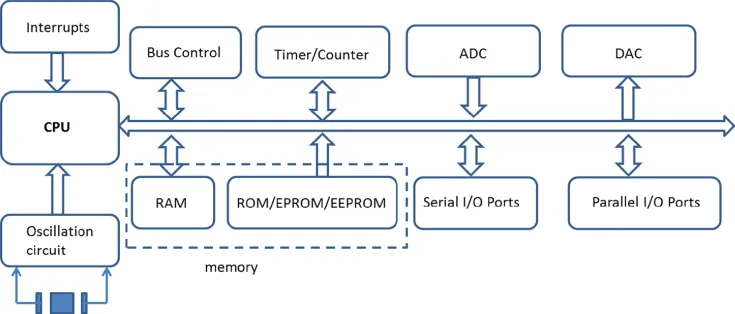
Detailed schematic diagram of a microcontroller.
Figure 1.3 Detailed schematic diagram of a microcontroller.
Figure 1.3 shows a more detailed schematic...

Table of contents

  1. Cover
  2. Table of Contents
  3. Dedication
  4. About the Author
  5. Preface
  6. Author’s Acknowledgments
  7. About the companion website
  8. Part I: Introduction to ArmĀ® Mbedā„¢ and IoT
  9. Part II: ArmĀ® Mbedā„¢ Development
  10. Part III: The IoT Starter Kit and IoT Projects
  11. Part IV: Appendices
  12. Index
  13. End User License Agreement