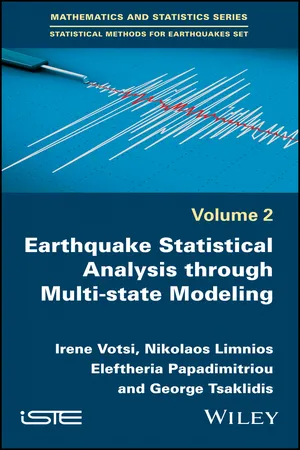
Earthquake occurrence modeling is a rapidly developing research area. This book deals with its critical issues, ranging from theoretical advances to practical applications.
The introductory chapter outlines state-of-the-art earthquake modeling approaches based on stochastic models. Chapter 2 presents seismogenesis in association with the evolving stress field. Chapters 3 to 5 present earthquake occurrence modeling by means of hidden (semi-)Markov models and discuss associated characteristic measures and relative estimation aspects. Further comparisons, the most important results and our concluding remarks are provided in Chapters 6 and 7.
eBook - ePub
Earthquake Statistical Analysis through Multi-state Modeling
- English
- ePUB (mobile friendly)
- Available on iOS & Android
eBook - ePub
Earthquake Statistical Analysis through Multi-state Modeling
About this book
Information
1
Fundamentals on Stress Changes
“We still do not know one thousandth of one percent of what nature has revealed to us”— A. Einstein
1.1. Introduction
Earthquake generation is the result of the accumulation and release of strain on a given fault or fault segment. External stress produces deformation (strain), which under elastic conditions leads eventually to failure. The elastic deformation is instantaneous and is completely recoverable when the applied stress is removed. When a linear relation exists between the applied stress and the resultant strain, the material is characterized as purely elastic. This assumption is a good approximation for small deformations. In the case where the material continues to deform beyond the elastic limit, it undergoes permanent deformation and failure occurs due to the breakdown of interatomic bonds.
Earthquakes are generated by displacement on discontinuities in the elastic part of the lithosphere, with the seismogenic faults assumed to maintain the elastic properties. The continuous plate motion loads the faults and fault segments that are located along the plate boundaries, for example, and the resulting accumulated strain will culminate in a slip onto the fault surfaces. Given that the plate motion is considered stable, the strain loading and release is expected to be regular in time, unless these fault segments are not expected to follow the stick and slip stages completely independently. Successive earthquake occurrences are usually interdependent [SCH 90]. This implies that a slip on one segment seems to “load” or “unload” adjacent segments, and thus their earthquake recurrence cannot be independent. This suits the observation that their reoccurrence does not take place in regular interseismic periods. Accumulation of strain, which governs the earthquake recurrence times, differs among different areas since the strain rate depends on the tectonic activity as the relative plate motion. At the interface between adjacent plates, for example, the strain rate acquires its maximum values, which resulted in the most frequent and largest earthquakes. In continental regions where the rates of strain accumulation are lower, whereas the seismicity is more diffused, appropriate approximations are required to achieve estimates of the anticipated earthquake hazard.
Despite substantial advances in our understanding in the last decades since the associated faults are interacting through their stress field, we still have a long way to go to achieve reliable estimates of the recurrence times of stronger earthquakes associated with the major faults in a given area. This highlights the requisiteness for intensifying our efforts towards identification of the location and occurrence time of the anticipated strong earthquakes. Substantial progress has been made in identifying the source regions of future earthquakes by stress interaction modeling, which led to the assessment that the slip during the occurrence of a strong earthquake changes the stress field and increases the likelihood for the occurrence of nearby earthquakes. Outstanding examples are the stress calculation after the preferential occurrence of the aftershocks of the 1992 Landers main shock (Mw = 7.3) [KIN 94] and the along-strike sequential occurrence of large earthquakes in the North Anatolian Fault [STE 97], which will be presented in more detail in the following sections. Although these cases, along with a considerable number of earthquake occurrences, were consistent with these forecasts, other earthquake forecasts based on the relevant approach were not verified. The recognition that stress changes considerably influence the time and place of the next earthquake has been reviewed in [HAI 10].
The earthquake-prone areas encompass fault zones containing a large number of faults, with the location of some of them being unknown, and for this reason, several recent devastating earthquakes are associated with faults whose hazard was inadequately assessed. The Coulomb stress changes caused by the displacement in the occurrence of strong earthquakes associated with specific faults and fault segments in a fault population were confirmed to be ample to explain many seismic observations, including aftershock locations, spatial evolution of earthquake series and absence of expected shocks in active regions after the occurrence of strong earthquakes. This is due to the fact that the failure of one fault segment transfers stresses to the nearby segments, which encourages or discourages more earthquakes associated with these faults. Therefore, fault interaction is an indispensable component for any seismic hazard assessment. The effect of the Coulomb stress changes has a remarkable impact on the distances of two or three fault lengths. Remote triggering at distances equal to several fault lengths, which can reach thousands of kilometers, depending on the magnitude of the causative earthquake, has been observed; however, after a strong earthquake, it is perfectly determined by the propagation of transient (dynamic) seismic waves because they are capable of inducing failure either immediately or by delayed triggering. The triggering role of the passage of seismic waves is mainly important in the near field.
The assessment of the earthquake forecasts based on the calculation of stress changes is mainly performed with the available earthquake catalogs that span a duration (100–150 years) much shorter than the recurrence intervals of the strong earthquakes in a given study area, which may take values of hundreds to thousands of years. This is the main reason why many strong earthquakes cannot be forecasted, thereby making a deterministic seismic hazard assessment more uncertain. Stress modeling has proved to be effective in most of the places where it is applied; nevertheless, it is not adequate for an integrated seismic hazard assessment because it has been accomplished in mapped (already-known) active faults. For this purpose, we need to use techniques that can reveal the anticipated hazard by modeling complex interactions using mathematical analysis together with stress changes calculations, based on and interpreted with realistic physical models.
1.2. Stress interaction
The occurrence of an earthquake is influenced by the slow continuous tectonic loading along with the stress changes due to the coseismic slip of the previous earthquakes; in particular, the stronger and the closer ones that occur close together both in time and space (otherwise a time “delay” is observed in the occurrence of an anticipated earthquake) manifest these stress interactions, meaning that during an earthquake occurrence, the stress transferred to the neighboring faults may increase or decrease the stress onto them, and in this way, it may enhance or inhibit earthquake occurrence there. Earthquake interaction is of particular interest to understand whether strong earthquakes cluster both spatially and temporally, occurring in time intervals of some months or years, or even in shorter time frames, instead of hundreds of years, which is the typical recurrence time of such earthquakes when the associated faults are considered individually.
The state of stress is examined soon after an earthquake occurs, considering that the stress is released from the activated fault. The causative fault remains inactive during the interevent time, which represents the time for this certain fault reactivation, i.e. the time that the stress needs to be rebuilt and released again in the second earthquake, typically hundreds to thousands of years. When an earthquake occurs, the stress is not dissipated, with its changes exhibiting a certain spatial pattern around the fault that failed, and particularly at the fault tips. These stress changes were found to be related to changes in seismicity behavior and triggering at distances much longer than the fault length and for stress changes as small as 0.1 bar [REA 92, KIN 94]. In any case, an earthquake occurs by stress which triggers only when the fault is in the late phase of its seismic cycle, meaning that it is already mature and close to failure. The stress state of the particular fault or fault segment might be evaluated on the basis of its known stressing rate and recurrence history.
Therefore, the recurrence time of strong earthquakes depends on the long-term tectonic loading, which is assumed constant with time, the stress drop during the earthquake occurrence and the stress at which the fault failed (failure stress). Stress changes may modify the mean return period and cause either advancement or retardation of the next e...
Table of contents
- Cover
- Table of Contents
- List of Abbreviations
- List of Symbols
- Preface
- Introduction
- 1 Fundamentals on Stress Changes
- 2 Hidden Markov Models
- 3 Hidden Markov Renewal Models
- 4 Hitting Time Intensity
- 5 Models Comparison
- Discussion & Concluding Remarks
- Appendices
- References
- Index
- End User License Agreement
Trusted by 375,005 students
Access to over 1.5 million titles for a fair monthly price.
Study more efficiently using our study tools.
Frequently asked questions
Yes, you can cancel anytime from the Subscription tab in your account settings on the Perlego website. Your subscription will stay active until the end of your current billing period. Learn how to cancel your subscription
No, books cannot be downloaded as external files, such as PDFs, for use outside of Perlego. However, you can download books within the Perlego app for offline reading on mobile or tablet. Learn how to download books offline
Perlego offers two plans: Essential and Complete
- Essential is ideal for learners and professionals who enjoy exploring a wide range of subjects. Access the Essential Library with 800,000+ trusted titles and best-sellers across business, personal growth, and the humanities. Includes unlimited reading time and Standard Read Aloud voice.
- Complete: Perfect for advanced learners and researchers needing full, unrestricted access. Unlock 1.5M+ books across hundreds of subjects, including academic and specialized titles. The Complete Plan also includes advanced features like Premium Read Aloud and Research Assistant.
We are an online textbook subscription service, where you can get access to an entire online library for less than the price of a single book per month. With over 1.5 million books across 990+ topics, we’ve got you covered! Learn about our mission
Look out for the read-aloud symbol on your next book to see if you can listen to it. The read-aloud tool reads text aloud for you, highlighting the text as it is being read. You can pause it, speed it up and slow it down. Learn more about Read Aloud
Yes! You can use the Perlego app on both iOS and Android devices to read anytime, anywhere — even offline. Perfect for commutes or when you’re on the go.
Please note we cannot support devices running on iOS 13 and Android 7 or earlier. Learn more about using the app
Please note we cannot support devices running on iOS 13 and Android 7 or earlier. Learn more about using the app
Yes, you can access Earthquake Statistical Analysis through Multi-state Modeling by Irene Votsi,Nikolaos Limnios,Eleftheria Papadimitriou,Georgios Tsaklidis,George Tsaklidis in PDF and/or ePUB format, as well as other popular books in Mathematics & Mathematical Analysis. We have over 1.5 million books available in our catalogue for you to explore.