Provides a comprehensive description of mass spectrometry basics, applications, and perspectives
Mass spectrometry is a modern analytical technique, allowing for fast and ultrasensitive detection and identification of chemical species. It can serve for analysis of narcotics, counterfeit medicines, components of explosives, but also in clinical chemistry, forensic research and anti-doping analysis, for identification of clinically relevant molecules as biomarkers of various diseases. This book describes everything readers need to know about mass spectrometry—from the instrumentation to the theory and applications. It looks at all aspects of mass spectrometry, including inorganic, organic, forensic, and biological MS (paying special attention to various methodologies and data interpretation). It also contains a list of key terms for easier and faster understanding of the material by newcomers to the subject and test questions to assist lecturers.
Knowing how crucial it is for young researchers to fully understand both the power of mass spectrometry and the importance of other complementary methodologies, Mass Spectrometry: An Applied Approach teaches that it should be used in conjunction with other techniques such as NMR, pharmacological tests, structural identification, molecular biology, in order to reveal the true function(s) of the identified molecule.
Provides a description of mass spectrometry basics, applications and perspectives of the technique
Oriented to a broad audience with limited or basic knowledge in mass spectrometry instrumentation, theory, and its applications in order to enhance their competence in this field
Covers all aspects of mass spectrometry, including inorganic, organic, forensic, and biological MS with special attention to application of various methodologies and data interpretation
Includes a list of key terms, and test questions, for easier and faster understanding of the material
Mass Spectrometry: An Applied Approach is highly recommended for advanced students, young scientists, and anyone involved in a field that utilizes the technique.
1Department of Biochemistry and Neurobiology, Faculty of Materials Science and Ceramics, AGH University of Science and Technology, Kraków, Poland
2Centre of Polymer and Carbon Materials, Polish Academy of Sciences, Zabrze, Poland
Mass spectrometry underwent a rapid and dynamic development during recent years. Innovative solutions brought highly advanced instruments that fulfill user demands with respect to sensitivity, speed, and simplicity of operation.
Mass spectrometer, independently on its construction, measures the ratio of mass of a molecule to its charge, m/z. While interpreting data obtained during analysis, it should be carefully noted that not always the m/z value can be directly related to the molecular mass of the analyzed compound. This happens when multiple charges are being attached to the molecule (multiple ionization), which results from the attachment or depletion of a proton or several protons. Even a popular electron impact ionization generates radicals, depleted of one electron. Typically, we tend to neglect this electron while analyzing spectra at low resolution. However, this lack of one electron will be clearly seen during high‐resolution analysis using Fourier transform ion cyclotron resonance (FT‐ICR) instrument. The multiplicity of ionization depends on the ion source used and their different types. These are described in the following chapters of this book.
The principle of operation of the apparatus can be compared to the sensitive balance, by which we weigh mass of molecules. Another association implies a comparison of a mass spectrometer with electrophoresis in a vacuum because the analyzed molecules, in the form of ions, are accelerated in the device under the influence of applied potential.
Until recently, the mass spectrometer consisted of elements traditionally associated with various ionization methods. For example, matrix‐assisted laser desorption/ionization (MALDI) was combined with the time‐of‐flight (TOF) analyzer, and electron impact/chemical ionization (EI/CI) was typically used with quadrupole or magnetic and electrostatic analyzers. Today's constructions are built of “blocks” that can create combinations not yet very common, such as MALDI with ion trap, electron ionization with TOF, inductively coupled plasma (ICP) with TOF, and electrospray with TOF (qTOF). New constructions like Orbitrap are relatively cheap and affordable by many laboratories.
The mass spectrometer consists of several basic elements, presented schematically in Figure 1.1.
Figure 1.1 Components of the mass spectrometer.
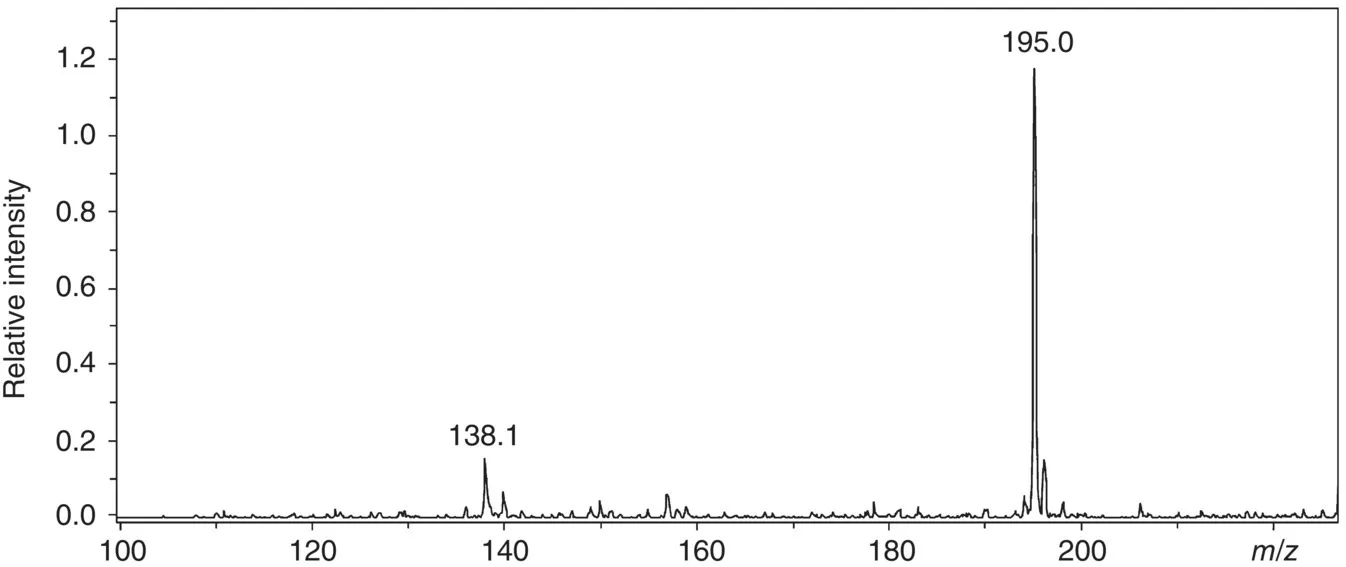
The basic requirement for a substance to be analyzed in a mass spectrometer is its ability to ionize. Ions can move in a vacuum under the influence of an applied electric field. It is important to note that vacuum is necessary inside mass spectrometer, where ions are analyzed. Ion sources, in many cases, do not require vacuum at all. The heterogeneous ion beam is separated in the analyzer depending on the m/z values for the individual ions. Separated ions are then introduced into a detector that converts quantum ion current into electrical current. The system control software transcribes the intensity of these signals as a function of the m/z value and presents these data as a mass spectrum, as shown in Figure 1.2.
Figure 1.2 Exemplary mass spectrum of caffeine obtained by electrospray ionization mass spectrometry (ESI‐MS) technique. Signal at m/z 195.0 corresponds to the protonated molecule of caffeine.
Spectra are derived from the substances that are present in the sample. The mass spectrometer can simultaneously analyze the mixture (to some extent), which is extremely important in the study of complex biological material or other unknown samples. It is also possible to analyze selected substances only in the mixture. This saves analysis time, reduces the amount of data on the hard drive, and improves the signal‐to‐noise ratio. This method is referred to as the single ion monitoring (SIM) or multiple ion monitoring (MIM) and is mainly used for quantitative analysis of compounds and their fragment ions.
The main advantages of a mass spectrometer, compared with other techniques, are as follows:
Speed of analysis.
High sensitivity, reaching femto‐/attomolar level.
Simultaneous analysis of many components of mixtures.
Ability to obtain information on the structure of the compounds (including amino acid sequence) and posttranslational modifications.
Possibility of combining with separation techniques (e.g. gas and liquid chromatography, capillary electrophoresis, isotachophoresis).
Quantitative analysis.
Analysis of the elemental composition.
Analysis of isotopic composition.
Unambiguous identification of the substance.
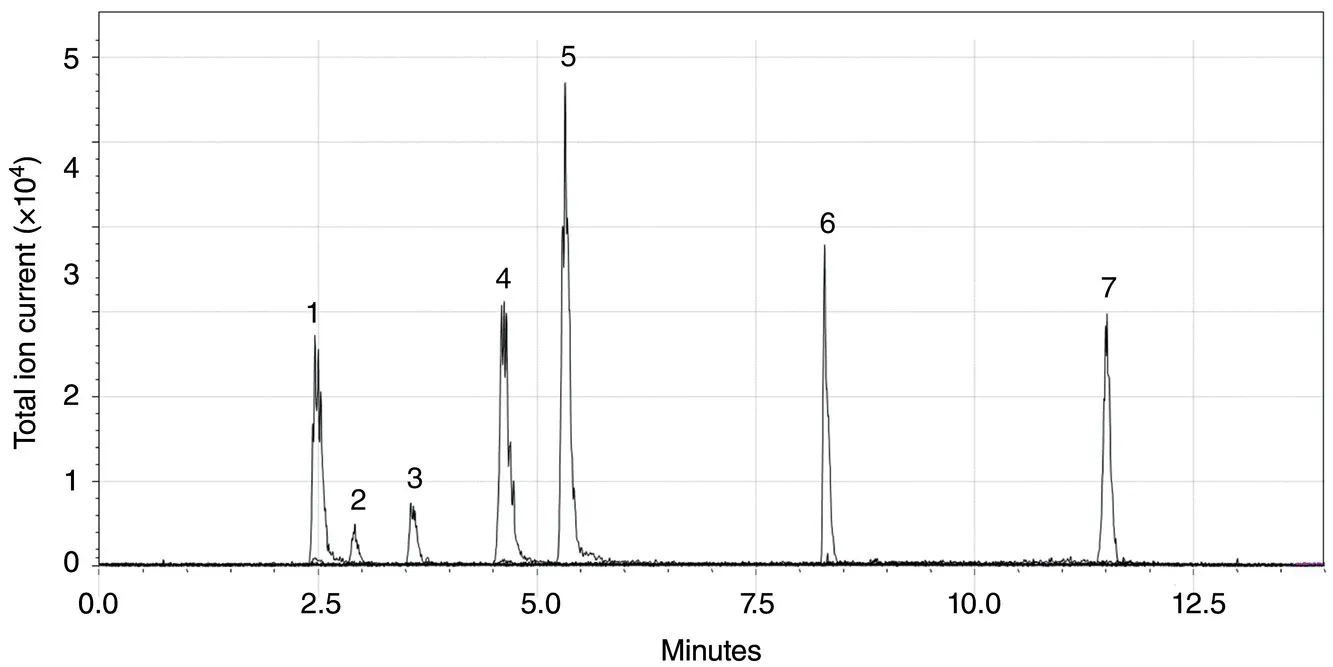
This latter feature distinguishes mass spectrometry from other detection techniques encountered in chromatographic or electrophoretic methods. It is worth emphasizing here that the chromatogram obtained by ultraviolet–visible (UV/Vis) detection, electrochemical or other, generates only the signal intensity for the eluted fraction and the retention time. However, this is insufficient to obtain detailed information about the nature of the substance eluted from the column. The overlap of several components additionally complicates such analysis. Simply put, retention time is not a sufficient method of identification even if standards are provided. We cannot assume in such case that there is no other component in the mixture having the same retention time. The mass spectrometer, used as a detector, gives the exact mass of the substance, together with the information on its structure, hence eliminating the above problems. By analogy to the UV/Vis chromatogram, the mass spectrometer generates a mass chromatogram (Figure 1.3) having several features:
It provides the relationship between the retention time of the substance and the intensity of the peaks on the spectrum (quantitative analysis).
It also provides information on substances eluted from the column at the same time.
It moreover provides detailed information about the structure of the compounds (identification of unknown components).
Figure 1.3 Mass chromatogram of several designer drugs separated by the reversed‐phase liquid chromatography (LC)‐ESI‐MS.
Figure 1.3 shows the retention time on the horizontal axis and the absolute intensity of the signals (a.i.) on the vertical axis....
Table of contents
Cover
Table of Contents
List of Contributors
Preface
1 Introduction
2 A Brief History of Mass Spectrometry
3 Basic Definitions
4 Instrumentation
5 Hyphenated Techniques
6 Mass Spectrometry Imaging
7 Tandem Mass Spectrometry
8 Mass Spectrometry Applications
9 Appendix
10 Abbreviations
Index
End User License Agreement
Trusted by 375,005 students
Access to over 1.5 million titles for a fair monthly price.
Study more efficiently using our study tools.
Frequently asked questions
Yes, you can cancel anytime from the Subscription tab in your account settings on the Perlego website. Your subscription will stay active until the end of your current billing period. Learn how to cancel your subscription
No, books cannot be downloaded as external files, such as PDFs, for use outside of Perlego. However, you can download books within the Perlego app for offline reading on mobile or tablet. Learn how to download books offline
Perlego offers two plans: Essential and Complete
Essential is ideal for learners and professionals who enjoy exploring a wide range of subjects. Access the Essential Library with 800,000+ trusted titles and best-sellers across business, personal growth, and the humanities. Includes unlimited reading time and Standard Read Aloud voice.
Complete: Perfect for advanced learners and researchers needing full, unrestricted access. Unlock 1.5M+ books across hundreds of subjects, including academic and specialized titles. The Complete Plan also includes advanced features like Premium Read Aloud and Research Assistant.
Both plans are available with monthly, semester, or annual billing cycles.
We are an online textbook subscription service, where you can get access to an entire online library for less than the price of a single book per month. With over 1.5 million books across 990+ topics, we’ve got you covered! Learn about our mission
Look out for the read-aloud symbol on your next book to see if you can listen to it. The read-aloud tool reads text aloud for you, highlighting the text as it is being read. You can pause it, speed it up and slow it down. Learn more about Read Aloud
Yes! You can use the Perlego app on both iOS and Android devices to read anytime, anywhere — even offline. Perfect for commutes or when you’re on the go. Please note we cannot support devices running on iOS 13 and Android 7 or earlier. Learn more about using the app
Yes, you can access Mass Spectrometry by Marek Smoluch, Giuseppe Grasso, Piotr Suder, Jerzy Silberring, Marek Smoluch,Giuseppe Grasso,Piotr Suder,Jerzy Silberring in PDF and/or ePUB format, as well as other popular books in Physical Sciences & Spectroscopy & Spectrum Analysis. We have over 1.5 million books available in our catalogue for you to explore.