This book provides the reader with a solid understanding of the fundamental modeling of photovoltaic devices. After the material independent limit of photovoltaic conversion, the readers are introduced to the most well-known theory of "classical" silicon modeling. Based on this, for each of the most important PV materials, their performance under different conditions is modeled. This book also covers different modeling approaches, from very fundamental theoretic investigations to applied numeric simulations based on experimental values. The book concludes wth a chapter on the influence of spectral variations. The information is supported by providing the names of simulation software and basic literature to the field.
The information in the book gives the user specific application with a solid background in hand, to judge which materials could be appropriate as well as realistic expectations of the performance the devices could achieve.
The introduction gives a brief overview of the history of modelingand its use in photovoltaics. Important milestones in the research and development of photovoltaic devices are explained. The references of this chapter can serve to the the reader as a summary of the most fundamental literature in the field of photovoltaics.
keywords: History of photovoltaic modeling, modeling and simulation, solar cell, analytical model, numerical model, photovoltaic applications
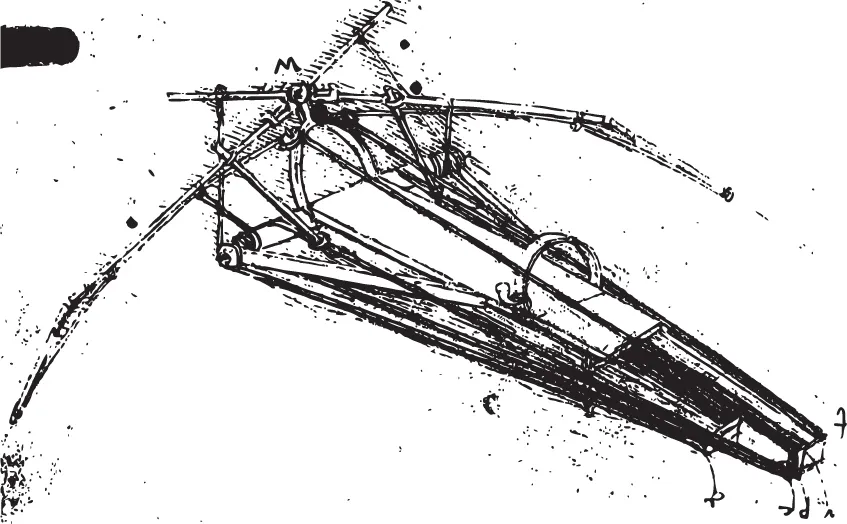
Although models are rarely visible in a final invention or technical system, they are essential to their existence. Models are a core component of each innovative process. First models often consist of an abstract understanding of a system itself and its possible improvements. These models might be explained easily, and paper and pencil could suffice as tools for their further development. They can be extended in detail using more complex models, such as scientific calculations. The next steps often include prototype models using building materials such as clay, paper or three-dimensional printing technologies. Among the most famous models are the drawings and model buildings of Leonardo da Vinci. Although not all of them proved to be fully functional designs, they still are a source of inspiration to many people today with respect to their high scientific and artistic quality. Figure 1.1 shows a drawing of a model of a flying machine by Leonardo da Vinci.
Figure 1.1 Drawing of a model of a flying machine by Leonardo da Vinci.
However, for a long time any mistakes and changing assumptions—both being characteristics of an innovation process—have led to an elaborative effort in adapting the model. The invention of computers has brought a radical change to the field of modeling. Steadily increasing computing power has enabled scientists, engineers, and architects to increase the level of detail and variation in their models. Analytical models, which had to be simplified before or were too laborious for use in research, development and field applications, can now be calculated. A new type of model has even evolved: Numerical models using mathematical models based on often iterative computational algorithms. The current level of maturity in photovoltaic research and development has been significantly enabled through the use of numerical models, while the findings of quantum and semiconductor physics have enabled photovoltaics (PV) at all.
Today, there are more than 150 years of research on photovoltaic modeling. Beginning with the observations of Edmond A. Becquerel in 1839 [1], the first patent of a solar cell was filed in 1888 [2]. Ultimately, the first solar cell was demonstrated by Bell Laboratories in 1954 [3]. The fundamental theoretical work in semiconductor physics, such as the work of William Shockley and Hans J. Queisser [4, 5], laid the foundation for the photovoltaic prototypes built in the middle of the last century. Based on the study of Shockley and Queisser [4], research has mainly focused on silicon for terrestrial outdoor applications and III-V devices for space.
In the following years, research has become more application-oriented, addressing the fundamental questions of 1) how to obtain an acceptable performance at acceptable cost and 2) how to build and process photovoltaic devices industrial scale. With the work of Harold Hovel [6], and later on, Martin A. Green [7] and Jenny Nelson [8], photovoltaic devices were modeled in detail, both in theory and in practical aspects. Most of the fundamental literature on modeling focused on semiconductor materials, especially Si and III-V materials. The optimal use of both extraterrestrial and terrestrial radiation led to the invention of multijunction solar cells. Additionally, modeling approaches included research on the thermodynamic limits of photochemical conversion [9, 10].
In the meantime, organic materials evolved and chalcocites continuously kept a small, but distinct, proportion of PV appliances. Cost issues enforced the development of low-cost silicon materials such as amorphous, polycrystalline and “dirty” silicon. In order to enhance their performance, light trapping and advanced doping methodologies were developed.
Today, we are closer than ever before to realizing a broad range of PV applications covering almost every area where human beings use technology. Many countries have decided to make PV a part of their national energy supply, and PV materials are a standard solution for space applications and distinct places. Some mobile applications, such as electric fences or mobile charging stations, are powered with PV. Furthermore, new applications arise. For example, low power electronic devices and the internet of things with its many distributed wireless sensor nodes can use PV as their power source.
There are as many applications as materials, and each material will behave very differently for a specific application. In most cases, the influence of the incoming radiation in its spectral variation and intensity will dominate. However, as is the case for space applications or concentrated photovoltaics, the influence of temperature on the devices will affect the performance for most materials, and this effect will vary from material to material.
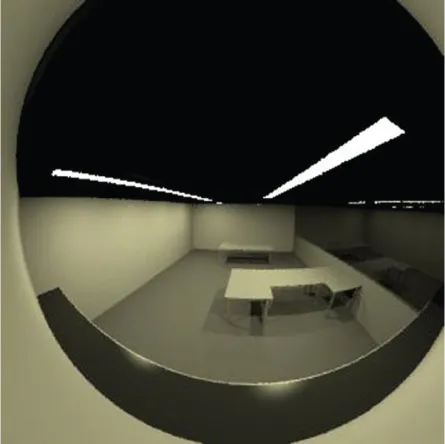
Most materials are tested and modeled to the solar standard spectrum AM1.5 and a device temperature of 25 °C. This standard is very important in order to have reproducible reference conditions in order to mark progress, and the current best performers are updated twice a year in Green’s Table [11]. However, these conditions will never occur in nature and might not reveal the best performer for low irradiance or indoor applications or concentrated PV. Already under realistic outdoor operation, the performance might differ significantly from STC. Knowledge of the incoming spectral irradiance is therefore as important as knowledge of the material used. Ray-tracing programs combined with meteorological and building models, such as DAYSIM [12], can assist in obtaining realistic conditions for an application. Figure 1.2 shows a ray-tracing model of an office room simulated with Radiance.
Figure 1.2 Ray-tracing model of an office room. The model includes measured transmission values and other material properties [13].
The recent introduction of cloud computational power, providing easy access to large and distributed computational resources at reasonable cost, might also open up a new world in the research and development of photovoltaics for two reasons. First, numerical models are by their nature deeply coupled to the available computing power. Thus, cloud computing enables more complexity in the applied models. Second, cloud computing also provides easy access to parallel computing, which leads to significant reduction in the computing time for each model. This will be a major step for all ray-tracing models, but will also ease the use of quantum mechanical models, as they are required for the detailed calculation of many material parameters in photovoltaics. These calculations could also reduce the required amount of measurements, thus reducing the research cost.
The increasing availability of various data, such as local weather data or geographical information, is also known as Big Data. While at first glance this might not be of interest from a research point of view, Big Data might become a powerful tool in the development of prototypes and application-shaped products. The use of machine learning and artificial intelligence in data science can also assist in developing models. For example, patterns could be found in characterization measurements while using material components as a feature. Thus, the modeling of photovoltaic devices promises to become even more interesting in the coming years.
This book covers the current most important analytical, numerical and experimental models for the main photovoltaic materials and applications and invites you, the reader, to participate in this interesting and important field of science and engineering.
References
1. Becquerel, E., On Electron Effects under the Influence of Solar Radiation. C. R. Acad. Sci., 9, 561, 1839.
2. Weston, E., Art of utilizing solar radiant energy, US Patent 389125 A, 1888.
3. Chapin, D. M., Fuller D. M. and Pearson, G. L., A New Silicon p-n Junction Photocell for Converting Solar Radiation into Electrical Power. J. Appl. Phys. 25(5), 676–677, 1954.
4. Shockley, W. and Queisser, H. J., Detailed Balance...
Table of contents
Cover
Title page
Copyright page
Dedication
Preface
Chapter 1: Introduction
Chapter 2: Fundamental Limits of Solar Energy Conversion
Chapter 3: Optical Modeling of Photovoltaic Modules with Ray Tracing Simulations
Chapter 4: Optical Modelling and Simulations of Thin-Film Silicon Solar Cells
Chapter 5: Modelling of Organic Photovoltaics
Chapter 6: Modeling the Device Physics of Chalcogenide Thin Film Solar Cells
Chapter 7: Temperature and Irradiance Dependent Efficiency Model for GaInP-GaInAs-Ge Multijunction Solar Cells
Chapter 8: Variation of Output with Environmental Factors
Chapter 9: Modeling of Indoor Photovoltaic Devices
Chapter 10: Modelling Hysteresis in Perovskite Solar Cells
Index
End User License Agreement
Trusted by 375,005 students
Access to over 1.5 million titles for a fair monthly price.
Study more efficiently using our study tools.
Frequently asked questions
Yes, you can cancel anytime from the Subscription tab in your account settings on the Perlego website. Your subscription will stay active until the end of your current billing period. Learn how to cancel your subscription
No, books cannot be downloaded as external files, such as PDFs, for use outside of Perlego. However, you can download books within the Perlego app for offline reading on mobile or tablet. Learn how to download books offline
Perlego offers two plans: Essential and Complete
Essential is ideal for learners and professionals who enjoy exploring a wide range of subjects. Access the Essential Library with 800,000+ trusted titles and best-sellers across business, personal growth, and the humanities. Includes unlimited reading time and Standard Read Aloud voice.
Complete: Perfect for advanced learners and researchers needing full, unrestricted access. Unlock 1.5M+ books across hundreds of subjects, including academic and specialized titles. The Complete Plan also includes advanced features like Premium Read Aloud and Research Assistant.
Both plans are available with monthly, semester, or annual billing cycles.
We are an online textbook subscription service, where you can get access to an entire online library for less than the price of a single book per month. With over 1.5 million books across 990+ topics, we’ve got you covered! Learn about our mission
Look out for the read-aloud symbol on your next book to see if you can listen to it. The read-aloud tool reads text aloud for you, highlighting the text as it is being read. You can pause it, speed it up and slow it down. Learn more about Read Aloud
Yes! You can use the Perlego app on both iOS and Android devices to read anytime, anywhere — even offline. Perfect for commutes or when you’re on the go. Please note we cannot support devices running on iOS 13 and Android 7 or earlier. Learn more about using the app
Yes, you can access Photovoltaic Modeling Handbook by Monika Freunek Muller, Monika Freunek Müller,Monika Freunek Muller, Monika Freunek Müller in PDF and/or ePUB format, as well as other popular books in Physical Sciences & Energy. We have over 1.5 million books available in our catalogue for you to explore.