This is the second edition of Freshwater Algae; the popular guide to temperate freshwater algae. This book uniquely combines practical information on sampling and experimental techniques with an explanation of basic algal taxonomy plus a key to identify the more frequently-occurring organisms. Fully revised, it describes major bioindicator species in relation to key environmental parameters and their implications for aquatic management.
This second edition includes:
the same clear writing style as the first edition to provide an easily accessible source of information on algae within standing and flowing waters, and the problems they may cause
the identification of 250 algae using a key based on readily observable morphological features that can be readily observed under a conventional light microscope
up-to-date information on the molecular determination of taxonomic status, analytical microtechniques and the potential role of computer analysis in algal biology
upgrades to numerous line drawings to include more detail and extra species information, full colour photographs of live algae – including many new images from the USA and China
Bridging the gap between simple identification texts and highly specialised research volumes, this book is
used both as a comprehensive introduction to the subject and as a laboratory manual. The new edition will be invaluable to aquatic biologists for algal identification, and for all practitioners and researchers working within aquatic microbiology in industry and academia.
eBook - ePub
Freshwater Algae
Identification, Enumeration and Use as Bioindicators
- English
- ePUB (mobile friendly)
- Available on iOS & Android
eBook - ePub
Freshwater Algae
Identification, Enumeration and Use as Bioindicators
About this book
Information
1
Introduction to Freshwater Algae
1.1 General introduction
Algae are widely present in freshwater environments, such as lakes and rivers, where they are typically present as microorganisms – visible only with the aid of a light microscope. Although relatively inconspicuous, they have a major importance in the freshwater environment, both in terms of fundamental ecology and in relation to human use of natural resources.
This book considers the diversity of algae in freshwater environments and gives a general overview of the major groups of these organisms (Chapter 1), methods of collection and enumeration (Chapter 2) and keys to algal groups and major genera (Chapter 4). Algae are considered as indicators of environmental conditions (bioindicators) in terms of individual species (Chapter 1) and as communities (Chapter 3).
1.1.1 Algae – an overview
The word ‘algae’ originates from the Latin word for seaweed and is now applied to a broad assemblage of organisms that can be defined both in terms of morphology and general physiology. They are simple organisms, without differentiation into roots, stems and leaves – and their sexual organs are not enclosed within protective coverings. In terms of physiology, they are fundamentally autotrophic (obtaining all their materials from inorganic sources) and photosynthetic – generating complex carbon compounds from carbon dioxide and light energy. Some algae have become secondarily heterotrophic, taking up complex organic molecules by organotrophy or heterotrophy (Tuchman, 1996), but still retaining fundamental genetic affinities with their photosynthetic relatives (Pfandl et al., 2009).
The term ‘algae’ (singular alga) is not strictly a taxonomic term but is used as an inclusive label for a number of different phyla that fit the broad description noted earlier. These organisms include both prokaryotes (cells lacking a membrane-bound nucleus; see Section 1.3) and eukaryotes (cells with a nucleus plus typical membrane-bound organelles).
Humans have long made use of algal species, both living and dead. Fossil algal diatomite deposits, for example, in the form of light but strong rocks, have been used as building materials and filtration media in water purification and swimming pools. Some fossil algae, for example Botryococcus, can give rise to oil-rich deposits. Certain species of green algae are cultivated for the purpose of extracting key biochemicals for use in medicine and cosmetics. Even blue-green algae have beneficial uses. Particularly, Spirulina, which was harvested by the Aztecs of Mexico, is still used by the people around Lake Chad as a dietary supplement. Spirulina tablets may still be obtained in some health food shops. Blue-green algae are, however, better known in the freshwater environment as nuisance organisms, forming dense blooms. These can have adverse effects in relation to toxin build-up and clogging filters/water courses – affecting the production of drinking water and recreational activities.
1.1.2 Algae as primary producers
As fixers of carbon and generators of biomass, algae are one of three major groups of photosynthetic organism within the freshwater environment. They are distinguished from higher plants (macrophytes) in terms of size and taxonomy and from photosynthetic bacteria in terms of their biochemistry. Unlike algae (eukaryotic algae and cyanophyta), photosynthetic bacteria are strict anaerobes and do not evolve oxygen as part of the photosynthetic process (Sigee, 2004).
The level of primary production by algae in freshwater bodies can be measured as fixed carbon per unit area with time (mg C m−3 h−1) and varies greatly from one environment to another. This is seen, for example, in different lakes – where primary production varies with trophic status and with depth in the water column (Fig. 1.1). Eutrophic lakes, containing high levels of available nitrogen and phosphorus, have very high levels of productivity in surface waters, decreasing rapidly with depth due to light absorption by algal biomass. In contrast, mesotrophic and oligotrophic lakes have lower overall productivity – but this extends deep into the water column due to greater light penetration.
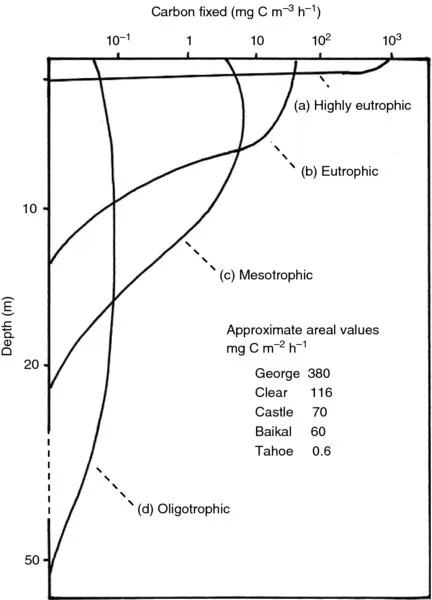
Figure 1.1 Examples of algal primary production in lakes of different trophic status, showing how rates of production typically change with depth. Examples of each lak...
Table of contents
- Cover
- Titlepage
- Copyright
- Preface to the First Edition
- Preface to the Second Edition
- Acknowledgements
- 1 Introduction to Freshwater Algae
- 2 Sampling, Biomass Estimation and Counts of Freshwater Algae
- 3 Algae as Bioindicators
- 4 A Key to the More Frequently Occurring Freshwater Algae
- Glossary
- References
- Index
- End User License Agreement
Trusted by 375,005 students
Access to over 1.5 million titles for a fair monthly price.
Study more efficiently using our study tools.
Frequently asked questions
Yes, you can cancel anytime from the Subscription tab in your account settings on the Perlego website. Your subscription will stay active until the end of your current billing period. Learn how to cancel your subscription
No, books cannot be downloaded as external files, such as PDFs, for use outside of Perlego. However, you can download books within the Perlego app for offline reading on mobile or tablet. Learn how to download books offline
Perlego offers two plans: Essential and Complete
- Essential is ideal for learners and professionals who enjoy exploring a wide range of subjects. Access the Essential Library with 800,000+ trusted titles and best-sellers across business, personal growth, and the humanities. Includes unlimited reading time and Standard Read Aloud voice.
- Complete: Perfect for advanced learners and researchers needing full, unrestricted access. Unlock 1.5M+ books across hundreds of subjects, including academic and specialized titles. The Complete Plan also includes advanced features like Premium Read Aloud and Research Assistant.
We are an online textbook subscription service, where you can get access to an entire online library for less than the price of a single book per month. With over 1.5 million books across 990+ topics, we’ve got you covered! Learn about our mission
Look out for the read-aloud symbol on your next book to see if you can listen to it. The read-aloud tool reads text aloud for you, highlighting the text as it is being read. You can pause it, speed it up and slow it down. Learn more about Read Aloud
Yes! You can use the Perlego app on both iOS and Android devices to read anytime, anywhere — even offline. Perfect for commutes or when you’re on the go.
Please note we cannot support devices running on iOS 13 and Android 7 or earlier. Learn more about using the app
Please note we cannot support devices running on iOS 13 and Android 7 or earlier. Learn more about using the app
Yes, you can access Freshwater Algae by Edward G. Bellinger,David C. Sigee in PDF and/or ePUB format, as well as other popular books in Biological Sciences & Zoology. We have over 1.5 million books available in our catalogue for you to explore.