Energy Production Systems Engineering presents IEEE, Electrical Apparatus Service Association (EASA), and International Electrotechnical Commission (IEC) standards of engineering systems and equipment in utility electric generation stations.
Includes fundamental combustion reaction equations
Provides methods for measuring radioactivity and exposure limits
Includes IEEE, American Petroleum Institute (API), and National Electrical Manufacturers Association (NEMA) standards for motor applications
Introduces the IEEE C37 series of standards, which describe the proper selections and applications of switchgear
Describes how to use IEEE 80 to calculate the touch and step potential of a ground grid design
This book enables engineers and students to acquire through study the pragmatic knowledge and skills in the field that could take years to acquire through experience alone.
To understand the basic requirements of OSHA 1910.269 and Subpart S
To apply recommendations of NFPA 70 (National Electrical Code®) and NFPA 70E (Electrical Safety in the Workplace) for compliance with OSHA 1910 Subpart S
To apply recommendations of IEEE C2 (National Electrical Safety Code) for compliance with OSHA 1910.269
To be able to determine minimum approach distance (MAD), limited approach boundary, restricted approach boundary, and arc flash boundary for installation
To be able to determine minimum safety clearance for electric supply station fences
To be able to determine the minimum illumination requirements for electric supply station locations
To be able to determine the proper electrical PPE (personal protective equipment) required for various tasks
To be able to determine the correct classification for areas where hazardous materials may be present
IF ONE were to try to reduce the function of the electrical engineer in the electric power generation industry to one sentence, it would be “to ensure the design, implementation, and operation of a SAFE and RELIABLE electrical system.” Electrical safety is of primary importance in the electric utility generation industry. The generation industry is unique from other industrial environments. The available short-circuit fault currents can be very large since the generation source is close and can supply a large amount of fault current. The service voltages at various pieces of equipment can be greater in magnitude for the larger electrical machines utilized in the generation station. Combustible materials may be handled, stored, and utilized in power generation facilities. The above conditions require the power plant electrical engineer to be very familiar with governmental regulations and industry standards regarding safety requirements to ensure the safe operation of the generation facility.
OSHA (Occupational Health and Safety Administration) (osha.gov) issues regulations that cover occupational health and safety. These regulations have the same effect as law. For general industry, which includes utilities, the applicable regulation is OSHA CFR 1910 – General Industry Standards. For general industry, electrical safety is covered under Subpart S. However, under OSHA CFR 1910, there is a separate section for special industries under Subpart R and the electric utility industry is covered under OSHA 1910.269 of Subpart R. This section covers the operation and maintenance of electric power generation systems and equipment and applies to installations utilized for the generation of electrical energy that are accessible only to qualified employees. One might think that all of the requirements for a generation facility fall under OSHA CFR 1910.269 and not OSHA CFR 1910 Subpart S since OSHA CFR 1910.269 regulations were written for electric generation, transmission, and distribution systems, but that is not always the case. So how does a plant engineer know when to apply OSHA 1910 Subpart S (general industry) or OSHA 1910 Subpart R 269 or possibly both regulations? OSHA provides guidance with that question in Appendix A of 1910.269.
To understand how Appendix A addresses this, we need to understand that OSHA segregates its safety requirements into two general categories: electrical safe installation methods and electrical safe work practices.
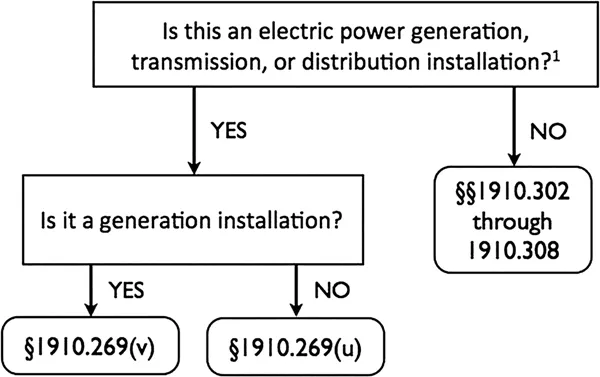
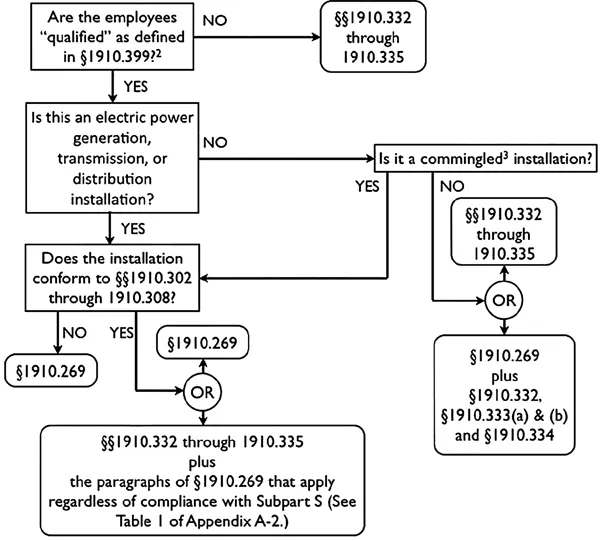
1910.269 Appendix A-1 as shown in Figure 1.1 answers the question of which regulation (1910.269 or 1910 Subpart S) applies to electrical installation requirements and 1910.269 Appendix A-2 as shown in Figure 1.2 answers the question of which regulation (1910.269 or 1910 Subpart S) applies to electrical safe work practices.
Figure 1.1 Appendix A-1 – Application of 1910.269 and 1910 Subpart S to Electrical Installations. .
Source: Reproduced with permission of U.S. Department of Labor
Figure 1.2 Appendix A-2 – Application of 1910.269 and 1910 Subpart S to Electrical Safety-Related Work Practices. .
Source: Reproduced with permission of U.S. Department of Labor
For regulations regarding the safety of the electrical installation, if the facility is directly associated with a generation, transmission, or distribution system, then OSHA CFR 1910.269 is th...
Table of contents
Cover
Series Title Page
Title Page
Copyright
Dedication
Contents
List of Figures
List of Tables
List of Annex
Acknowledgments
Introduction
Chapter 1 Electrical Safety
Chapter 2 Basic Thermal Cycles
Chapter 3 Boilers and Steam Generators
Chapter 4 Fossil Fuels and The Basic Combustion Process
Chapter 6 Nuclear Power
Chapter 7 Conveyors
Chapter 8 Fans
Chapter 9 Pumps
Chapter 10 Condenser Cooling System
Chapter 11 Steam Turbines
Chapter 12 Gas Turbines
Chapter 13 Reciprocating Engines
Chapter 14 Electrical System
Chapter 15 Transformers and Reactors
Chapter 16 Generators
Chapter 17 Motors
Chapter 18 Variablefrequency Drivesystems
Chapter 19 Switchgear
Chapter 20 Battery/Vital Bus Systems
Chapter 21 Ground System
Chapter 22 Electrical System Protection and Coordination
chapter 23 control systems
Chapter 24 Instruments and Meters
Chapter 25 Valves and Actuators
Chapter 26 Emission Control Systems
Chapter 27 Water Treatment
Chapter 28 Solar and Wind Energy
Annexes
Index
IEEE Press Series on Power Engineering
Eula
Trusted by 375,005 students
Access to over 1.5 million titles for a fair monthly price.
Study more efficiently using our study tools.
Frequently asked questions
Yes, you can cancel anytime from the Subscription tab in your account settings on the Perlego website. Your subscription will stay active until the end of your current billing period. Learn how to cancel your subscription
No, books cannot be downloaded as external files, such as PDFs, for use outside of Perlego. However, you can download books within the Perlego app for offline reading on mobile or tablet. Learn how to download books offline
Perlego offers two plans: Essential and Complete
Essential is ideal for learners and professionals who enjoy exploring a wide range of subjects. Access the Essential Library with 800,000+ trusted titles and best-sellers across business, personal growth, and the humanities. Includes unlimited reading time and Standard Read Aloud voice.
Complete: Perfect for advanced learners and researchers needing full, unrestricted access. Unlock 1.5M+ books across hundreds of subjects, including academic and specialized titles. The Complete Plan also includes advanced features like Premium Read Aloud and Research Assistant.
Both plans are available with monthly, semester, or annual billing cycles.
We are an online textbook subscription service, where you can get access to an entire online library for less than the price of a single book per month. With over 1.5 million books across 990+ topics, we’ve got you covered! Learn about our mission
Look out for the read-aloud symbol on your next book to see if you can listen to it. The read-aloud tool reads text aloud for you, highlighting the text as it is being read. You can pause it, speed it up and slow it down. Learn more about Read Aloud
Yes! You can use the Perlego app on both iOS and Android devices to read anytime, anywhere — even offline. Perfect for commutes or when you’re on the go. Please note we cannot support devices running on iOS 13 and Android 7 or earlier. Learn more about using the app
Yes, you can access Energy Production Systems Engineering by Thomas Howard Blair in PDF and/or ePUB format, as well as other popular books in Physical Sciences & Energy. We have over 1.5 million books available in our catalogue for you to explore.