BEST PRACTICES FROM CANADA'S HIGH-PERFORMING SCHOOL SYSTEMS
Empowered Educators in Canada is one volume in a series that explores how high-performing educational systems from around the world achieve strong results. The anchor book, Empowered Educators: How High-Performing Systems Shape Teaching Quality Around the World, is written by Linda Darling-Hammond and colleagues, with contributions from the authors of this volume.
Empowered Educators in Canada details the core commonalities that exist across Canada with special emphasis on the localized nature of the systems—a hallmark of Canadian education. Canada boasts a highly educated population, and the provinces/territories truly value education as evidenced by the significant proportion of public funds allocated to schooling.
Operated by the provinces and territories, participation in kindergarten, primary, and secondary education is close to 100% across the nation. In addition to offering traditional academics, secondary education includes opportunities for students to attend technical and vocational programs. To demonstrate exemplary education systems, the authors examine two top-performing jurisdictions, Alberta and Ontario, which have developed strong supports for teacher development.
Canadian teachers are highly qualified, and salary scales in all jurisdictions are typically based on a teacher's level of education and years of experience. While Canada has enjoyed much educational success, the education of First Nations students has historically been one of the country's more controversial and contentious issues.
Overall, Canada is a country that is proud of its education system and places a high value on—and participation in—publicly funded education.
Pamela Osmond-Johnson, Carol Campbell, and Ken Zeichner
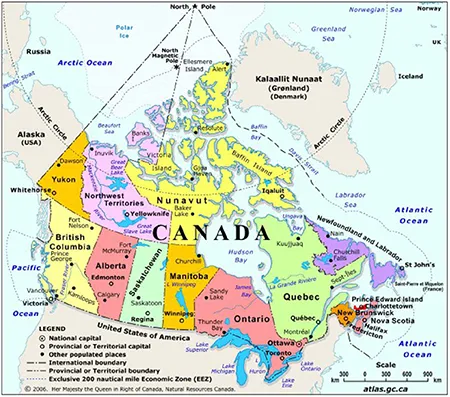
UNLIKE MOST INDUSTRIALIZED COUNTRIES around the world, there is no federal body of education in Canada; rather, education is under provincial or territorial authority, granted under Canada’s Constitution Act of 1867. As highlighted in Figure 1-1, Canada is composed of ten provinces (Alberta, British Columbia, Manitoba, New Brunswick, Newfoundland and Labrador, Nova Scotia, Ontario, Prince Edward Island, Quebec, and Saskatchewan) and three territories (Nanavut, Northwest Territories, and Yukon). Thus, while there are many similarities across provincial and territorial education systems, there are significant policy variations in the areas of curriculum, assessment and accountability. These differences reflect the geography, history, language, culture, and corresponding specialized needs of the diverse populations served in each jurisdiction. All the education systems in Canada, however, are highly developed and widely accessible, reflecting a shared societal belief in the importance of education (CMEC, 2015). In this volume we begin by outlining the core commonalities that exist across the country while paying special attention to the localized nature of the systems—a hallmark of Canadian education. We then take a closer look at two of Canada’s top performing jurisdictions, Alberta and Ontario, as exemplars of school systems that have developed strong supports around teacher development within their own unique policy contexts.
Figure 1-1Provinces and Territories of Canada.
Source: Natural Resources Canada.
Overview of Canada
Canada is a multicultural society, with a foreign-born population of almost 20% (OECD, 2015). The Canadian constitution recognizes both English and French as its two official languages. According to 2011 Statistics Canada census data, 5.8 million (17.5%) of Canadians speak both official languages. Nearly 7 million (21%) Canadians reported speaking French most often at home in 2011, although this is largely concentrated in the province of Quebec. In the rest of Canada, 74.1% of Canadians speak only English at home (CMEC, 2015). The minority language rights of French-speaking students living outside the province of Quebec and English-speaking students living in the province of Quebec are protected in the Canadian Charter of Rights and Freedoms. The Canadian Charter or Rights and Freedoms outlines the conditions under which Canadians have the right to access publicly funded education in either minority language. Each province and territory has established French-language school boards to manage the French-first-language schools. In the province of Quebec, the same structure applies to education in English-first-language schools.
All Canadians meeting age and residence requirements have access to free public education. In 2010–2011, there were 5,053,985 total students enrolled in public elementary and secondary schools in Canada (CMEC, 2015). Education is under provincial jurisdiction and there is no federal department of education. That being said, the federal government plays an important role in Canadian education, directly making provisions for First Nations schools on reserves and indirectly providing funding through intergovernmental transfers which aim to redistribute wealth across the country and “ensure a significant degree of equality across provinces in their ability to deliver social services such as education” (Parkin, 2015, p. 25). Although localized variations exist, the education systems within the ten provinces and three territories are based around a common belief in the importance of education, as evidenced by the significant proportion of budgets allocated to schooling (approximately 20% of total expenditures, depending on the jurisdiction).
In 2013, Canada’s elementary and secondary school systems employed 397,122 educators (Statistics Canada, 2014), most of whom had four or five years of postsecondary study. The teaching profession is unionized in all jurisdictions; however, the scope of the work of teacher associations varies. National frameworks around teacher competencies, professionalism, and the work of teachers do not exist. Rather, teacher appraisal varies across jurisdictions and the establishment of professional standards and certification of the teaching profession are provincial/territorial responsibilities (OECD, 2015). To teach in Canada educators are required to obtain at least a bachelor of education from one of approximately 50 accredited teacher education programs at universities across the country. Some also offer postgraduate preparation for teaching. With large surpluses in teacher supply contrasted with available teaching jobs, Canadian teacher education programs and schools are selective in choosing candidates and teachers, which some analysts suggest is a contributor to high achievement (OECD, 2011). Positive learning environments and strong instructional leadership have also been identified as keys in Canada’s continued school improvement efforts. Indicators from PISA 2012 showed that Canadian 15-year-olds viewed teacher-student relations at levels that are higher than the OECD average and school leaders reporter higher than average levels of instructional leadership (OCED, 2015).
Canada has a highly educated population, with 53% of 25–64-year-olds holding tertiary qualifications in 2012—ranking first among countries participating in the Organisation for Economic Co-operation and Development’s (OECD) analyses, which collectively averaged 33% (OECD, 2014). In recent decades, Canada has consistently been ranked as a top performer on the OECD’s Programme for International Student Assessment (PISA) (OECD, 2015). Across the ten provinces, Canadian 15-year-olds scored well above the OECD average in both mathematics and reading in the 2012 rankings and, of the 65 countries and economies participating in the assessment, only three OECD and six non-OECD countries outperformed Canada. As Parkin (2015) points outs, based on a variety of international assessments, “no country outside of East Asia performs better than Canada on a regular basis” (p. 6).
Complementing its focus on high quality education, Canada also has a strong focus on health and well-being, providing all residents with free health care and access to a host of social services dedicated to child, youth, and adult development. Since 2000, Canada has particularly focused on the provision of social programs and services in early childhood (birth to age 6) (Government of Canada, 2011). A national Universal Child Care Benefit (UCCB) issues a taxable monthly payment of $100 per child to families with children under the age of six (OECD, 2015). This funding is used at the discretion of parents to offset the costs of raising children. In late 2014, the federal government proposed increases to UCCB to $160 per child under the age of six and $60 per month for children aged 6–17. The increases took effect on January 1, 2015, and the first retroactive payment was made to families in July of 2015. Additional provincial baby bonuses and supplements for low-income families are also available to those who meet certain qualifications, with benefits and criteria varying between jurisdictions. While improvements in children’s health have been made in a number of areas (such as infant mortality, teenage births, and bullying), when it comes to overall child well-being, UNICEF (2013) describes Canada as a country “stuck in the middle”, achieving a middle ranking on their report card of 29 of the richest countries for the past decade. As such, key public education issues include a focus on diversity and equity with particular attention to social justice issues such as poverty, gender issues, mental health, racism, and violence prevention.
That being said, the impact of socioeconomic status on achievement in Canada is less than the OECD average, particularly in mathematics (9.4% compared with the OECD average of 14%). In fact, “in every OCED country except Finland, the socioeconomic status of the neighborhood a student is born in and of the local school they attend has more of an impact on their academic performance than in Canada” (Parkin, 2015, p. 24). Achievement among immigrant children is a particularly remarkable aspect of the nation’s success as Canada is among only a few countries internationally where there is no significant achievement gap between its immigrant and nonimmigrant students on the PISA (OECD, 2015). It is also one of the few countries where there is no significant performance gap between students who speak the language of instruction at home and those who do not (OECD, 2011). These successes were recently highlighted by the Center on International Education Benchmarking (CIEB, 2015), who identified Canada as one of only three nations (with Finland and Estonia) whose education systems “are able to offer their students a quality education regardless of socioeconomic background at a low cost and still come out at the top of the international league tables for overall student performance.”
Nevertheless, while Canada performs highly in international comparisons, there are some variations across provincial and territorial systems. For example, 2011 data for the upper secondary graduation indicates: “The proportion of students who completed their education in the expected time varied considerably across the country: from 12% in Nunavut to 84% in Nova Scotia” (Statistics Canada, 2015, p. 41). A Pan Canadian Assessment Program (PCAP) is administered to a sample of students across the ten provinces every three years. The average performance Canada is high; however, several provinces demonstrate performance at or above the Canadian average—Alberta in science and math; British Columbia in science; Newfoundland and Labrador in science; Ontario in math, reading, and science; and Quebec in math (CMEC, 2014). Within an overall high-performing system, it is important to remember that school education in Canada varies by province and territory.
Governance of School Systems
Provincial and territorial systems are centralized and schools have less autonomy regarding resource allocation, curriculum, and assessment than many of their OECD counterparts (OECD, 2015). In all 13 jurisdictions, departments or ministries of education are responsible for the organization, delivery, and assessment of education at elementary and secondary levels. A minister of education, who is almost always an elected member of the legislature, is appointed by the government leader to lead the department. Responsibility for the overall operation of the departments, however, is with the deputy ministers, who belong to the civil service. The provincial/territorial ministry or department provides education, administrative and financial management and school support functions. It also establishes the terms of the educational services to be provided, including the policy and legislative frameworks (CMEC, 2015). The ministry or department of education typically lays out basic requirements around the assessment of students, with school boards and schools having the authority to establish their own assessment policies within the provincial/territorial framework. While format and structure vary across the country, students in most jurisdictions are required to participate in provincial or territorial summative examinations at key stages (typically grades 3, 6, and upper secondary) (OECD, 2015). The ministers of education collaborate through the Council of Ministers of Education, Canada (CMEC), with key pan-Canadian educational policies focused around evaluation and assessment (OECD, 2015).
Typically, school boards (also known as districts, divisions or district education councils in different provinces) are entrusted with local governance of education. Members are elected by public ballot, and the authority for operational and administrational (including financial) duties is delegated to local leaders at the discretion of the provincial and territorial governments. Local authorities oversee the group of schools within their board or division, and are responsible for curriculum implementation, personnel, student enrollment, and initiation of proposals for new construction or other major capital expenditures.
Organization of the System
Primary and Elementary Education (Grades K–8)
Operated by the local education authorities, one year of pregrade one (kindergarten) for five-year-olds is available in all provinces/territories. Preschool classes may also be available from age four or earlier, although there is substantial variation between jurisdictions in terms of provision and operation (OECD, 2015). Across Canada, 95 percent of five-year-olds attend pre-elementary or elementary school, and over 40 percent of four-year-olds are enrolled in junior kindergarten. Emphasized in the primary and elementary school curriculum are the basic subjects of language, mathematics, social studies, science, health and physical education, and introductory arts, with some jurisdictions including second-language learning. In general, schooling is compulsory from ages 5–18 but, in some provinces, can begin at age four and continue until graduation from secondary school or age 21. In 2012, the average hours per year of total compulsory instruction time for primary and elementary students in Canada was 919—higher than the OECD average of 794 hours (OECD, 2014).
Secondary Education (Grades 9–12)
Almost 98% of elementary students progress to the secondary level. Here, students are required to take primarily compulsory courses in the first years with access to specialized courses in later years to prepare for the job market or meet the entrance requirements of postsecondary institutions in specific areas of interest. Typically, vocational and academic programs are offered within the same secondary schools, but so...
Table of contents
Cover
Title page
Copyright
Foreword
Acknowledgments
About the Sponsoring Organizations
About the Authors
Online Documents and Videos
1 Education in Canada
2 Teacher Policies and Practices in Alberta
3 Teacher Policies and Practices in Ontario
Appendix Methodology
References
Eula
Trusted by 375,005 students
Access to over 1.5 million titles for a fair monthly price.
Study more efficiently using our study tools.
Frequently asked questions
Yes, you can cancel anytime from the Subscription tab in your account settings on the Perlego website. Your subscription will stay active until the end of your current billing period. Learn how to cancel your subscription
No, books cannot be downloaded as external files, such as PDFs, for use outside of Perlego. However, you can download books within the Perlego app for offline reading on mobile or tablet. Learn how to download books offline
Perlego offers two plans: Essential and Complete
Essential is ideal for learners and professionals who enjoy exploring a wide range of subjects. Access the Essential Library with 800,000+ trusted titles and best-sellers across business, personal growth, and the humanities. Includes unlimited reading time and Standard Read Aloud voice.
Complete: Perfect for advanced learners and researchers needing full, unrestricted access. Unlock 1.5M+ books across hundreds of subjects, including academic and specialized titles. The Complete Plan also includes advanced features like Premium Read Aloud and Research Assistant.
Both plans are available with monthly, semester, or annual billing cycles.
We are an online textbook subscription service, where you can get access to an entire online library for less than the price of a single book per month. With over 1.5 million books across 990+ topics, we’ve got you covered! Learn about our mission
Look out for the read-aloud symbol on your next book to see if you can listen to it. The read-aloud tool reads text aloud for you, highlighting the text as it is being read. You can pause it, speed it up and slow it down. Learn more about Read Aloud
Yes! You can use the Perlego app on both iOS and Android devices to read anytime, anywhere — even offline. Perfect for commutes or when you’re on the go. Please note we cannot support devices running on iOS 13 and Android 7 or earlier. Learn more about using the app
Yes, you can access Empowered Educators in Canada by Carol Campbell,Ken Zeichner,Ann Lieberman,Pamela Osmond-Johnson in PDF and/or ePUB format, as well as other popular books in Education & Education Administration. We have over 1.5 million books available in our catalogue for you to explore.