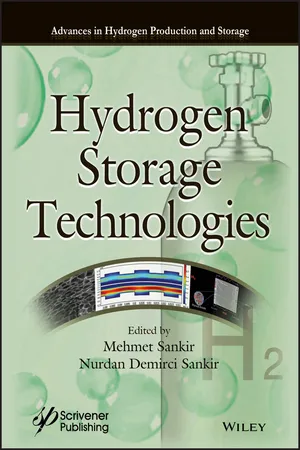
Hydrogen Storage Technologies
eBook - ePub

Hydrogen Storage Technologies

  1. English
  2. ePUB (mobile friendly)
  3. Available on iOS & Android
eBook - ePub

About this book

Hydrogen storage is considered a key technology for stationary and portable power generation especially for transportation. This volume covers the novel technologies to efficiently store and distribute hydrogen and discusses the underlying basics as well as the advanced details in hydrogen storage technologies.

The book has two major parts: Chemical and electrochemical hydrogen storage and Carbon-based materials for hydrogen storage. The following subjects are detailed in Part I:

  • Multi stage compression system based on metal hydrides
  • Metal-N-H systems and their physico-chemical properties
  • Mg-based nano materials with enhanced sorption kinetics
  • Gaseous and electrochemical hydrogen storage in the Ti-Z-Ni
  • Electrochemical methods for hydrogenation/dehydrogenation of metal hydrides

In Part II the following subjects are addressed:

  • Activated carbon for hydrogen storage obtained from agro-industrial waste
  • Hydrogen storage using carbonaceous materials
  • Hydrogen storage performance of composite material consisting of single walled carbon nanotubes and metal oxide nanoparticles
  • Hydrogen storage characteristics of graphene addition of hydrogen storage materials
  • Discussion of the crucial features of hydrogen adsorption of nanotextured carbon-based materials

Frequently asked questions

Yes, you can cancel anytime from the Subscription tab in your account settings on the Perlego website. Your subscription will stay active until the end of your current billing period. Learn how to cancel your subscription.
No, books cannot be downloaded as external files, such as PDFs, for use outside of Perlego. However, you can download books within the Perlego app for offline reading on mobile or tablet. Learn more here.
Perlego offers two plans: Essential and Complete
  • Essential is ideal for learners and professionals who enjoy exploring a wide range of subjects. Access the Essential Library with 800,000+ trusted titles and best-sellers across business, personal growth, and the humanities. Includes unlimited reading time and Standard Read Aloud voice.
  • Complete: Perfect for advanced learners and researchers needing full, unrestricted access. Unlock 1.4M+ books across hundreds of subjects, including academic and specialized titles. The Complete Plan also includes advanced features like Premium Read Aloud and Research Assistant.
Both plans are available with monthly, semester, or annual billing cycles.
We are an online textbook subscription service, where you can get access to an entire online library for less than the price of a single book per month. With over 1 million books across 1000+ topics, weโ€™ve got you covered! Learn more here.
Look out for the read-aloud symbol on your next book to see if you can listen to it. The read-aloud tool reads text aloud for you, highlighting the text as it is being read. You can pause it, speed it up and slow it down. Learn more here.
Yes! You can use the Perlego app on both iOS or Android devices to read anytime, anywhere โ€” even offline. Perfect for commutes or when youโ€™re on the go.
Please note we cannot support devices running on iOS 13 and Android 7 or earlier. Learn more about using the app.
Yes, you can access Hydrogen Storage Technologies by Mehmet Sankir, Nurdan Demirci Sankir, Mehmet Sankir,Nurdan Demirci Sankir in PDF and/or ePUB format, as well as other popular books in Physical Sciences & Energy. We have over one million books available in our catalogue for you to explore.

Information

Year
2018
Print ISBN
9781119459880
eBook ISBN
9781119460626
Edition
1
Subtopic
Energy

Part I
CHEMICAL AND ELECTROCHEMICAL HYDROGEN STORAGE

Chapter 1
Metal Hydride Hydrogen Compression Systems โ€“ Materials, Applications and Numerical Analysis

Evangelos I. Gkanas* and Martin Khzouz
Hydrogen for Mobility Lab, Institute for Future Transport and Cities, School of Mechanical, Automotive and Aerospace Engineering, Coventry University, Coventry, UK
*Corresponding author: [email protected]/[email protected]

Abstract

In this chapter, an analysis of the usage of hydrogen storage technologies for the design and construction of effective thermally driven hydrogen compressors is presented. A discussion on the available technologies for compressing hydrogen is presented; followed by an analysis of the combination of metal hydrides to design a metal hydride hydrogen compression (MHHC) system. The physicochemical and thermodynamic aspects of the metal hydride formation is introduced and the most suitable materials for compression processes are considered and analyzed. The necessity for the development of an accurate numerical analysis to describe a multistage MHHC system is explained, analyzed and discussed.
Keywords: Hydrogen storage, metal hydrides, hydrogen compression, thermally driven compressor, intermetallic compounds, numerical analysis, renewable energy

1.1 Introduction

In the current chapter, the topic of hydrogen compression by utilization of metal hydrides will be discussed and analyzed. Initially, the importance of using hydrogen technologies will be introduced, followed by an analysis and comparison between the most dominant ways to compress hydrogen such as mechanical compression, electrochemical compression and metal hydride hydrogen compression. The case of operating metal hydrides connected in series to compress hydrogen will be further analyzed in terms of the available metal hydride families, the physicochemical nature of hydrogen sorption by metallic materials, the thermodynamic aspects of metal hydride formation and the heat management of metal hydride tanks during the compression. The challenges for the proper material selection will be identified and analyzed, followed by a detailed analysis of the most promising materials for such application. The final part of the chapter will present a detailed mathematical analysis during the operation of a multistage MHHC system by introducing the necessary assumptions for the study. Furthermore, the heat, mass and momentum conservation equations for the needed numerical analysis will be introduced for the hydrogen-metal system in a step-by-step analysis, whereas a detailed case of a three-stage compression system will also be considered and analyzed.

1.2 Adoption of a Hydrogen-Based Economy

1.2.1 Climate Change and Pollution

The uncontrolled emissions of carbon dioxide (CO2) through human activities are subject to global concern regarding energy sustainability, global climate and quality of human life [1]. Carbon dioxide is an essential component for life; thus, the CO2 concentration in the atmosphere in either low or elevated levels can lead to global climate change, including all the side effects of this process [2, 3]. To achieve reduction in energy-related greenhouse gas emissions, several improvements must be achieved in terms of the energy supply sectors; conversion towards different energy sources is mandatory [4].

1.2.2 Toward a Hydrogen-Based Future

For the establishment of a globally hydrogen-based economy, safe and efficient ways of producing, storing and compressing hydrogen are mandatory for both stationary and mobile applications; small and/or large scale [5, 6]. Theoretically, hydrogen and electricity are enough to satisfy global energy needs, and can form an energy system that would be independent of energy sources [7]. Hydrogen does not normally exist naturally; it can be used as an energy vector to store/extract energy from fossil fuels and/or renewable energy sources (RES) and then convert to electricity and heat by using fuel cells or combustion engines [8, 9]. Thus, hydrogen will play a key role in integrating future energy systems and bridging the transition from a fossil-based to a more RES-based energy economy. Furthermore, there are other certain technological obstacles for the full implementation of the hydrogen economy in the next years; effective, green and economically viable hydrogen production [10], further development of the PEM fuel cells in terms of reliability, efficiency and cost [11] and the effective storage of hydrogen [12].

1.2.3 Hydrogen Storage

For successful application of hydrogen as an energy carrier, hydrogen needs to be stored safely for variable periods of time as efficiently as gasoline [13], while simple handling and low costs should also be ensured. Under normal temperature and pressure conditions, 1 kg of hydrogen will occupy a volume of 12.15 m3 and an energy content of 33.5 kWh, whereas for the same energy content, the volume that gasoline occupies is 0.0038 m3. Thus, for hydrogen to become a competitive energy carrier, its volume density must be increased [14]. As a result, three separate ways for hydrogen storage are identified: Compressed hydrogen storage, hydrogen storage in liquid form, and sol...

Table of contents

  1. Cover
  2. Title page
  3. Copyright page
  4. Preface
  5. Part I: Chemical and Electrochemical Hydrogen Storage
  6. Part II: Carbon-Based Materials for Hydrogen Storage
  7. Index
  8. End User License Agreement