- Explores emerging trends and perspectives in personality assessment, building on current knowledge and looking ahead to the future landscape of the field
- Discusses emerging technologies and how these can be combined with psychological theories in order to enhance the real-world practice of assessing personality
- Comprehensive sections address gaps in current knowledge and collate contributions and advances from diverse areas and perspectives
- The chapter authors are eminent scholars from across the globe who bring together new research from many different countries and cultures
- English
- ePUB (mobile friendly)
- Available on iOS & Android
eBook - ePub
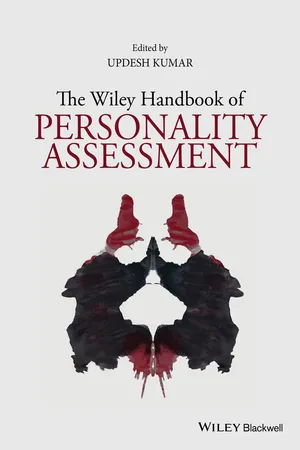
The Wiley Handbook of Personality Assessment
About this book
The Wiley Handbook of Personality Assessment presents the state-of-the-art in the field of personality assessment, providing a perspective on emerging trends, and placing these in the context of research advances in the associated fields.
Information
Section II
Emerging Assessment Perspectives and Methodological Issues
13
Objective Personality Assessment with the MMPI-2: An Internationally Adaptable Measure
James N. Butcher
University of Minnesota, Minneapolis, USA
The Minnesota Multiphasic Personality Inventory (MMPI-2) is the most widely researched and used clinical personality inventory in contemporary assessment psychology. The MMPI was originally published by the psychologist Starke Hathaway and psychiatrist J.C. McKinley in the 1940s as a means of obtaining a client’s perspective on their personality characteristics and mental health problems in psychiatric and medical settings through a self-report questionnaire. This true–false personality inventory rapidly became a standard personality instrument during the Second World War, and came to be used in a variety of applications such as mental health evaluations, personnel screening, and forensic evaluations. The extent of use of the MMPI resulted from its user-friendly self-report administration format and because of the symptom measures that have well established validity in assessing clinical symptoms and syndromes (Butcher, 2011; Friedman, Bolinskey, Levak & Nichols, 2015). The original MMPI was revised in the 1980s and published in two separate forms – an adult version, the MMPI-2 (Butcher, Dahlstrom, Graham, Tellegen, & Kaemmer, 1989), and an adolescent form, MMPI-A (Butcher et al., 1992). The MMPI-2 questionnaire, described below, is a 567-item inventory comprising symptoms, beliefs, and attitudes in adults above age 18.
Assessing Test Validity
One of the most important features of the MMPI-2 in addressing a client’s personality responses is that there are measures that provide information as to how openly and honestly the individual cooperated in sharing symptoms and attitudes. The measures on the MMPI-2 to address response attitudes are referred to as validity scales. The validity measures contribute substantially to the assessment of clients because many people being evaluated are motivated to present themselves in ways that do not disclose accurate information. For example, people being evaluated in pretrial criminal evaluations might exaggerate their symptoms in order to appear more psychologically disturbed than they are. And, applicants being evaluated for positions as airline pilots or police officers who are given the MMPI-2 tend to present themselves as highly virtuous and having no mental health or personality symptoms. Thus it is important in MMPI-2 interpretation to determine whether the client has cooperated sufficiently with the testing to provide valid results (Baer, Wetter, Nichols, Greene, & Berry, 1995; Bagby, Buis, & Nicholson, 1995). The basic validity scales for the MMPI-2 are described below.
The Cannot Say Index (?)
One important validity measure, though not considered a “scale”, is the Cannot Say Score. This index is the total number of items omitted in the inventory. High numbers of omitted items (Cannot Say scores greater than 30) can indicate that the client is uncooperative with the assessment and can invalidate the protocol.
TRIN and VRIN Scales
Some clients approach the items on the MMPI-2 by responding in an inconsistent manner – a characteristic that could be found among some individuals who seek to manipulate the test results. Two inconsistency scales have been developed for the MMPI-2. These scales are based on the analysis of the individual’s response to the items in a consistent or inconsistent manner. The scales comprise item pairs that involve responses that are semantically inconsistent; for example, a pair of items that contain content that cannot logically be answered in the same direction if the subject is responding consistently to the content. The VRIN scale is a valuable measure of random responding. The TRIN scale assesses a client’s tendency to endorse a significant percentage of the MMPI-2 items in either an “all True” or “all False” manner (Butcher et al., 2001).
The L (Lie) Scale
The L scale, developed for the original MMPI, is a measure of the client’s willingness to acknowledge faults or problems (Hathaway & McKinley, 1942). Individuals who score high on this scale are presenting an overly favorable picture of their personality attributes and adjustment. People who score high on the L scale tend to be claiming virtue that is not found among people in general. The L scale is particularly valuable in providing response information in situations such as personnel screening or family custody cases, because many people in these situations attempt to show only positive aspects of themselves and present themselves as “better” adjusted than they actually are.
The K (Defensiveness) Scale
The K scale is a measure of test defensiveness that was originally developed by Meehl (see Meehl and Hathaway, 1946) to assess whether a client is responding in an overly defensive way or showing a tendency to minimize problems. The K scale, in addition to serving as an index of defensiveness, serves also as a correction factor to compensate for the tendency of some people to deny problems. If a client shows high defensiveness on the MMPI-2 items, a portion of the K scale score (Hs. + 0.5K; Pd + 0.4K; Pt + 1K; Sc + 1K; and Ma + 0.2K) is added to five clinical scales as a means of detecting certain symptoms that the client likely avoided endorsing due to defensiveness. The K scale has been shown to be a valuable measure of test defensiveness (see Baer et al., 1995); however, the use of the K score to correct for defensiveness has not proven to make a differential contribution much beyond what the scale scores do separately. They are used today primarily because so much of the research included them.
The S (Superlative Self Presentation) Scale
The S scale was developed through a refined empirical scale construction approach. First, items that empirically discriminated between a sample of airline pilot job applicants and the MMPI-2 normative sample were obtained. Next, the items on the S scale were further refined by excluding items that reduced the scale homogeneity (Butcher et al., 2001). Finally, the 50 items on the S scale were factor-analyzed in order to develop subscales that allowed for further understanding of test defensiveness by examining the item content the client endorsed. The five subscales for the S scale are: Beliefs in Human Goodness (S1); Serenity (S2); Contentment with Life (S3); Patience and Denial of Irritability and Anger (S4); and Denial of Moral Flaws (S5) (Butcher & Han, 1995). The S scale is highly correlated with the K scale (0.81), confirming the assessment of test defensiveness. However, the S scale contains more extensive item content and allows the practitioner to obtain a perspective on the types of defensive item contents the subject is endorsing.
The Infrequency Scales
There are three infrequency scales on MMPI-2 that have been developed to assess infrequent or exaggerated responding to the items: the F or Infrequency Scale, the F(B) or Back F Scale, and the F(p) or Infrequency Psychopathology Scale. They address unusual responding by highlighting the client’s endorsement of extreme or rarely endorsed items. The original F scale for the MMPI was developed to evaluate the tendency of some clients to exaggerate their problems on the test by over-responding to extreme items. The items on this measure are very unusual or bizarre symptoms that are rarely endorsed by test-takers. People who endorse a number of these items tend to exaggerate symptoms on the MMPI-2, perhaps as a way of trying to convince professionals that they need psychological services. This test-taking strategy is also found among clients in personal injury cases who feel a need to claim problems in order to influence the decision-makers in the case that they are severely impaired. The F scale can be elevated for several possible reasons. The profile could be invalid because the client became confused or disoriented or responded in a random ma...
Table of contents
- Cover
- Title Page
- Table of Contents
- About the Editor
- About the Contributors
- Foreword
- Preface
- Section I: Emerging Conceptual Trends
- Section II: Emerging Assessment Perspectives and Methodological Issues
- Index
- End User License Agreement
Trusted by 375,005 students
Access to over 1.5 million titles for a fair monthly price.
Study more efficiently using our study tools.
Frequently asked questions
Yes, you can cancel anytime from the Subscription tab in your account settings on the Perlego website. Your subscription will stay active until the end of your current billing period. Learn how to cancel your subscription
No, books cannot be downloaded as external files, such as PDFs, for use outside of Perlego. However, you can download books within the Perlego app for offline reading on mobile or tablet. Learn how to download books offline
We are an online textbook subscription service, where you can get access to an entire online library for less than the price of a single book per month. With over 1.5 million books across 990+ topics, we’ve got you covered! Learn about our mission
Look out for the read-aloud symbol on your next book to see if you can listen to it. The read-aloud tool reads text aloud for you, highlighting the text as it is being read. You can pause it, speed it up and slow it down. Learn more about Read Aloud
Yes! You can use the Perlego app on both iOS and Android devices to read anytime, anywhere — even offline. Perfect for commutes or when you’re on the go.
Please note we cannot support devices running on iOS 13 and Android 7 or earlier. Learn more about using the app
Please note we cannot support devices running on iOS 13 and Android 7 or earlier. Learn more about using the app
Yes, you can access The Wiley Handbook of Personality Assessment by Updesh Kumar in PDF and/or ePUB format, as well as other popular books in Psychology & Personality in Psychology. We have over 1.5 million books available in our catalogue for you to explore.