Java Programming for Android Developers For Dummies
eBook - ePub

Java Programming for Android Developers For Dummies

  1. English
  2. ePUB (mobile friendly)
  3. Available on iOS & Android
eBook - ePub

Java Programming for Android Developers For Dummies

About this book

Develop the next killer Android App using Java programming!

Android is everywhere! It runs more than half the smartphones in the U.S.—and Java makes it go. If you want to cash in on its popularity by learning to build Android apps with Java, all the easy-to-follow guidance you need to get started is at your fingertips. Inside, you'll learn the basics of Java and grasp how it works with Android; then, you'll go on to create your first real, working application. How cool is that?

The demand for Android apps isn't showing any signs of slowing, but if you're a mobile developer who wants to get in on the action, it's vital that you get the necessary Java background to be a success. With the help of Java Programming for Android Developers For Dummies, you'll quickly and painlessly discover the ins and outs of using Java to create groundbreaking Android apps—no prior knowledge or experience required!

  • Get the know-how to create an Android program from the ground up
  • Make sense of basic Java development concepts and techniques
  • Develop the skills to handle programming challenges
  • Find out how to debug your app

Don't sit back and watch other developers release apps that bring in the bucks! Everything you need to create that next killer Android app is just a page away!

Frequently asked questions

Yes, you can cancel anytime from the Subscription tab in your account settings on the Perlego website. Your subscription will stay active until the end of your current billing period. Learn how to cancel your subscription.
No, books cannot be downloaded as external files, such as PDFs, for use outside of Perlego. However, you can download books within the Perlego app for offline reading on mobile or tablet. Learn more here.
Perlego offers two plans: Essential and Complete
  • Essential is ideal for learners and professionals who enjoy exploring a wide range of subjects. Access the Essential Library with 800,000+ trusted titles and best-sellers across business, personal growth, and the humanities. Includes unlimited reading time and Standard Read Aloud voice.
  • Complete: Perfect for advanced learners and researchers needing full, unrestricted access. Unlock 1.4M+ books across hundreds of subjects, including academic and specialized titles. The Complete Plan also includes advanced features like Premium Read Aloud and Research Assistant.
Both plans are available with monthly, semester, or annual billing cycles.
We are an online textbook subscription service, where you can get access to an entire online library for less than the price of a single book per month. With over 1 million books across 1000+ topics, we’ve got you covered! Learn more here.
Look out for the read-aloud symbol on your next book to see if you can listen to it. The read-aloud tool reads text aloud for you, highlighting the text as it is being read. You can pause it, speed it up and slow it down. Learn more here.
Yes! You can use the Perlego app on both iOS or Android devices to read anytime, anywhere — even offline. Perfect for commutes or when you’re on the go.
Please note we cannot support devices running on iOS 13 and Android 7 or earlier. Learn more about using the app.
Yes, you can access Java Programming for Android Developers For Dummies by Barry Burd in PDF and/or ePUB format, as well as other popular books in Computer Science & Software Development. We have over one million books available in our catalogue for you to explore.

Information

Part 1

Getting Started with Java Programming for Android Developers

IN THIS PART …
Downloading the software
Installing Java and Android
Creating dirt-simple Android apps
Testing Android apps on your computer
Chapter 1

All about Java and Android

IN THIS CHAPTER
check
The consumer's view of the Android ecosystem
check
The ten-cent tour of Java and Android technologies
Until the mid-2000s, the word android represented a mechanical, humanlike creature — a rootin’-tootin’ officer of the law with built-in machine guns or a hyperlogical space traveler who can do everything except speak using contractions. And then in 2005, Google purchased Android, Inc. — a 22-month-old company creating software for mobile phones. That move changed everything.
In 2007, a group of 34 companies formed the Open Handset Alliance. Its task is “to accelerate innovation in mobile and offer consumers a richer, less expensive, and better mobile experience”; its primary project is Android, an open, free operating system based on the Linux operating system kernel.
Though HTC released the first commercially available Android phone near the end of 2008, in the United States the public's awareness of Android and its potential didn't surface until early 2010.
Since then, Android's ecosystem has enjoyed steady growth. Kantar Worldpanel ComTech reports (at www.kantarworldpanel.com/global/smartphone-os-market-share/article): “The latest smartphone OS data … for the three months ending March 2016 shows Android continuing to grow sales across the EU5, US, and Urban China. There were solid gains in the EU5 (Great Britain, Germany, France, Italy, and Spain), up 7.1% points to 75.6%. In the US, Android share increased 7.3% points to 65.5%, and in China, it rose nearly 6% points to over 77%.”1

The Consumer Perspective

A consumer considers the alternatives:
  • Possibility #1: No mobile phone
    Advantages: Inexpensive; no interruptions from callers.
    Disadvantages: No instant contact with friends and family; no calls to services in case of emergencies.
  • Possibility #2: A feature phone
    This type of mobile phone isn’t a smartphone. Though no official rule defines the boundary between feature phone and smartphone, a feature phone generally has an inflexible menu of Home screen options, compared with a smartphone's ″desktop″ of downloaded apps.
    Advantage: Less expensive than a smartphone.
    Disadvantages: Less versatile than a smartphone, not nearly as cool as a smartphone, and nowhere near as much fun as a smartphone.
  • Possibility #3: An iPhone
    Advantages: Great-looking graphics.
    Disadvantages: Little or no flexibility with the single-vendor iOS operating system; only a handful of models to choose from.
  • Possibility #4: A Windows phone or another non-Android, non-Apple smartphone
    Advantage: Having a smartphone without having to belong to a crowd.
    Disadvantage: The possibility of owning an orphan product when the smartphone wars come to a climax.
  • Possibility #5: An Android phone
    Advantages: Using a popular, open platform with lots of industry support and powerful market momentum; writing your own software and installing it on your own phone (without having to post the software on a company's website); publishing software without having to face a challenging approval process.
    Disadvantages: Security concerns when using an open platform; dismay when iPhone users make fun of your phone.
For me, Android's advantages far outweigh its possible disadvantages. And you're reading a paragraph from Java Programming for Android Developers For Dummies, 2nd Edition, so you're likely to agree with me.

The Many Faces of Android

Version numbers can be tricky. My PC's model number is T420s. When I download the users’ guide, I download one guide for any laptop in the T400 series. (No guide specifically addresses the T420, let alone the T420s.) But when I have driver problems, knowing that I have a T420s isn't good enough. I need drivers that are specific to my laptop's 7-digit model number. The moral to this story: What constitutes a “version number” depends on who's asking for the number.
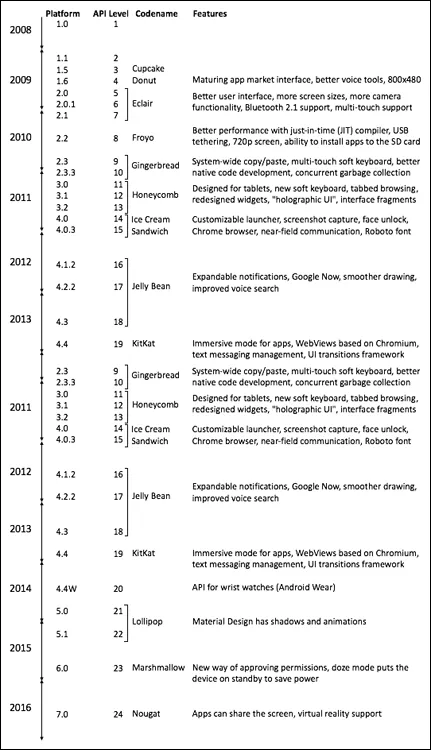
With that in mind, you can see a history of Android versions in Figure 1-1.
image
FIGURE 1-1: Versions of Android.
A few notes on Figure 1-1 are in order:
  • The platform number is of interest to the consumer and to the company that sells the hardware.
    If you’re buying a phone with Android 5.1, for example, you might want to know whether the vendor will upgrade your phone to Android 6.0.
  • The API level (also known as the SDK version) is of interest to the Android app developer.
    For example, the word MATCH_PARENT has a specific meaning in Android API Levels 8 and higher. You might type MATCH_PARENT in code that uses API Level 7. If you do (and...

Table of contents

  1. Cover
  2. Title Page
  3. Table of Contents
  4. Introduction
  5. Part 1: Getting Started with Java Programming for Android Developers
  6. Part 2: Writing Your Own Java Programs
  7. Part 3: Working with the Big Picture: Object-Oriented Programming
  8. Part 4: Powering Android with Java Code
  9. Part 5: The Part of Tens
  10. About the Author
  11. Advertisement Page
  12. Connect with Dummies
  13. End User License Agreement