Coding For Dummies
eBook - ePub

Coding For Dummies

  1. English
  2. ePUB (mobile friendly)
  3. Available on iOS & Android
eBook - ePub

Coding For Dummies

About this book

Coding For Dummies, (9781119293323) was previously published as Coding For Dummies, (9781118951309). While this version features a new Dummies cover and design, the content is the same as the prior release and should not be considered a new or updated product.


Hands-on exercises help you learn to code like a pro

No coding experience is required for Coding For Dummies, your one-stop guide to building a foundation of knowledge in writing computer code for web, application, and software development. It doesn't matter if you've dabbled in coding or never written a line of code, this book guides you through the basics. Using foundational web development languages like HTML, CSS, and JavaScript, it explains in plain English how coding works and why it's needed.

Online exercises developed by Codecademy, a leading online code training site, help hone coding skills and demonstrate results as you practice.

The site provides an environment where you can try out tutorials built into the text and see the actual output from your coding. You'll also gain access to end-of-chapter challenges to apply newly acquired skills to a less-defined assignment. So what are you waiting for?

  • The current demand for workers with coding and computer science skills far exceeds the supply
  • Teaches the foundations of web development languages in an easy-to-understand format
  • Offers unprecedented opportunities to practice basic coding languages
  • Readers can access online hands-on exercises and end-of-chapter assessments that develop and test their new-found skills

If you're a student looking for an introduction to the basic concepts of coding or a professional looking to add new skills, Coding For Dummies has you covered.

Frequently asked questions

Yes, you can cancel anytime from the Subscription tab in your account settings on the Perlego website. Your subscription will stay active until the end of your current billing period. Learn how to cancel your subscription.
No, books cannot be downloaded as external files, such as PDFs, for use outside of Perlego. However, you can download books within the Perlego app for offline reading on mobile or tablet. Learn more here.
Perlego offers two plans: Essential and Complete
  • Essential is ideal for learners and professionals who enjoy exploring a wide range of subjects. Access the Essential Library with 800,000+ trusted titles and best-sellers across business, personal growth, and the humanities. Includes unlimited reading time and Standard Read Aloud voice.
  • Complete: Perfect for advanced learners and researchers needing full, unrestricted access. Unlock 1.4M+ books across hundreds of subjects, including academic and specialized titles. The Complete Plan also includes advanced features like Premium Read Aloud and Research Assistant.
Both plans are available with monthly, semester, or annual billing cycles.
We are an online textbook subscription service, where you can get access to an entire online library for less than the price of a single book per month. With over 1 million books across 1000+ topics, we’ve got you covered! Learn more here.
Look out for the read-aloud symbol on your next book to see if you can listen to it. The read-aloud tool reads text aloud for you, highlighting the text as it is being read. You can pause it, speed it up and slow it down. Learn more here.
Yes! You can use the Perlego app on both iOS or Android devices to read anytime, anywhere — even offline. Perfect for commutes or when you’re on the go.
Please note we cannot support devices running on iOS 13 and Android 7 or earlier. Learn more about using the app.
Yes, you can access Coding For Dummies by Nikhil Abraham in PDF and/or ePUB format, as well as other popular books in Design & Certification Guides in Computer Science. We have over one million books available in our catalogue for you to explore.

Information

Part 1

Getting Started with Coding

IN THIS PART …
Understand what code is and what you can build with it.
Review programming languages used to write code.
Code for the web using front-end and back-end programming languages.
Follow the process programmers use to create code.
Write your first program using code.
Chapter 1

What Is Coding?

IN THIS CHAPTER
Seeing what code is and what it can do
Touring your first program using code
Understanding programming languages used to write code
“A million dollars isn’t cool, you know what’s cool? A billion dollars.”
— SEAN PARKER, THE SOCIAL NETWORK
Every week the newspapers report on another technology company that has raised capital or sold for millions of dollars. Sometimes, in the case of companies like Instagram, WhatsApp, and Uber, the amount in the headline is for billions of dollars. These articles may pique your curiosity, and you may want to see how code is used to build the applications that experience these financial outcomes. Alternatively, your interests may lie closer to work. Perhaps you work in an industry in decline, like print media, or in a function that technology is rapidly changing, like marketing. Whether you are thinking about switching to a new career or improving your current career, understanding computer programming or “coding” can help with your professional development. Finally, your interest may be more personal — perhaps you have an idea, a burning desire to create something, a website or an app, to solve a problem you have experienced, and you know reading and writing code is the first step to building your solution. Whatever your motivation, this book will shed light on coding and programmers, and help you think of both not as mysterious and complex but approachable and something you can do yourself.
In this chapter, you will understand what code is, what industries are affected by computer software, the different types of programming languages used to write code, and take a tour of a web app built with code.

Defining What Code Is

Computer code is not a cryptic activity reserved for geniuses and oracles. In fact, in a few minutes you will be writing some computer code yourself! Most computer code performs a range of tasks in our lives from the mundane to the extraordinary. Code runs our traffic lights and pedestrian signals, the elevators in our buildings, the cell phone towers that transmit our phone signals, and the space ships headed for outer space. We also interact with code on a more personal level, on our phones and computers, and usually to check email or the weather.

Following instructions

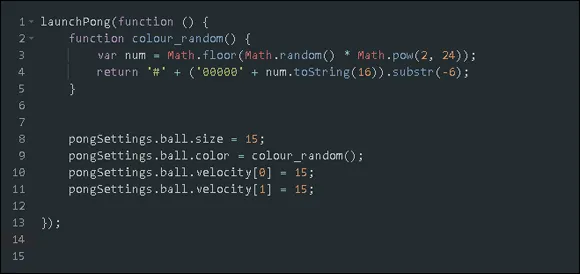
Computer code is a set of statements, like sentences in English, and each statement directs the computer to perform a single step or instruction. Each of these steps is very precise, and followed to the letter. For example, if you are in a restaurant and ask a waiter to direct you to the restroom, he might say, “head to the back, and try the middle door.” To a computer, these directions are so vague as to be unusable. Instead, if the waiter gave instructions to you as if you were a computer program he might say, “From this table, walk northeast for 40 paces. Then turn right 90 degrees, walk 5 paces, turn left 90 degrees, and walk 5 paces. Open the door directly in front of you, and enter the restroom.” Figure 1-1 shows lines of code from the popular game, Pong. Do not worry about trying to understand what every single line does, or feel intimated. You will soon be reading and writing your own code.
image
FIGURE 1-1: Computer code from the game Pong.
One rough way to measure a program’s complexity is to count its statements or lines of code. Basic applications like the Pong game have 5,000 lines of code, while more complex applications like Facebook currently have over 10 million lines of code. Whether few or many lines of code, the computer follows each instruction exactly and effortlessly, never tiring like the waiter might when asked for the 100th time for the location of the restroom.
tip
Be careful of only using lines of code as a measure for a program’s complexity. Just like when writing in English, 100 well written lines of code can perform the same functionality as 1,000 poorly written lines of code.

Writing code with some Angry Birds

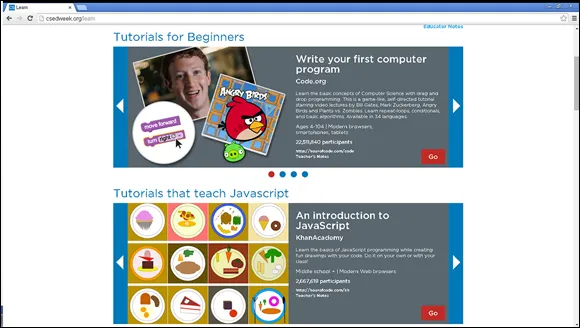
If you have never written code before, now is your chance to try! Go to http://csedweek.org/learn and under the heading “Tutorials for Beginners” click the “Write Your First Computer Program” link with the Angry Birds icon, as shown in Figure 1-2. This tutorial is meant for those with no previous computer programming experience, and introduces the basic building blocks used by all computer programs. The most important take-away from the tutorial is to understand that computer programs use code to literally and exactly tell the computer to execute a set of instructions.
image
FIGURE 1-2: Write your first computer program with a game-like tutorial using Angry Birds.
tip
Computer Science Education Week is an annual program dedicated to elevating the profile of computer science during one week in December. In the past, President Obama, Bill Gates, basketball player Chris Bosh, and singer Shakira, among others, have supported and encouraged people from the US and around the world to participate.

Understanding What Coding Can Do for You

Coding can be used to perform tasks and solve problems that you experience every day. The “everyday” situations in which programs or apps can provide assistance continues to grow at an exponential pace, but this was not always the case. The rise of web applications, internet connectivity, and mobile phones have inserted software programs into daily life, and lowered the barrier for you to become a creator, solving personal and professional problems with code.

Eating the world with software

In 2011, Marc Andreessen, creator of Netscape Navigator and now venture capitalist, noted that “software is eating the world.” He predicted that software companies would disrupt existing companies at a rapid pace. Traditionally, code powered software used on desktops and laptops. The software had to first be installed, and then you had to supply data to the program. Three trends have dramatically increased the use of code in everyday life:
  • Web-based software: This software operates in the browser without requiring installation. For example, if you wanted to check your email, you previously had to install an email client either by downloading the software or from a CD-ROM. Sometimes, issues arose when the software was not available for your operating system, or conflicted with your operating system version. Hotmail, a web-based email client, rose to popularity, in part, because it allowed users visiting www.hotmail.com to instantly check their email without worrying about installation or software compatibility. Web applications increased consumer appetite to try more applications, and developers in turn were incentivized to write more applications.
  • Internet broadband connectivity: Broadband connectivity has increased, providing a fast Internet connection to more people in the last few years than in the previous decade. Today, more than two billion people can access web-based software, up from approximately 50 million only a decade ago.
  • Mobile phones: Today’s smartphones bring programs with you wherever you go, and help supply data to programs. Many software programs became more useful when accessed on-the-go than when limited to a desktop computer. For instance, use of maps app...

Table of contents

  1. Cover
  2. Title Page
  3. Table of Contents
  4. Introduction
  5. Part 1: Getting Started with Coding
  6. Part 2: Building the Silent and Interactive Web Page
  7. Part 3: Putting Together a Web Application
  8. Part 4: Developing Your Coding Skills Further
  9. Part 5: The Part of Tens
  10. About the Author
  11. Advertisement Page
  12. Connect with Dummies
  13. End User License Agreement