Crumbling Genome
eBook - ePub

Crumbling Genome

The Impact of Deleterious Mutations on Humans

  1. English
  2. ePUB (mobile friendly)
  3. Available on iOS & Android
eBook - ePub

Crumbling Genome

The Impact of Deleterious Mutations on Humans

About this book

A thought-provoking exploration of deleterious mutations in the human genome and their effects on human health and wellbeing

Despite all of the elaborate mechanisms that a cell employs to handle its DNA with the utmost care, a newborn human carries about 100 new mutations, originated in their parents, about 10 of which are deleterious. A mutation replacing just one of the more than three billion nucleotides in the human genome may lead to synthesis of a dysfunctional protein, and this can be inconsistent with life or cause a tragic disease. Several percent of even young people suffer from diseases that are caused, exclusively or primarily, by pre]existing and new mutations in their genomes, including both a wide variety of genetically simple Mendelian diseases and diverse complex diseases such as birth anomalies, diabetes, and schizophrenia. Milder, but still substantial, negative effects of mutations are even more pervasive. As of now, we possess no means of reducing the rate at which mutations appear spontaneously. However, the recent flood of genomic data made possible by next-generation methods of DNA sequencing, enabled scientists to explore the impacts of deleterious mutations on humans with previously unattainable precision and begin to develop approaches to managing them.

Written by a leading researcher in the field of evolutionary genetics, Crumbling Genome reviews the current state of knowledge about deleterious mutations and their effects on humans for those in the biological sciences and medicine, as well as for readers with only a general scientific literacy and an interest in human genetics.

  • Provides an extensive introduction to the fundamentals of evolutionary genetics with an emphasis on mutation and selection
  • Discusses the effects of pre-existing and new mutations on human genotypes and phenotypes
  • Provides a comprehensive review of the current state of knowledge in the field and considers crucial unsolved problems
  • Explores key ethical, scientific, and social issues likely to become relevant in the near future as the modification of human germline genotypes becomes technically feasible

Crumbling Genome is must-reading for students and professionals in human genetics, genomics, bioinformatics, evolutionary biology, and biological anthropology. It is certain to have great appeal among all those with an interest in the links between genetics and evolution and how they are likely to influence the future of human health, medicine, and society.
Frequently asked questions

Yes, you can cancel anytime from the Subscription tab in your account settings on the Perlego website. Your subscription will stay active until the end of your current billing period. Learn how to cancel your subscription.
At the moment all of our mobile-responsive ePub books are available to download via the app. Most of our PDFs are also available to download and we're working on making the final remaining ones downloadable now. Learn more here.
Perlego offers two plans: Essential and Complete
  • Essential is ideal for learners and professionals who enjoy exploring a wide range of subjects. Access the Essential Library with 800,000+ trusted titles and best-sellers across business, personal growth, and the humanities. Includes unlimited reading time and Standard Read Aloud voice.
  • Complete: Perfect for advanced learners and researchers needing full, unrestricted access. Unlock 1.4M+ books across hundreds of subjects, including academic and specialized titles. The Complete Plan also includes advanced features like Premium Read Aloud and Research Assistant.
Both plans are available with monthly, semester, or annual billing cycles.
We are an online textbook subscription service, where you can get access to an entire online library for less than the price of a single book per month. With over 1 million books across 1000+ topics, we’ve got you covered! Learn more here.
Look out for the read-aloud symbol on your next book to see if you can listen to it. The read-aloud tool reads text aloud for you, highlighting the text as it is being read. You can pause it, speed it up and slow it down. Learn more here.
Yes! You can use the Perlego app on both iOS or Android devices to read anytime, anywhere — even offline. Perfect for commutes or when you’re on the go.
Please note we cannot support devices running on iOS 13 and Android 7 or earlier. Learn more about using the app.
Yes, you can access Crumbling Genome by Alexey S. Kondrashov in PDF and/or ePUB format, as well as other popular books in Biological Sciences & Evolution. We have over one million books available in our catalogue for you to explore.

Information

1
Genotypes and Phenotypes

I grew my own body… Nobody else did it for me. So
if I grew it, I must have known how to grow it.
Jerome D. Salinger, Teddy, 1953.
Hereditary information of a cell is stored in double‐stranded DNA molecules which, for a geneticist, are texts written in a four‐letter alphabet {A, T, G, C}. Recent technological advances have made it possible to efficiently read long DNA texts. Before dividing, a cell produces two copies of its hereditary information by DNA replication. From each parent, an individual human receives a haploid genotype, a 3.2‐billion‐letter‐long DNA text which is subdivided into 23 molecules, chromosomes. Also, tiny mitochondrial chromosomes are received from the mother only. The consensus of genotypes within a species is called the genome of the species. Some segments of the genome are transcribed into RNAs, and some segments of these RNAs are translated into proteins. Parental genotypes recombine in the course of meiosis, a form of cell division which halves the amount of DNA in a cell. In the course of sexual reproduction, a multicellular diploid organism develops from a single cell, zygote. Together with the environment, the genotype of the zygote determines the phenotype of the organism.

1.1 DNA is a Text

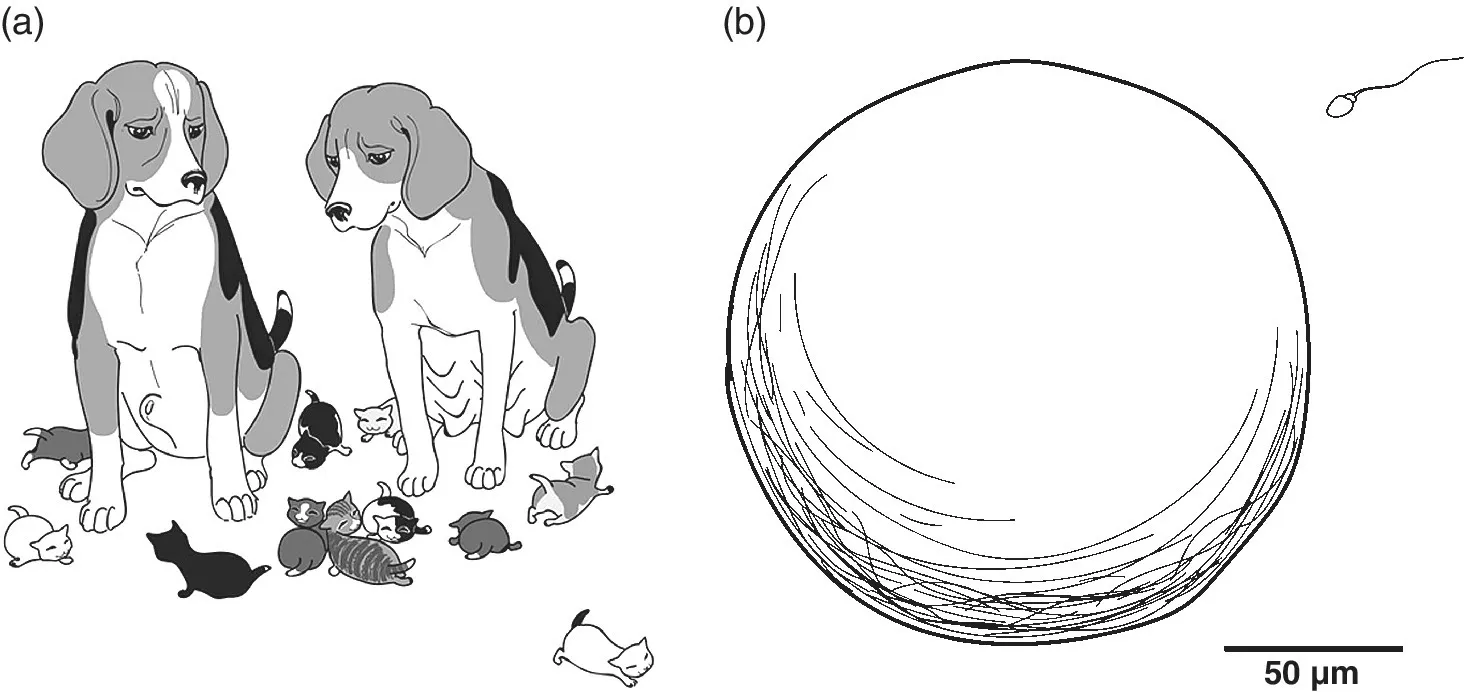
Inheritance is a salient phenomenon. Dogs beget dogs, and Beagles beget Beagles. Because an instruction on how to make a unique individual Beagle dog must be a lengthy one, there must be something, transmitted from parents to offspring, which carries an enormous amount of information. In the course of sexual reproduction, a multicellular organism develops from a single cell, called a zygote, which is produced by fertilization, fusion of two gametes, an egg and a sperm. A mammalian egg is just ~0.2 mm in diameter, and the head of a mammalian sperm is still much smaller, being only ~0.005 mm across. And yet even this tiny sperm is large enough for the job: mammals are about as similar to their fathers as to their mothers (Figure 1.1).
image
Figure 1.1 Phenomenon of heredity. (a) Mother and Father Beagle dogs stare with dismay at their kittens (joke). (b) A tiny mammalian sperm approaching an egg.
Thus, hereditary information must be packed at the molecular scale. Which molecule carries instructions from parents to offspring? In 1944, DNA emerged as a likely answer when it was shown that bacteria may acquire traits of other bacteria after ingesting their DNA. Then, in 1953, came the discovery, by Raymond Gosling, Rosalind Franklin, Maurice Wilkins, James Watson, and Francis Crick, of three properties of DNA which make it exquisitely suitable for storing and propagating information (Figure 1.2).
image
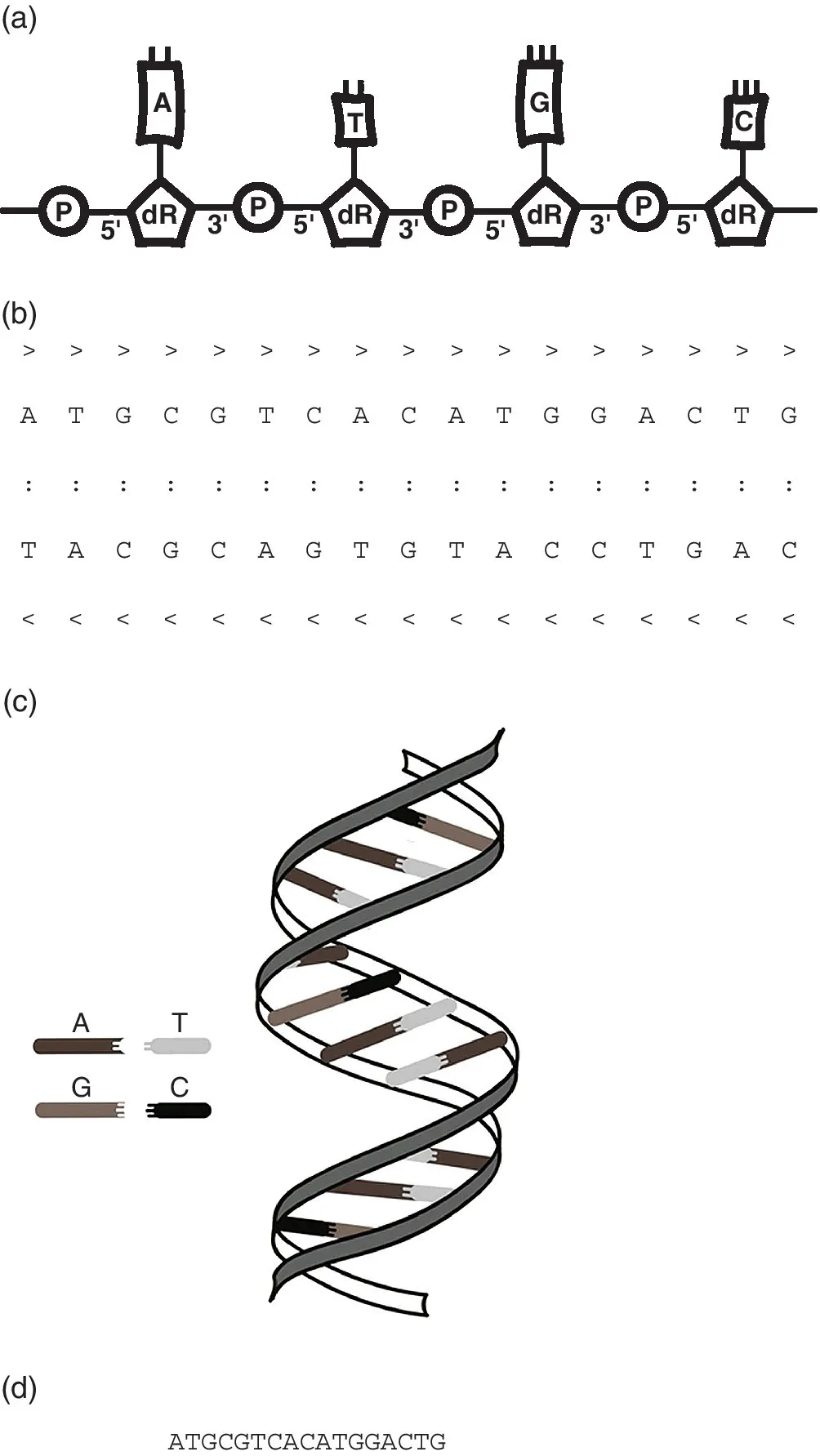
Figure 1.2 The fundamentals of DNA. (a) A single DNA strand with bases A, T, G, and C attached to it. P stands for a phosphate, and dR for a deoxyribose. (b) A scheme of double‐stranded DNA, consisting of two complementary strands (ā€œ>ā€ shows the 5' > 3' direction of a strand, and ā€œ:ā€ shows weak bounds connecting the two strands to each other). (c) A double‐stranded DNA shown in its actual shape of a right‐handed helix. (d) A double‐stranded DNA shown as a sequence of nucleotides in one of its strands, or a text written in a four‐letter alphabet. For a geneticist, this simplistic representation is usually enough.
First, DNA is a linear polymer. A strand of DNA consists of a regular alternation of phosphates (residues of phosphoric acid, H3PO4) and sugars called deoxyribose, to each of which one of the four possible bases (known as A, T, G, and C, for adenine, thymine, guanine, and cytosine) is attached at a side. A and G are bigger molecules, called purines, and T and C are smaller molecules, called pyrimidines. The only thing we care about in deoxyribose is that its two ends, by which it is attached to two adjacent phosphates, are different, and one is called 5' and the other 3' (both ā€œendsā€ of a phosphate are identical). All deoxyriboses within a DNA strand have the same orientation, which provides direction to the whole strand. Traditionally, a single DNA strand is shown in the 5' > 3' direction. Together, a phosphate, a deoxyribose, and a base are called a nucleotide, and nucleotides are denoted by the same letters as bases. Chemical details are not too important for a geneticist: I do not remember the exact structures of A, T, G, or C.
Secondly, there is no firm limit on the length of a DNA strand, which can consist of hundreds of millions of nucleotides. Moreover, there are also no restrictions on the order of nucleotides within a strand. Thus, if we think of a sequence of nucleotides as a text, written in a four‐letter alphabet {A, T, G, C}, any message (such as ACCATCATCGATGACT…) is chemically possible. A four‐letter ...

Table of contents

  1. Cover
  2. Title Page
  3. Table of Contents
  4. Preface
  5. 1 Genotypes and Phenotypes
  6. 2 Mendelian Inheritance and Population Genetics
  7. 3 Complex Traits and Their Inheritance
  8. 4 Unavoidable Mutation
  9. 5 Struggle for Fidelity
  10. 6 Mutation Rates
  11. 7 Natural Selection
  12. 8 Functioning DNA and Junk DNA
  13. 9 It Takes All the Running You Can Do
  14. 10 Phenomenon of Imperfection
  15. 11 Our Imperfect Fitness
  16. 12 Our Imperfect Wellness
  17. 13 Mutational Pressure on Our Species
  18. 14 Ethical Issues
  19. 15 What to Do?
  20. Index
  21. End User License Agreement