Laser Surgery in Veterinary Medicine
eBook - ePub

Laser Surgery in Veterinary Medicine

  1. English
  2. ePUB (mobile friendly)
  3. Available on iOS & Android
eBook - ePub

Laser Surgery in Veterinary Medicine

About this book

This book is a state-of-the-art reference to using surgical lasers to treat animal patients. Encompassing theory and practice, it emphasizes procedures, techniques, and equipment, with specific recommendations for laser settings.   While most of the procedures emphasize surgeries on dogs and cats, this practical guide also dedicates chapters to equine, small mammal, avian, aquatic animal, and reptile surgeries, making it an excellent clinical reference for any busy veterinarian. 

The book begins with background information on the theory and science of laser surgery, then details specific surgical procedures with step-by-step instructions and accompanying photographs. The next section provides practical guidance for incorporating lasers into the veterinary practice, and the final section offers a look at the future of lasers in veterinary medicine and surgery. A companion website features video clips of surgery procedures. 

  • Presents a state-of-the-art guide to using laser surgery in veterinary practice, from theory and procedures to techniques and equipment
  • Focuses on dogs and cats, including specialties such as ophthalmic laser surgery, laser neurosurgery, and photodynamic therapy, with chapters on equine, small mammal, avian, aquatic animal, and reptile surgeries
  • Draws on the experience of more than 20 experts in various areas
  • Provides practical advice for incorporating laser surgery into the veterinary practice, with the heart of the book devoted to specific surgical procedures
  • Includes specific recommendations for laser settings and techniques for the procedures discussed
  • Offers video clips demonstrating surgical techniques on a companion website 

Laser Surgery in Veterinary Medicine is an essential resource for anyone using surgical lasers in veterinary medicine, including veterinary students, practitioners, and specialists.
Frequently asked questions

Yes, you can cancel anytime from the Subscription tab in your account settings on the Perlego website. Your subscription will stay active until the end of your current billing period. Learn how to cancel your subscription.
At the moment all of our mobile-responsive ePub books are available to download via the app. Most of our PDFs are also available to download and we're working on making the final remaining ones downloadable now. Learn more here.
Perlego offers two plans: Essential and Complete
  • Essential is ideal for learners and professionals who enjoy exploring a wide range of subjects. Access the Essential Library with 800,000+ trusted titles and best-sellers across business, personal growth, and the humanities. Includes unlimited reading time and Standard Read Aloud voice.
  • Complete: Perfect for advanced learners and researchers needing full, unrestricted access. Unlock 1.4M+ books across hundreds of subjects, including academic and specialized titles. The Complete Plan also includes advanced features like Premium Read Aloud and Research Assistant.
Both plans are available with monthly, semester, or annual billing cycles.
We are an online textbook subscription service, where you can get access to an entire online library for less than the price of a single book per month. With over 1 million books across 1000+ topics, we’ve got you covered! Learn more here.
Look out for the read-aloud symbol on your next book to see if you can listen to it. The read-aloud tool reads text aloud for you, highlighting the text as it is being read. You can pause it, speed it up and slow it down. Learn more here.
Yes! You can use the Perlego app on both iOS or Android devices to read anytime, anywhere — even offline. Perfect for commutes or when you’re on the go.
Please note we cannot support devices running on iOS 13 and Android 7 or earlier. Learn more about using the app.
Yes, you can access Laser Surgery in Veterinary Medicine by Christopher J. Winkler in PDF and/or ePUB format, as well as other popular books in Medicine & Veterinary Medicine. We have over one million books available in our catalogue for you to explore.

Information

Year
2019
Print ISBN
9781119486015
eBook ISBN
9781119485988
Edition
1

Part I
The Science of Laser Surgery

1
Laser Physics and Equipment

Peter Vitruk

Introduction

This chapter covers the principles of laser physics to the extent and depth required to understand basic structure and function of a veterinary surgical laser and the process of generating laser light, followed by a discussion on equipment focusing on the practical aspects of CO2 lasers (the most commonly used surgical laser in veterinary surgery) while briefly reviewing other types of more specialized surgical lasers.

Creating Laser Light

Photons and Waves

According to the photon theory of light, light is made of particles called photons. A photon travels at the speed of light c; it carries a specific electromagnetic energy (E = hf, where h is Planck's constant and f is the photon's frequency); and it has a momentum, or spin, that defines its polarization. The photon theory of light took its origin from the efforts of Max Planck to properly explain the spectrum of blackbody radiation; it remains an important part of Quantum Mechanics, which explains the properties of light and matter on the microscopic scale.
According to the wave theory of light, light travels in a wave at the speed of light c, just as in photon theory. Such a wave is made of both electric and magnetic waves oscillating at frequency f (also just as in photon theory). The orientation of the electrical field defines the wave's polarization. The wave theory of light is an important concept in many branches of physics from optics to electromagnetism. Quantum electrodynamics (QED) is the theory that combines both photon and wave theories of light together.
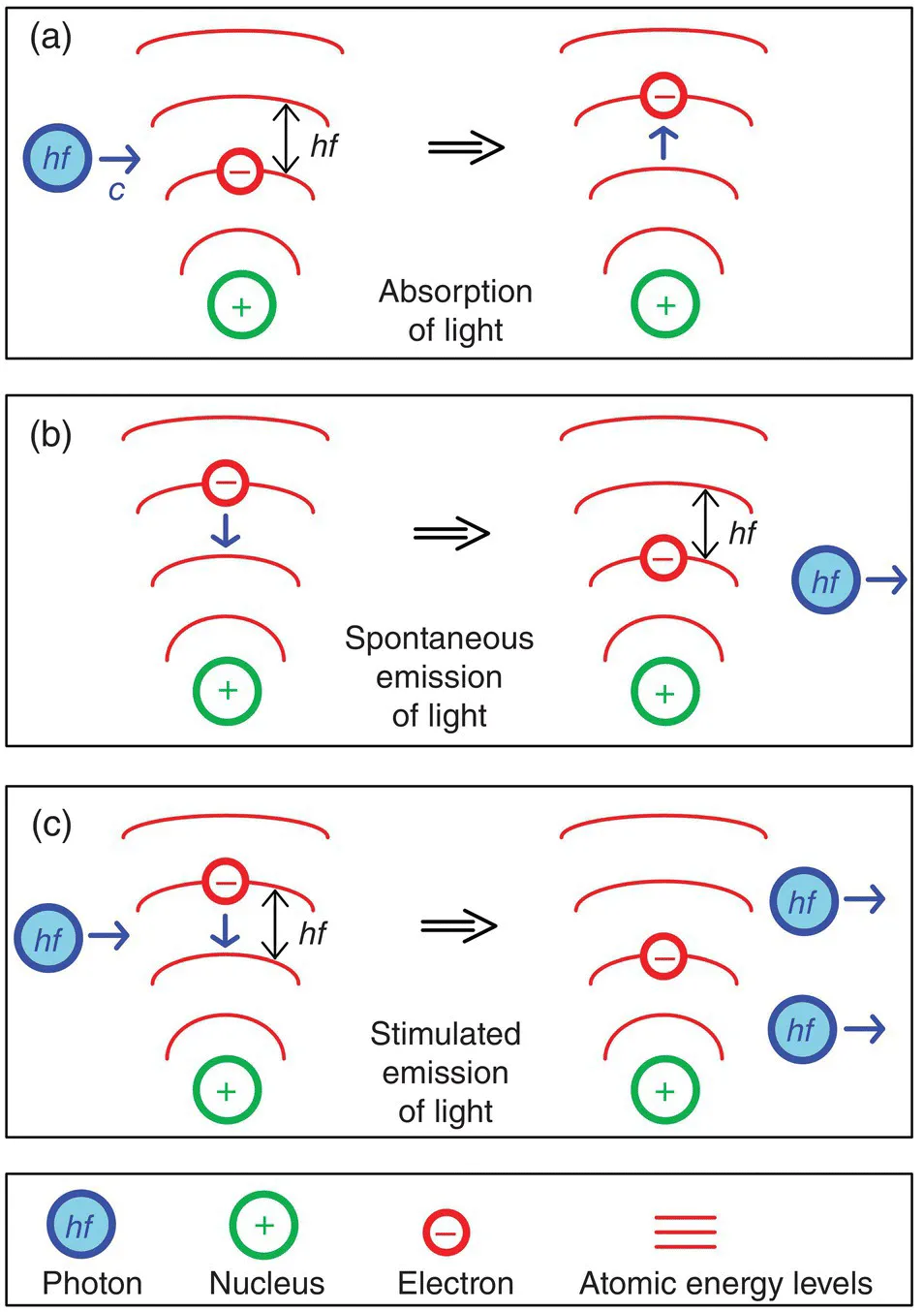
When considering the principles of lasers and processes involved in generating laser light, it is useful to think of light in terms of photons, emitted or absorbed when atoms or molecules of the active medium inside the laser change their atomic or molecular energy states. For instance, if an electron of an atom having its two energy states separated by hf, is impacted by a photon of energy hf, and the photon is absorbed by the atom, the electron will undergo an energy change from a lower state to a higher state (Figure 1.1a).
Schematics illustrating absorption (a), spontaneous emission (b), and stimulated emission (c) of light by an atom. At the bottom are symbols of photon, nucleus, electron, and atomic energy levels.
Figure 1.1 Absorption (a), spontaneous emission (b), and stimulated emission (c) of light by an atom.
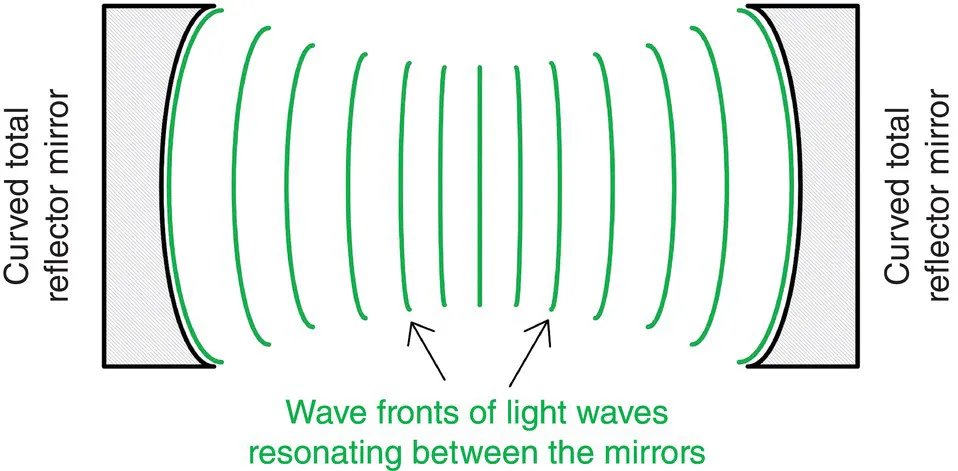
At the same time, when considering the optical properties of the laser apparatus known as the optical resonator, it is most helpful to think of light in terms of waves. For instance, consider the shape of the resonator mirror that matches the shape of the laser beam's wave front reflected from the mirror surface (Figure 1.2). Such a light wave with an extended curved wavefront is the result of a superimposition of many individual synchronized photons of the same frequency.
Image described by caption and surrounding text.
Figure 1.2 Laser resonator mode having its wavefront matching the shape of the resonator mirrors.

Absorption, Spontaneous Emission, and Stimulated Emission

An atom or molecule that has absorbed a photon and entered a higher energy state (Figure 1.1a), will undergo an energy transition to a lower energy state while emitting a photon with energy equal to the difference between the two states (Figure 1.1b). This is known as spontaneous emission, the source of natural light.
In addition to light absorption and spontaneous emission, a third way light interacts with matter is also possible, and was first described by Albert Einstein (Siegman 1986; Verdeyen 1989; Saleh and Teich 1991; Endo and Walter 2007). If the energy of a photon matches the difference between the two states, and the electron is in the higher of the two states, then the incoming photon will trigger the electron to jump to a lower energy state while an identical photon will be emitted in the same direction as the original incoming photon (Figure 1.1c). Such emission of light is referred to as stimulated emission.

Active Medium and Excitation (Pumping) Mechanism

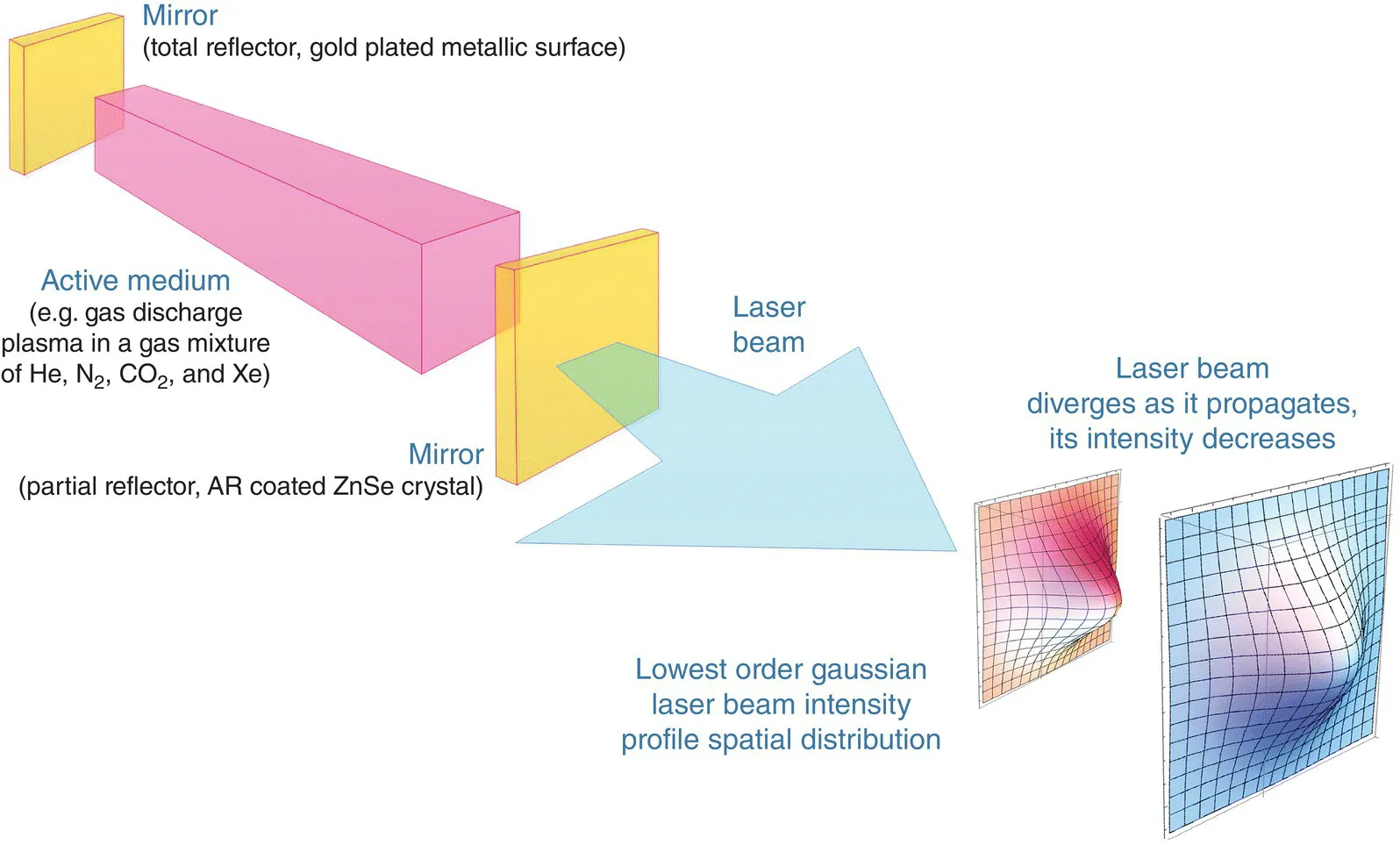
A working laser requires two critical components: an active medium (a medium of atoms or molecules in high energy states, such as carbon dioxide gas in a CO2 laser) and an optical resonator. The high‐energy states of an active medium can be created through a variety of mechanisms, such as energizing atoms or molecules optically (optical pumping), or electrically. Figure 1.3 illustrates an active medium placed between two mirrors that form an optical resonator.
Image described by caption and surrounding text.
Figure 1.3 Laser resonator and an active medium producing a monochromatic, coherent, collimated laser beam exiting through the partially reflective resonator mirror. The lowest‐order resonator mode is bell‐shaped (Gaussian beam intensity profile). As it propagates away from the resonator, the laser beam diverges.

Optical Resonator

An optical resonator typically consists of two mirrors, one a total reflector (often concave), and the other partially reflective and partially transmissive. The transmissivity of the partial reflector represents the resonator loss of laser light, and for many practical lasers, the loss is designed to match the amplification of light as it takes a round trip through the active medium (Figure 1.3). The length of the resonator apparatus is inversely proportional to how strong the amplification (or gain) is for any particular type of laser. Weak gain lasers, such as surgical CO2 gas lasers or ophthalmic excimer gas lasers, require an active medium of relatively long length. Strong gain lasers, such as solid‐state erbium or semic...

Table of contents

  1. Cover
  2. Table of Contents
  3. Dedication and Acknowledgments
  4. About the Editor
  5. Foreword
  6. Preface
  7. List of Contributors
  8. Disclaimer
  9. About the Companion Website
  10. Part I: The Science of Laser Surgery
  11. Part II: Laser Surgery in Canines and Felines
  12. Part III: Laser Surgery in Equines
  13. Part IV: Laser Surgery in Exotics Species
  14. Part V: Integrating Surgical Lasers in Your Veterinary Practice
  15. Part VI: The Future of Lasers in Veterinary Medicine and Surgery
  16. Appendix A: Glossary
  17. Appendix B: Certifying and Academic Laser Organizations
  18. Appendix C: Tables of Laser Settings
  19. Index
  20. End User License Agreement