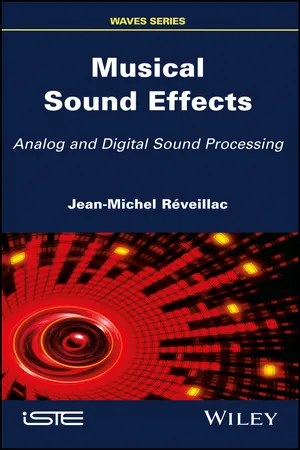
- English
- ePUB (mobile friendly)
- Available on iOS & Android
eBook - ePub
About this book
For decades performers, instrumentalists, composers, technicians and sound engineers continue to manipulate sound material. They are trying with more or less success to create, to innovate, improve, enhance, restore or modify the musical message. The sound of distorted guitar of Jimi Hendrix, Pierre Henry's concrete music, Pink Flyod's rock psychedelic, Kraftwerk 's electronic music, Daft Punk and rap T-Pain, have let emerge many effects: reverb, compression, distortion, auto-tune, filter, chorus, phasing, etc. The aim of this book is to introduce and explain these effects and sound treatments by addressing their theoretical and practical aspects.
Information
1
Notes on the Theory of Sound
This chapter presents concepts that are indispensable to understanding and studying the phenomena associated with sound. In this study, readers can find the details required to discuss the variety of ways that exist to process sounds.
Mathematical equations are deliberately presented in their simplest and purest forms, without going into detail and avoiding any mathematical proofs. However, the standards of scientific rigor to which all physical sciences are committed have not been lost.
1.1. Basic concepts
We shall begin by describing the nature of a sound, followed by a few of its characteristics, before turning to the question of how our ears work. This leads into an analysis of the typology of sounds, spectral analysis and timbre.
To conclude, we will present the fundamental aspects of the propagation of sound, and we will consider a few common phenomena to be explored in more detail in subsequent chapters.
1.1.1. What is sound?
Although this question might seem simple, the answer is by no means easy. There are two ways to approach this topic: from a purely scientific perspective, working from the laws of physics, or alternatively by thinking about how our senses allow us to perceive sound.
Physicists view sound as a mechanical wave that propagates as a perturbation within an elastic medium or object. In other words, they view sound as the forward-and-backward motion (mechanical oscillation) of particles around their resting position. Electromagnetic waves, on the other hand, propagate as energy in the form of an electric field coupled to a magnetic field.

Figure 1.1. A simple example of a mechanical wave. Here, the wave is created on the surface of the water after a stone is thrown in
Many people will find it easier to define sounds as auditory sensations.
Sounds are produced by vibrating objects. These objects are sources, and the environment in which the sound is emitted carries the sound to our ears. When a sound reaches our ears, our brains allow us to perceive it, become aware of it and interpret it.
Most of the objects around us can produce sounds when they interact with shocks, friction, airflows or deformations. Who has not entertained themselves by twanging a plastic ruler at the edge of a table?

Figure 1.2. Vibrating ruler at the edge of a table
Sound cannot propagate in a vacuum, since there is no medium to convey the vibration.
Like all physical phenomena, sounds can be characterized. We can use parameters such as the intensity, the pitch and the timbre to define and distinguish different sounds. Other parameters are possible too – people interpret sounds as they hear them. This involves subjective phenomena, so-called psychoacoustic phenomena, which depend on the physiology, culture and ethnicity of the individuals receiving the sound message. This approach to decrypting the process of sound characterization is highly complex. We will quickly encounter questions to which science has not yet been able to provide comprehensive answers.
Over the centuries, philosophers have often wondered: does a sound exist if no one is there to hear it?
The field of science that studies the physics of sound phenomena is know...
Table of contents
- Cover
- Table of Contents
- Title
- Copyright
- Foreword
- About this Book
- Introduction
- 1 Notes on the Theory of Sound
- 2 Audio Playback
- 3 Types of Effect
- 4 Filtering Effects
- 5 Modulation Effects
- 6 Frequency Effects
- 7 Dynamic Effects
- 8 Time Effects
- 9 Unclassifiables
- Conclusion
- Appendices
- Glossary
- Bibliography
- Index
- End User License Agreement
Trusted by 375,005 students
Access to over 1.5 million titles for a fair monthly price.
Study more efficiently using our study tools.
Frequently asked questions
Yes, you can cancel anytime from the Subscription tab in your account settings on the Perlego website. Your subscription will stay active until the end of your current billing period. Learn how to cancel your subscription
No, books cannot be downloaded as external files, such as PDFs, for use outside of Perlego. However, you can download books within the Perlego app for offline reading on mobile or tablet. Learn how to download books offline
Perlego offers two plans: Essential and Complete
- Essential is ideal for learners and professionals who enjoy exploring a wide range of subjects. Access the Essential Library with 800,000+ trusted titles and best-sellers across business, personal growth, and the humanities. Includes unlimited reading time and Standard Read Aloud voice.
- Complete: Perfect for advanced learners and researchers needing full, unrestricted access. Unlock 1.5M+ books across hundreds of subjects, including academic and specialized titles. The Complete Plan also includes advanced features like Premium Read Aloud and Research Assistant.
We are an online textbook subscription service, where you can get access to an entire online library for less than the price of a single book per month. With over 1.5 million books across 990+ topics, we’ve got you covered! Learn about our mission
Look out for the read-aloud symbol on your next book to see if you can listen to it. The read-aloud tool reads text aloud for you, highlighting the text as it is being read. You can pause it, speed it up and slow it down. Learn more about Read Aloud
Yes! You can use the Perlego app on both iOS and Android devices to read anytime, anywhere — even offline. Perfect for commutes or when you’re on the go.
Please note we cannot support devices running on iOS 13 and Android 7 or earlier. Learn more about using the app
Please note we cannot support devices running on iOS 13 and Android 7 or earlier. Learn more about using the app
Yes, you can access Musical Sound Effects by Jean-Michel Réveillac in PDF and/or ePUB format, as well as other popular books in Technology & Engineering & Electrical Engineering & Telecommunications. We have over 1.5 million books available in our catalogue for you to explore.