- English
- ePUB (mobile friendly)
- Available on iOS & Android
About this book
Presents the latest strategies in the development and use of composite materials for large structures and the effects of defects
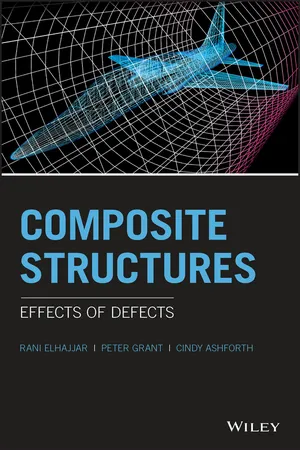
Practical Design and Validation of Composites Structures: Effects of Defects offers an important guide to the use of fiber-reinforced composites and how they affect the durability and safety of engineering structures such as aircraft, ships, bridges, wind turbines as well as sporting equipment. The text draws on the authors' direct experience in industry and academia to cover the most recent strategies in the development of composite structures and uniquely integrates the assessment of the effects of defects introduced during production.
This comprehensive resource builds on an essential introduction to the characteristics of composites and the most common types of defects encountered in production. The authors review the recent manufacturing methods and technologies used for inspecting composite structures and the design issues related to an analysis of their failure and strength incorporating the variability of processing. The text also contains information on the latest regulatory requirements and the relevant standards associated with the testing and design within a robust design philosophy and approach. This important resource:
- Offers a comprehensive review of the most current regulatory developments in the use of composites for the construction of complex composite structures
- Presents information on the basic characteristics of composites
- Includes testing strategies for determining the impacts of production defects
- Reviews the most current manufacturing methods and inspection technologies in the field
- Contains methods for statistical analysis and processing of experimental effects of defects test data
Written for professional engineers in mechanical engineering, automotive engineering, aerospace engineering, civil engineering, and energy engineering as well as industry and academic researchers, Practical Design and Validation of Composites Structures: Effects of Defects is the hands-on text that covers the essential information needed to understand the use of composites and how they affect complex engineering projects using composites.
Trusted by 375,005 students
Access to over 1 million titles for a fair monthly price.
Study more efficiently using our study tools.
Information
1
Characteristics of Composites
1.1. Introduction to Behavior
- Composites are notch sensitive, but they shouldn't be considered “brittle.” Cracks, holes, and other notch geometries that cause a stress concentration will reduce tension, compression, and shear strength. Matrix‐dominated damage types, such as delamination, can grow after development of a “sharp crack,” assuming out‐of‐plane loads can sustain growth.
- Composites are dimensionally stable in‐plane, but out‐of‐plane/through‐thickness loads are important because composites are generally anisotropic with the lowest strength coming in out‐of‐plane tension and shear. The very low thermal expansion can lead to significant residual stresses when composites are combined with metals in hybrid structure. Residual stresses can also occur in the composite in service or during the cure process due the different coefficients of expansion between the fiber and matrix.
- Composite structures will generally have competing failure modes that will be a function of specific part geometry and may vary with environment.
- Composites are more sensitive to environmental effects and overheating. Most composite matrices absorb moisture in a diffusion process that adds weight. Tension, compression, and shear strength can all be affected by temperature and moisture content.
- Composites typically exhibit flat S‐N curves if defects are not present.
- Composite structure must be characterized as a function of laminate layup, materials, thickness, process variables, and individual part geometry.
| Metal structure | Composite structure |
| Tensile residual strength is affected by cracks (compression response is typically not). | Tensile and compressive strength are affected by stress concentrations. |
| Yielding to minimize the effects of small holes and design details that cause stress concentration. | Localized bearing failure in reaction to small damage, holes, and design details that cause stress concentrations. |
| Net section analysis may be used to size static strength for the presence of holes. | Semi‐empirical methods or advanced analyses needed to size composite structure with stress concentrations. |
| Not sized for static strength with cracks or “manufacturing defects.” | Static strength sizing with acceptable damage and manufacturing defects. |
1.2. Introduction to Composite Analysis


Table of contents
- Cover
- Table of Contents
- Preface
- Chapter 1: Characteristics of Composites
- Chapter 2: Design Methodology and Regulatory Requirements
- Chapter 3: Material, Manufacturing, and Service Defects
- Chapter 4: Inspection Methods
- Chapter 5: Effects of Defects – Design Values and Statistical Considerations
- Chapter 6: Selected Case Studies in Effects of Defects
- Glossary
- Index
- End User License Agreement
Frequently asked questions
- Essential is ideal for learners and professionals who enjoy exploring a wide range of subjects. Access the Essential Library with 800,000+ trusted titles and best-sellers across business, personal growth, and the humanities. Includes unlimited reading time and Standard Read Aloud voice.
- Complete: Perfect for advanced learners and researchers needing full, unrestricted access. Unlock 1.4M+ books across hundreds of subjects, including academic and specialized titles. The Complete Plan also includes advanced features like Premium Read Aloud and Research Assistant.
Please note we cannot support devices running on iOS 13 and Android 7 or earlier. Learn more about using the app