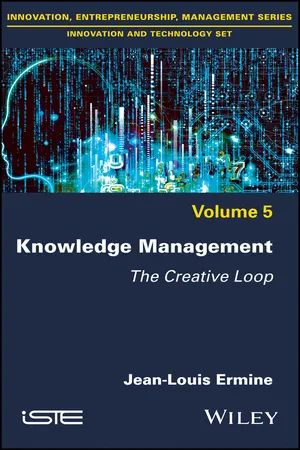
Knowledge management is a strategic issue for companies, and international standards such as ISO recently integrate it into its requirements. However, it is still an ill-defined concept, and methodologies to implement it are not very well known. This book is the result of over twenty years of research in different labs and application in a wide range of public or private companies around the world. It gives a global and coherent view both from the theoretical and practical point of views.
- English
- ePUB (mobile friendly)
- Available on iOS & Android
eBook - ePub
About this book
Information
PART 1
Theoretical Elements
1
A Knowledge Value Chain
1.1. Introduction
This chapter introduces the notion of knowledge through the concept of a value chain.
Its purpose is to clarify the relationships between the concepts of data, information, knowledge and skill, by relying on the abundant literature that has been written on these subjects. All of these concepts, which are rarely formalized and often conflated, are related and dependent, and they need to be better defined. In this chapter, this clarification results in a guidance tool to help managers understand the added value produced by knowledge and act to develop this resource.
In the “knowledge economy” [FOR 09], knowledge is viewed as a resource that is a key factor in success and the basis for a company’s competitive advantage. The objective of knowledge management (KM) is to optimize this new resource. It is therefore important to analyze the added value that KM can bring to a company. This is a difficult problem to address. For example, cost/benefit analyses for KM have never really been completed successfully. The approach proposed here is not based on the unpromising cost analysis, but on the value analysis. It is based on the nature of knowledge and its use in a company. We will see that knowledge is the result of closed-loop, continuous and simultaneous transformations within a company. We can, however, distinguish several formal transformation steps that are known as the knowledge value chain (KVC) [ERM 12]. This value chain is conceptual and does not presume any complexity in its implementation within a company. It is very useful for managers to locate potential sources of value of KM. The objective of the KVC is to provide an analysis and action framework that will make it possible to act on this value chain and thereby improve the company’s performance.
1.2. Different KVCs
The value chain is a management concept that was developed and popularized by Michael Porter [POR 85]. A value chain is a chain of production activities in a company, from the input to the end user. The products or services pass successively through all of the activities in the chain and, with each step, the products and services acquire value. A value chain is a breakdown of a company’s approach into activities that produce value. These components are the basic elements on which a company relies to create a product or provide a valuable service for their customers. The activity chain confers more added value to the products or services than the sum of the values added by each activity.
Identifying the value generated through this chain is the approach chosen by top management. The differences between the value chains of competitors are the key factors of competitiveness. In terms of competitiveness, the value is what customers are willing to pay for what the company provides them. A company is profitable if the value that it generates is greater than the costs to create the product or the service. Creating such a value is the goal of all competitive strategy. The value, instead of the cost, must be used to analyze competitive standing. The value chain characterizes the generic activities that add value to a company: the “primary activities” including logistics, production, marketing and sales and services; and the “secondary activities” including infrastructure, human resources management, R&D and supply. The vectors of cost and value are identified for each activity.
Classic value chains do not include knowledge, although it is now seen as a company’s most important strategic resource [DAV 98, DRU 93, HAL 93, STA 92]. The value incorporated in products or services is essentially due to the development of resources derived from organizational knowledge [QUI 92]. In fact, a company’s ability to produce can be considered to be the integration and application of specialized knowledge collectively generated by the individuals in the company [GRA 91].
Consequently, the notion of value is not directed by the customer, as in Porter’s chain, but by the incorporation of knowledge in products or services in the company’s production process. This raises the question of defining more precisely what this “cognitive resource” is and how it is incorporated into the activity of a company. The goal of KM is to manage this resource integration in the company’s process. KM is a fairly new perspective on companies. Its philosophy, which must still be strengthened of course, is that a company produces value for its customers when it best manages the incorporation of its cognitive resources in its products and services. Thus, very simply, KM supposes that the production of knowledge implies the production of value. KM is interested in knowledge as a strategic resource that optimizes the production processes of a company.
To support the success of KM, it is useful to analyze the chain of knowledge integration in a company in order to identify and manage the different fundamental stages of enrichment for this cognitive resource and its incorporation into company activities. This is the KVC, viewed from a global point of view in a company.
The definition of a KVC based on a financial analysis of performance is problematic [CHO 00, MPH 94]. The competence-based view business theory offers an alternative approach. This theory considers the company as a portfolio of competences. Its competitiveness is based on the creation and development of competences and on its realization of a strategy capable of creating a link between goals, resources and objectives [PRA 90]. These competences have a cognitive nature, and this allows managers to identify the basic processes, like knowledge creation and organizational learning [LEO 95, NEL 91, PRA 90]. Carlucci et al. [CAR 04, p. 579] assert that the cognitive perspective of competence can be summarized by the interpretation that defines the competence of a company as a combination of knowledge assets, which make up what is called the company’s knowledge capital, and knowledge processes, which allow a company to successfully complete its operational processes. This provides a foundation for the definition of a KVC.
Following the considerable development of KM in the past few years, the concept of the KVC appeared and was recently debated. The authors [CAR 04, EUS 03, HOL 01, LEE 00, WAN 05] define a KVC as a set of KM processes. A KVC is therefore a KM framework organizing the basic KM processes, such as the knowledge process wheel described in Carlucci et al. [CAR 04]. The main processes in these different KVCs are as follows:
- – knowledge creation: this is definitely the most important process, because it creates knowledge capital, the purpose of all knowledge-based companies;
- – knowledge codification: this process concerns the appropriation of tacit knowledge, which is a very complex problem;
- – knowledge sharing: once a knowledge corpus is identified and a knowledge repository is elaborated, sharing this knowledge in a community is not really a standard task. This requires a lot of effort starting from the construction of the appropriate community to the...
Table of contents
- Cover
- Table of Contents
- Title
- Copyright
- Preface
- PART 1: Theoretical Elements
- PART 2: Practical Elements
- Bibliography
- Index
- End User License Agreement
Trusted by 375,005 students
Access to over 1.5 million titles for a fair monthly price.
Study more efficiently using our study tools.
Frequently asked questions
Yes, you can cancel anytime from the Subscription tab in your account settings on the Perlego website. Your subscription will stay active until the end of your current billing period. Learn how to cancel your subscription
No, books cannot be downloaded as external files, such as PDFs, for use outside of Perlego. However, you can download books within the Perlego app for offline reading on mobile or tablet. Learn how to download books offline
We are an online textbook subscription service, where you can get access to an entire online library for less than the price of a single book per month. With over 1.5 million books across 990+ topics, we’ve got you covered! Learn about our mission
Look out for the read-aloud symbol on your next book to see if you can listen to it. The read-aloud tool reads text aloud for you, highlighting the text as it is being read. You can pause it, speed it up and slow it down. Learn more about Read Aloud
Yes! You can use the Perlego app on both iOS and Android devices to read anytime, anywhere — even offline. Perfect for commutes or when you’re on the go.
Please note we cannot support devices running on iOS 13 and Android 7 or earlier. Learn more about using the app
Please note we cannot support devices running on iOS 13 and Android 7 or earlier. Learn more about using the app
Yes, you can access Knowledge Management by Jean-Louis Ermine in PDF and/or ePUB format, as well as other popular books in Business & Management. We have over 1.5 million books available in our catalogue for you to explore.