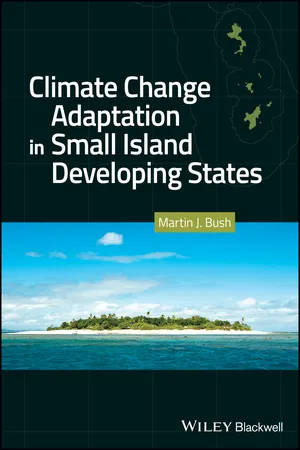
A groundbreaking synthesis of climate change adaptation strategies for small island states, globally
A wide ranging, comprehensive, and multi-disciplinary study, this is the first book that focuses on the challenges posed by climate change impacts on the Small Island Developing States (SIDS). While most of the current literature on the subject deals with specific regions, this book analyses the impacts of climate change across the Caribbean, the Pacific Ocean, and the African and Indian Ocean regions in order to identify and tackle the real issues faced by all the small island States.
As the global effects of climate change become increasingly evident and urgent, it is clear that the impact on small islands is going to be particularly severe. These island countries are especially vulnerable to rising sea levels, hurricanes and cyclones, frequent droughts, and the disruption of agriculture, fisheries and vital ecosystems. On many small islands, the migration of vulnerable communities to higher ground has already begun. Food security is an increasingly pressing issue. Hundreds of thousands of islanders are at risk. Marine ecosystems are threatened by acidification and higher seawater temperatures leading to increased pressure on fisheries—still an important source of food for many island communities.
The small island developing States emit only small amounts of carbon dioxide and other greenhouse gases. Yet many SIDS governments are allocating scarce financial and human resources in an effort to further reduce their emissions. This is a mistake.
Rather than focus on mitigation (i.e., the reduction of greenhouse gas emissions) Climate Change Adaptation in Small Island Developing States concentrates on adaptation. The author assesses the immediate and future impacts of climate change on small islands, and identifies a range of proven, cost-effective adaptation strategies. The book:
Focuses on the challenges of climate change faced by all of the world's small island developing States;
Provides comprehensive coverage of the latest research into the most likely environment impacts;
Uses numerous case studies to describe proven, practical, and cost-effective policies, including disaster management strategies—which can be developed and implemented by the SIDS;
Takes a unique, multidisciplinary approach, making it of particular interest to specialists in a variety of disciplines, including both earth sciences and life sciences.
This book is a valuable resource for all professionals and students studying climate change and its impacts. It is also essential reading for government officials and the ministries of the 51 small island developing States, as well as the signatories to the 2015 Paris climate agreement.
This introductory chapter outlines and summarizes the latest information and data about the Earth’s changing climate. It relies to a large extent on the fifth Assessment Report of the Intergovernmental Panel on Climate Change – the IPCC, the international scientific agency that reports every four or five years on climate change. But the chapter also integrates much of the most recent information on the impact of climate change, some of which suggests that the IPCC underestimates the threat to human welfare across the globe. The aim of the chapter is to look at the big picture in terms of the global impact of climate change. In subsequent chapters we will look at the impact of climate change on the different sectors of a country’s economy, and then specifically how climate change is an increasingly dangerous threat for Small Island Developing States (SIDS), and what measures can be taken to reduce the level of that threat.
The scientific evidence that human activity has influenced the climate system is overwhelming. The climate is changing and in ways that have never before been experienced in human history. The atmosphere and the oceans are warmer, continental areas of snow and ice have diminished, and sea‐levels have risen. These are well‐established scientific facts. Reliable climate data show that each of the last three decades has been successively warmer at the surface of the Earth than any preceding decade since measurements began over 150 years ago.
The evidence shows that the three decades before 2012 were the warmest period over several centuries in the northern hemisphere, and quite possibly the warmest period in more than a thousand years. Data measured by NASA and NOAA confirmed that 2014, and then 2015, were the hottest years on record. Then 2016 broke those records again. The year 2016 was the warmest on record in all the major global surface temperature datasets (NASA, 2015a; WMO, 2017).
The cryosphere is undergoing a huge transition: snow cover, sea ice, lake and river ice, glaciers, ice caps and ice sheets, permafrost and seasonally frozen ground, are all thawing and melting. Glaciers are melting almost everywhere and have contributed to sea‐level rise throughout the twentieth century. The rate of ice loss from the Greenland ice sheet has substantially increased over the last 20 years. Melting from the Antarctic ice sheet, mainly from the northern Antarctic peninsula and the Amundsen Sea sector of West Antarctica, has also increased. The extent of Arctic sea ice has decreased in every season, with the most rapid decrease taking place every summer. The trend continued in 2017 with the extent of the sea ice at both poles dropping to record levels. Never before in the satellite records has the area of sea ice at the north and south poles simultaneously fallen so dramatically. The summer Arctic sea ice minimum is decreasing by about 10–13% per decade – a figure that translates to around one million km2 each decade.
Snow cover has decreased in the northern hemisphere since the middle of the last century. In addition, because of the higher surface temperatures and changing snow cover, permafrost temperatures have increased in the northern hemisphere with commensurate reductions in thickness and area.
Figure 1.1 shows the trend in global mean temperatures since 1880 (NASA, 2015b).
Figure 1.1 Global mean temperature changes based on land and ocean data since 1880.
Source: Courtesy of NASA (2015b), http://data.giss.nasa.gov/gistemp/graphs/.
More than 90% of the thermal energy accumulated in the climate system over the last couple of decades has been absorbed and stored in the oceans. Only about 1% of this heat is held in the atmosphere.
Tracking ocean temperatures and the associated changes in ocean heat content allows scientists to monitor variations in the Earth’s energy imbalance. Ocean waters are getting warmer: the effect is greatest near the surface, and the upper 75 metres have been warming by over 0.1 °C per decade (IPCC, 2014a). But not only warmer: many large geographical areas of ocean water are becoming more saline as evaporation increases due to the higher surface temperatures. In contrast, other ocean areas, where precipitation is the dominant water cycle mechanism, may have become less saline.
These regional and differing trends in ocean salinity provide indirect evidence for widespread changes in evaporation and precipitation over the oceans, and by extension in the global hydrological cycle. These changes have major implications for rainfall patterns and intensities worldwide, and also for global patterns of ocean water circulation. As the lower atmosphere becomes warmer, evaporation rates increase, resulting in an increase in the amount of water vapour circulating throughout the troposphere. A consequence of this phenomenon is an increased frequency of intense rainfall events, mainly over land areas. In addition, because of warmer temperatures, more precipitation is falling as rain rather than snow – which has consequences for regional patterns of spring runoff.
As the oceans warm they expand, resulting in both global and regional sea‐level rise. The increased heat content of the oceans accounts for as much as 40% of the observed global sea‐level rise over the past 60 years.
The slow but steady change in the global water cycle has also had an impact on sea‐levels worldwide. Over the last century, global mean sea‐level rose by about 0.2 metres. The rate of sea‐level rise is also increasing: the rate now is greater than at any time during the last two millennia. NASA satellites have shown that sea‐levels are now rising at about 3 mm a year: a total of more than 50 mm between 1993 and 2010 (NASA, 2015c).
Some regions experience greater sea‐level rise than others. The tropical western Pacific saw some of the highest rising sea‐level rates over the period 1993–2015 – which became a significant factor in the extensive devastation of areas of the Philippines when typhoon Haiyan generated a massive storm surge in November 2013 (WMO, 2017).
The absorption of carbon dioxide (CO2) by ocean seawater, driven by higher atmospheric concentrations of the gas, has resulted in an increase in the acidity of the oceans. The acidity (pH) of ocean surface water has decreased by 0.1, which corresponds to a 26% increase in acidity, a change that many marine species cannot endure. In addition, as a result of the warming trend, oxygen concentrations have decreased in coastal waters and in many ocean regions.
Any changes in the Earth’s climate system that affect how much energy enters or leaves the Earth and its atmosphere alters the Earth’s energy equilibrium and will cause global mean temperatures to rise or fall. These changes, called radiative forcings (RF), quantify the v...
Table of contents
Cover
Title Page
Table of Contents
Preface
Abbreviations and Symbols
1 The Changing Climate
2 Small Island Developing States
3 Adapting to a Changing Climate
4 Adapting Energy Systems
5 Managing Adaptation
6 Country Profiles
Index
End User License Agreement
Trusted by 375,005 students
Access to over 1.5 million titles for a fair monthly price.
Study more efficiently using our study tools.
Frequently asked questions
Yes, you can cancel anytime from the Subscription tab in your account settings on the Perlego website. Your subscription will stay active until the end of your current billing period. Learn how to cancel your subscription
No, books cannot be downloaded as external files, such as PDFs, for use outside of Perlego. However, you can download books within the Perlego app for offline reading on mobile or tablet. Learn how to download books offline
We are an online textbook subscription service, where you can get access to an entire online library for less than the price of a single book per month. With over 1.5 million books across 990+ topics, we’ve got you covered! Learn about our mission
Look out for the read-aloud symbol on your next book to see if you can listen to it. The read-aloud tool reads text aloud for you, highlighting the text as it is being read. You can pause it, speed it up and slow it down. Learn more about Read Aloud
Yes! You can use the Perlego app on both iOS and Android devices to read anytime, anywhere — even offline. Perfect for commutes or when you’re on the go. Please note we cannot support devices running on iOS 13 and Android 7 or earlier. Learn more about using the app
Yes, you can access Climate Change Adaptation in Small Island Developing States by Martin J. Bush in PDF and/or ePUB format, as well as other popular books in Biological Sciences & Environmental Science. We have over 1.5 million books available in our catalogue for you to explore.