Enhanced Phase-Locked Loop Structures for Power and Energy Applications
eBook - ePub

Enhanced Phase-Locked Loop Structures for Power and Energy Applications

  1. English
  2. ePUB (mobile friendly)
  3. Available on iOS & Android
eBook - ePub

Enhanced Phase-Locked Loop Structures for Power and Energy Applications

About this book

Filling the gap in the market dedicated to PLL structures for power systems

Internationally recognized expert Dr. Masoud Karimi-Ghartemani brings over twenty years of experience working with PLL structures to Enhanced Phase-Locked Loop Structures for Power and Energy Applications, the only book on the market specifically dedicated to PLL architectures as they apply to power engineering. As technology has grown and spread to new devices, PLL has increased in significance for power systems and the devices that connect with the power grid. This book discusses the PLL structures that are directly applicable to power systems using simple language, making it easily digestible for a wide audience of engineers, technicians, and graduate students.

Enhanced phase-locked loop (EPLL) has become the most widely utilized architecture over the past decade, and many books lack explanation of the structural differences between PLL and EPLL. This book discusses those differences and also provides detailed instructions on using EPLL for both single-phase applications and three-phase applications. The book's major topics include:

  • A basic look at PLL and its standard structure
  • A full explanation of EPLL
  • EPLL extensions and modifications
  • Digital implementation of EPLL
  • Extensions of EPLL to three-phase structures

Dr. Karimi-Ghartemani provides basic analysis that helps readers understand each of the structures presented without requiring complicated mathematical proofs. His book is filled with illustrated examples and simulations that connect theory to the real world, making Enhanced Phase-Locked Loop Structures for Power and Energy Applications an ideal reference for anyone working with inverters, rectifiers, and related technologies.
Frequently asked questions

Yes, you can cancel anytime from the Subscription tab in your account settings on the Perlego website. Your subscription will stay active until the end of your current billing period. Learn how to cancel your subscription.
At the moment all of our mobile-responsive ePub books are available to download via the app. Most of our PDFs are also available to download and we're working on making the final remaining ones downloadable now. Learn more here.
Perlego offers two plans: Essential and Complete
  • Essential is ideal for learners and professionals who enjoy exploring a wide range of subjects. Access the Essential Library with 800,000+ trusted titles and best-sellers across business, personal growth, and the humanities. Includes unlimited reading time and Standard Read Aloud voice.
  • Complete: Perfect for advanced learners and researchers needing full, unrestricted access. Unlock 1.4M+ books across hundreds of subjects, including academic and specialized titles. The Complete Plan also includes advanced features like Premium Read Aloud and Research Assistant.
Both plans are available with monthly, semester, or annual billing cycles.
We are an online textbook subscription service, where you can get access to an entire online library for less than the price of a single book per month. With over 1 million books across 1000+ topics, we’ve got you covered! Learn more here.
Look out for the read-aloud symbol on your next book to see if you can listen to it. The read-aloud tool reads text aloud for you, highlighting the text as it is being read. You can pause it, speed it up and slow it down. Learn more here.
Yes! You can use the Perlego app on both iOS or Android devices to read anytime, anywhere — even offline. Perfect for commutes or when you’re on the go.
Please note we cannot support devices running on iOS 13 and Android 7 or earlier. Learn more about using the app.
Yes, you can access Enhanced Phase-Locked Loop Structures for Power and Energy Applications by Masoud Karimi-Ghartema in PDF and/or ePUB format, as well as other popular books in Technology & Engineering & Electrical Engineering & Telecommunications. We have over one million books available in our catalogue for you to explore.

I
PLL Structures for Single-Phase Applications

Part I of this text presents a comprehensive study of single-phase phase-locked loop (PLL) structures. Chapter 1 provides an overview of the standard PLL structure and explains its shortcomings with regard to power engineering applications. The concept of enhanced PLL (EPLL) is introduced in Chapter 2, and its suitability for power engineering applications is demonstrated. Chapter 3 presents various modifications and extensions to the basic EPLL structure in order to address different issues and to make it work for different applications. Details of digital implementation of EPLL structures are studied in Chapter 4. The integrated synchronization and control (ISC) concept for the operation of power electronic DC/AC converters is introduced and discussed in Chapter 5.

1
PLL Basics and Standard Structure

This chapter provides an overview of the standard phase-locked loop (PLL) structure and illustrates that this structure is not suitable for power engineering applications. The large double-frequency ripples in the PLL cause errors beyond admissible limits of many power engineering applications. Attempts to reduce such errors by means of linear filters bring about long transient response times inadmissible for similar applications.

1.1 Standard PLL Structure

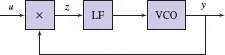
Structure of a standard PLL is shown in Figure 1.1 [5, 25, 31, 59]. The input signal is denoted by u(t), LF stands for loop filter, and VCO stands for voltage-controlled oscillator. The input signal is multiplied with the VCO’s output signal y, is passed through the LF, and the outcome is applied to the VCO.
c1-fig-0001
FIGURE 1.1 Structure of a standard PLL.
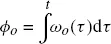
The VCO generates a sinusoidal signal whose phase angle is proportional to the integral of the VCO’s input. The VCO has a center frequency ωn, and the relationship between its output signal phase angle and the input signal is given by
(1.1)
images
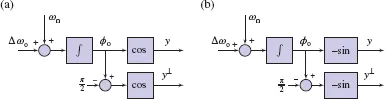
where ωo = ωn + Δωo is the estimated frequency and Δωo represents the deviation of frequency from the center frequency ωn.1 The VCO’s operation can be modeled as an integration and a trigonometric function as shown in Figure 1.2. The center frequency for the VCO is equal to the nominal value of the input signal frequency.
c1-fig-0001
FIGURE 1.2 Two recommended ...

Table of contents

  1. Cover
  2. Series page
  3. Title page
  4. Copyright page
  5. Dedication
  6. Preface
  7. Acknowledgments
  8. Acronyms
  9. Symbols
  10. Introduction
  11. I: PLL Structures for Single-Phase Applications
  12. II: Pll Structures for Three-Phase Applications
  13. References
  14. Index
  15. Ieee Press Series on Microelectronic Systems
  16. End User License Agreement