The energy consumption of a building has, in recent years, become a determining factor during its design and construction. With carbon footprints being a growing issue, it is important that buildings be optimized for energy conservation and CO2 reduction. This book therefore presents AI models and optimization techniques related to this application.
The authors start with a review of recent models for the prediction of building energy consumption: engineering methods, statistical methods, artificial intelligence methods, ANNs and SVMs in particular. The book then focuses on SVMs, by first applying them to building energy consumption, then presenting the principles and various extensions, and SVR. The authors then move on to RDP, which they use to determine building energy faults through simulation experiments before presenting SVR model reduction methods and the benefits of parallel computing. The book then closes by presenting some of the current research and advancements in the field.
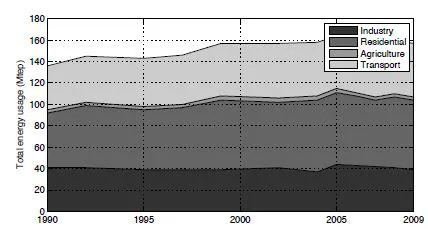
In Europe, buildings account for 40% of total energy use and 36% of total CO2 emission [EUR 10]. Figure 1.1 shows the annual energy consumption of each sector over 20 years from 1990 to 2009 in France. The part of industry decreased from 30% to 25%, and that of transport was stable around 30%. However, the usage of residential tertiary increased from 37% to 41%. We can see an increasing ratio of the building energy consumption during these years, and we can expect that the ratio will continue to increase in the future. The prediction of energy use in buildings is therefore significant for improving the energy performance of buildings, leading to energy conservation and reducing environmental impact.
However, the energy system in buildings is quite complex, as the energy types and building types vary greatly. In the literature, the main energy forms considered are heating/cooling loads, hot water and electricity consumption. The most frequently considered building types are offices, residential and engineering buildings, varying from small rooms to big estates. The energy behavior of a building is influenced by many factors, such as weather conditions, especially the dry bulb temperature, building construction and thermal property of the physical materials used, occupants and their behavior, sublevel components such as heating, ventilating and air conditioning (HVAC), and lighting systems.
Due to the complexity of the energy system, accurate consumption prediction is quite difficult. In recent years, a large number of approaches for this purpose, either elaborate or simple, have been proposed and applied to a broad range of problems. This research work has been carried out in the process of designing new buildings, operation or retrofit of contemporary buildings, varying from a building’s subsystem analysis to regional or national level modeling. Predictions can be performed on the whole building or sublevel components by thoroughly analyzing each influencing factor or approximating the usage by considering several major factors. An effective and efficient model has always been the goal of the research and engineering community.
Figure 1.1.Annual energy consumption in each sector of France
source: [COM 11]
The following sections review the recent work related to the modeling and prediction of building energy consumption (more details can be found in [ZHA 12b] and reference therein). The methods used in this application include engineering, statistical and artificial intelligence methods. The most widely used artificial intelligence methods are artificial neural networks (ANNs) and support vector machines (SVMs). In 2003 and 2010, Krarti and Dounis provided two overviews of artificial intelligence methods in the application of building energy systems [KRA 03, DOU 10]. The following chapters of this book especially focus on the prediction applications. To even further enrich the content and provide the readers with a complete view of various prediction approaches, this section also reviews engineering and statistical methods. Moreover, there are also some hybrid approaches that combine some of the above models to optimize predictive performance (see [YAO 05, WAN 06, KAR 06] [LIA 07]). In the following, we describe the problems, models, related problems, such as data pre-/postprocessing, and the comparison of these models.
1.2. Physical models
The engineering methods use physical principles to calculate thermal dynamics and energy behavior for the whole building level or for sublevel components. They have been adequately developed over the past 50 years. These methods can be roughly classified into two categories, the detailed comprehensive methods and the simplified methods. The comprehensive methods use very elaborate physical functions or thermal dynamics to calculate precisely, step by step, the energy consumption for all components of the building with the building’s and environmental information, such as external climate conditions, building construction, operation, utility rate schedule and HVAC equipment, as the inputs. In this section, we concentrate on the global view of models and applications, while the details of these computational processes are far beyond the purpose of this chapter. Readers may refer to [CLA 01] for more details. For HVAC systems, in particular, the detailed energy calculation is introduced in [MCQ 05]. The International Organization for Standardization (ISO) has developed a standard for the calculation of energy use for space heating and cooling for a building and its components [ISO 08].
Hundreds of software tools have been developed for evaluating energy efficiency, renewable energy, and sustainability in buildings, such as DOE-2, EnergyPlus, BLAST and ESP-r [SIM 11]. Some of them have been widely used for developing building energy standards and analyzing energy consumption and conservation measures of buildings. Surveys of these tools are performed in [ALH 01, CRA 08]. For readers’ information, the U.S. Department of Energy (DOE) maintains a list of almost all the energy simulation tools [SIM 11], which is constantly updated.
Although these elaborate simulation tools are effective and accurate, in practice, there are some difficulties. Since these tools are based on physical principles, to achieve an accurate simulation, they require details of building and environmental parameters as input data. On the one hand, these parameters are unavailable to many organizations, for instance, the information on each room in a large building is always difficult to obtain. This lack of precise inputs will lead to a low accurate simulation. On the other hand, operating these tools normally requires tedious expert work, making it difficult to perform. For these reasons, some researchers have proposed simpler models to offer alternatives to certain applications.
Al-Homoud [ALH 01] reviewed two simplified methods. One is the degree day method in which only one index, degree day, is analyzed. This steady-state method is suitable for estimating small buildings’ energy consumption where the envelope-based energy dominates. The other one is bin, also known as the temperature frequency method, which can be used to model large buildings where internally generated loads dominate or loads are not linearly dependent on outdoor/indoor temperature difference.
Weather conditions are important factors to determine building energy usage. These take many forms, such as temperature, humidity, solar radiation and wind speed, and vary over time. Certain studies are conducted to simplify weather conditions in building energy calculations. White and Reichmuth [WHI 96] attempted to use average monthly temperatures to predict monthly building energy consumption. This prediction is more accurate than standard procedures, which normally use heating and cooling degree days or temperature bins. Westphal and Lamberts [WES 04] predicted the annual heating and cooling load of non-residential buildings simply based on some weather variables, including monthly average of maximum and minimum temperatures, atmospheric pressure, cloud cover and relative humidity. Their results showed good accuracy on low mass envelope buildings, compared to elaborate simulation tools such as ESP, BLAST and DOE2.
As well as weather conditions, the building characteristic is another important yet complex factor in determining energy performance.
Yao and Steemers [YAO 05] developed a simple method of predicting a daily energy consumption profile for the design of a renewable energy system for residential buildings. The total building energy consumption was defined as the summation of several components: appliances, hot water and space heating. For each component, a specific modeling method was employed. For instance, to model electric appliances, they used the average end-use consumption from large amounts of statistical data. While modeling space heating demand, a simplified physical model was applied. Since the average value varies seasonally, this method predicts energy demand for one season at a time.
By adopting this divide-and-sum concept, Rice et al. [RIC 10] simplified each sublevel calculation to explain the system level building energy consumption. In the project “Updating the ASHRAE/ACCA Residential Heating and Cooling Load Calculation Procedures and Data” (RP-1199), Barnaby and Spitler [BAR 05b] proposed a residential load factor method, which is a simple method and can be done by hand. The load contributions from various sources were evaluated separately and then added up. Wang and Xu [WAN 06] simplified the physical characteristics of buildings to implement the prediction. For building envelopes, the model parameters were determined by using easily available physical details based on the frequency characteristic analysis. For various internal components, they used a thermal network of lumped thermal mass to represent the internal mass...
Table of contents
Cover
Table of Contents
Title
Copyright
Preface
Introduction
1 Overview of Building Energy Analysis
2 Data Acquisition for Building Energy Analysis
3 Artificial Intelligence Models
4 Artificial Intelligence for Building Energy Analysis
5 Model Reduction for Support Vector Machines
6 Parallel Computing for Support Vector Machines
Summary and Future of Building Energy Analysis
Bibliography
Index
End User License Agreement
Trusted by 375,005 students
Access to over 1.5 million titles for a fair monthly price.
Study more efficiently using our study tools.
Frequently asked questions
Yes, you can cancel anytime from the Subscription tab in your account settings on the Perlego website. Your subscription will stay active until the end of your current billing period. Learn how to cancel your subscription
No, books cannot be downloaded as external files, such as PDFs, for use outside of Perlego. However, you can download books within the Perlego app for offline reading on mobile or tablet. Learn how to download books offline
We are an online textbook subscription service, where you can get access to an entire online library for less than the price of a single book per month. With over 1.5 million books across 990+ topics, we’ve got you covered! Learn about our mission
Look out for the read-aloud symbol on your next book to see if you can listen to it. The read-aloud tool reads text aloud for you, highlighting the text as it is being read. You can pause it, speed it up and slow it down. Learn more about Read Aloud
Yes! You can use the Perlego app on both iOS and Android devices to read anytime, anywhere — even offline. Perfect for commutes or when you’re on the go. Please note we cannot support devices running on iOS 13 and Android 7 or earlier. Learn more about using the app
Yes, you can access Data Mining and Machine Learning in Building Energy Analysis by Frédéric Magoules,Hai-Xiang Zhao in PDF and/or ePUB format, as well as other popular books in Computer Science & Computer Science General. We have over 1.5 million books available in our catalogue for you to explore.