Laser beam combining techniques allow increasing the power of lasers far beyond what it is possible to obtain from a single conventional laser.One step further, coherent beam combining (CBC) also helps to maintain the very unique properties of the laser emission with respect to its spectral and spatial properties. Such lasers are of major interest for many applications, including industrial, environmental, defense, and scientific applications. Recently, significant progress has beenmade in coherent beam combining lasers, with a total output power of 100 kW already achieved. Scaling analysis indicates that further increase of output power with excellent beam quality is feasible by using existing state-of-the-art lasers. Thus, the knowledge of coherent beam combining techniques will become crucial for the design of next-generation highpower lasers. The purpose of this book is to present the more recent concepts of coherent beam combining by world leader teams in the field.
Engineering of Coherently Combined, High-Power Laser Systems
Gregory D. Goodno and Joshua E. Rothenberg
1.1 Introduction
In recent years, much effort has been expended toward scaling electric lasers to CW power levels on the order of 100 kW or greater [1]. The key challenge in such scaling is maintaining near-diffraction-limited (DL) beam quality (BQ) to enable tight focusing onto a distant target. Despite the maturation of scalable, diode-pumped laser amplifier technologies such as zigzag slabs [2] or fibers [3], thermal effects or optical nonlinearities currently limit near-DL output from single lasers to an order of magnitude lower power, around 10 kW.
Actively phase-locked coherent beam combination (CBC) of N laser amplifiers seeded by a common master oscillator (MO) represents an engineerable approach toward scaling laser brightness B (loosely defined here as B ∼ power/BQ2) beyond the limits of the underlying single-element laser technology. Ideally, the combined output behaves as if it were a single beam, and B is thereby increased by a factor of N over an unphased array or by a factor of N2 over any individual laser [4].
A compelling architectural advantage of CBC systems in comparison to single-aperture lasers of comparable power is the graceful degradation in response to failure of any gain element. This feature can be elucidated from the scaling of B ∼ N2, so the relative rate of change in brightness as individual lasers fail is 1/B (dB /dN) = 2/N. Hence, for large arrays, the drop in brightness is gradual. For example, failure of 1 out of N = 100 lasers would still allow a CBC system to continue operating at 98% of its original brightness.
Active CBC with servo-based phase locking can be straightforwardly engineered for very high channel counts and for very high-power laser gain elements. Recently, Northrop Grumman Aerospace Systems adopted an actively phase-locked approach to combine seven 15 kW Nd:YAG slab amplifier chains to demonstrate the world's first 100 kW electric laser with record-setting brightness [5]. As of this writing, work is underway to extend this technology to achieve similar power levels in a CBC array of fiber lasers with improved BQ and efficiency as well as reduced size and weight [6,7].
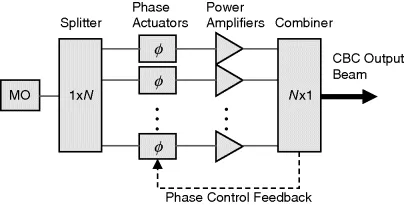
A canonical system-level architecture for a CBC laser array is shown in Figure 1.1. A single master oscillator is split to seed a number of N channels. Each channel contains a piston phase actuator capable of imposing at least one wave of phase and a coherence-preserving laser amplifier (or a chain of amplifiers) to boost the channel power to the limit of the laser technology. The high-power outputs from all N channels are geometrically combined, so they copropagate, either by using one or more beam splitters or by tiling side by side. The combined output beam is sampled optically to generate error signals for servo-based phase locking of all N channels up to a fraction of a wave.
Figure 1.1 System-level block diagram for an actively phase-locked CBC master oscillator power amplifier (MOPA) array.
From Figure 1.1, we can identify three key technologies that must be integrated to form an actively phase-locked, coherently combined, high-power laser system:
laser amplifiers, preserving coherence properties of a common master oscillator while providing high gain and high output power;
optical system, geometrically overlapping the amplified beams in the far field (FF) and for some implementations, in the near field (NF); and
active control systems, cophasing the amplified output beams via closed-loop feedback.
In the remainder of this chapter, we review recent advances in these three technology areas. We begin by deriving engineering requirements on laser source uniformity, presented as trades against combining efficiency. This provides a framework to assess coherent combining technologies amenable to scaling to both high channel counts and high powers, including active piston control using optical heterodyne phase detection and geometric beam combining, using either tiled apertures or diffractive optical elements (DOEs). Finally, we review the engineering challenges, design, and CBC test results of two specific solid-state laser amplifier technologies, Nd:YAG zigzag slabs and Yb:SiO2 fibers. These laser technologies are particularly well suited toward the demands of 100 kW level CBC owing to their scalability, high gain, high efficiency, and outstanding spatial and temporal coherence properties.
1.2 Coherent Beam Combining System Requirements
The primary requirement for high-efficiency CBC is that the combined beams must be mutually coherent in both space and time to allow complete constructive interference. This means the lasers must be spatially mode-matched and coaligned, power-balanced, copolarized, path length matched, and locked in phase with high precision. When these requirements are not perfectly met, combining efficiency suffers. For a large channel count CBC array, the coherence requirement can be expressed quantitatively and concisely in terms of statistical uniformity tolerances between the laser array elements [8].
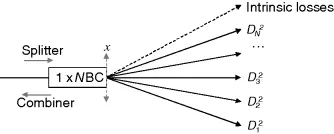
We consider a large array of N input beams, combined in a filled aperture configuration using a beam splitter optic in reverse as a beam combiner (BC). This BC can represent, for example, a tapered fiber coupler, a DOE, or a cascade of free space or guided wave splitters. The BC has a priori unequal power splitting fractions
over the desired channels n = 1 − N, where normalization
accounts for the possibility of coupling losses intrinsic to the BC into channels n > N (Figure 1.2). The BC efficiency as a splitter is then
, where the summation is over only the N channels of interest.
Figure 1.2 Power splitting ratios for a 1 × N beam splitter/combiner.
Operated as a N × 1 combiner, the spatially resolved, time-averaged combining efficiency η ′(x) is the ratio of power in the desired output port to the total input power. It is straightforward to show [9] that
(1.1)
Here, the brackets denote time averaging and En(x,t) are spatially and temporally nonuniform fie...
Table of contents
Cover
Related Titles
Title Page
Copyright
Preface
Acronyms
List of Contributors
Part One: Coherent Combining with Active Phase Control
Part Two: Passive and Self-Organized Phase Locking
Index
Trusted by 375,005 students
Access to over 1.5 million titles for a fair monthly price.
Study more efficiently using our study tools.
Frequently asked questions
Yes, you can cancel anytime from the Subscription tab in your account settings on the Perlego website. Your subscription will stay active until the end of your current billing period. Learn how to cancel your subscription
No, books cannot be downloaded as external files, such as PDFs, for use outside of Perlego. However, you can download books within the Perlego app for offline reading on mobile or tablet. Learn how to download books offline
Perlego offers two plans: Essential and Complete
Essential is ideal for learners and professionals who enjoy exploring a wide range of subjects. Access the Essential Library with 800,000+ trusted titles and best-sellers across business, personal growth, and the humanities. Includes unlimited reading time and Standard Read Aloud voice.
Complete: Perfect for advanced learners and researchers needing full, unrestricted access. Unlock 1.5M+ books across hundreds of subjects, including academic and specialized titles. The Complete Plan also includes advanced features like Premium Read Aloud and Research Assistant.
Both plans are available with monthly, semester, or annual billing cycles.
We are an online textbook subscription service, where you can get access to an entire online library for less than the price of a single book per month. With over 1.5 million books across 990+ topics, we’ve got you covered! Learn about our mission
Look out for the read-aloud symbol on your next book to see if you can listen to it. The read-aloud tool reads text aloud for you, highlighting the text as it is being read. You can pause it, speed it up and slow it down. Learn more about Read Aloud
Yes! You can use the Perlego app on both iOS and Android devices to read anytime, anywhere — even offline. Perfect for commutes or when you’re on the go. Please note we cannot support devices running on iOS 13 and Android 7 or earlier. Learn more about using the app
Yes, you can access Coherent Laser Beam Combining by Arnaud Brignon in PDF and/or ePUB format, as well as other popular books in Technology & Engineering & Electrical Engineering & Telecommunications. We have over 1.5 million books available in our catalogue for you to explore.