eBook - ePub
Virtual Reality and Augmented Reality
Myths and Realities
- English
- ePUB (mobile friendly)
- Available on iOS & Android
eBook - ePub
Virtual Reality and Augmented Reality
Myths and Realities
About this book
Virtual and Augmented Reality have existed for a long time but were stuck to the research world or to some large manufacturing companies. With the appearance of low-cost devices, it is expected a number of new applications, including for the general audience. This book aims at making a statement about those novelties as well as distinguishing them from the complexes challenges they raise by proposing real use cases, replacing those recent evolutions through the VR/AR dynamic and by providing some perspective for the years to come.
Information
1
New Applications
This chapter aims to give an overview of the new families of applications that have emerged or that have undergone massive development in this last decade. The first section (section 1.1) will analyze the manufacturing industry, exploring the development of virtual reality (VR), the emergence of augmented reality (AR) and the question of return on investment. This is mainly illustrated by real industrial examples, shared by the concerned actors themselves. The second section (section 1.2) explores the field of health and analyzes the impact VR and AR have had on training, on preparation for intervention and on uses in the world of surgery. Section 1.3 will examine applications related to city life, architecture and urbanism and will focus especially on developing mobility. Finally, we will end the chapter by looking at recent results in the field of training and in the field of heritage (section 1.4).
1.1. New industrial applications
1.1.1. Virtual reality in industry
Until recently, it was impossible to think of virtual reality without imagining using heavy and complex machinery that needed a dedicated team to operate it. These characteristics have certainly put the brakes on this technology being integrated into companies for whom ROI (return on investment) is a near-essential criterion for any decision related to making investments.
The broad periods across which companies were involved in AR can be described as follows.
1.1.1.1. The age of pioneers: researchers
Until 2005, only a few large industrial groups were interested in virtual reality. Their participation was strongly linked to the group’s research activities (fundamental and industrial research) and its interconnections with the higher education and research community. In France, the companies that were involved in research all possessed in-house Research and Development departments that were made up of researchers, doctors, engineers and research engineers working within national and Europe-wide projects, in close collaboration with researchers in large public sector research laboratories (e.g. Inria centers, CNRS units, university laboratories). PSA, RENAULT and AIRBUS are the companies that established this process with the CRV at PSA, RENAULT’s Technocentre and EADS IW (renamed the AIRBUS Innovation Group) for Airbus.
1.1.1.2. The experimenter’s age: innovative engineers
From 2005 to 2010 or so, many large companies learned of the emergence of this technology for virtual 3D prototyping and level 1 immersion. They wished to carry out experiments in order to analyze the potential of virtual reality in different professions (especially research department and organization and methods departments). The approach they adopted was quite different from that of the “pioneers”: they did not wish to set up an internal research center, but developed “innovation departments” that were associated with certain platforms for technological resources such as CLARTE at Laval or ENSAM at Chalon-sur-Saône. We can also give the example of DCNS, Plastic Omnium and many more.
1.1.1.3. The age of shared platforms
From 2010 to 2014, the widely used model was that of a shared platform available to companies in the region. In effect, as technology matured and its application for various purposes became more robust, many companies requested an institutional environment that allowed sharing of equipment (CAVE, Cadwall) on which the ROI was not realistically high enough for each company to invest in it. This model was initiated at LAVAL in 2000 by CLARTE and its technical platform for companies paved the way for platforms such as CIRV at St Nazaire, Industrilab in Picardie and Holo3 in Strasbourg.
1.1.1.4. The age of VR headsets and applications distributed on a very large scale: major players on the offensive
From late 2014, we have witnessed a techno-economic revolution in the field of VR. The field was fundamentally transformed by the appearance of the first Oculus headset, followed by its eponymous successors, as well as other headsets from other companies (each outperforming the other), such as the HTC Vive, all of which were also available at very low costs. Obviously, a headset cannot and may never be able to do the same things a high-end visiocube can. However, the “user-usability-immersion” cost equation for an HMD is such that actors within companies cannot help exploring them and factoring them into their deliberations. At best, they are considered complementary to the visiocube and, in the worst case scenario, they can replace them. It must be noted that the economic model of the HMD has nothing in common with the visiocube. In fact, the HMD is considered, in accounting terms, to be a consumable. Investment related to virtual reality is currently completely related to software and not to equipment, which significantly modifies the decision-making center.
1.1.2. Augmented reality and industrial applications
Augmented reality is a technology that has sparked off a lot of fantasies but delivered very little. In effect, many communicators rode on the message “add the virtual onto the real”, creating sensational videos that led the viewer to believe that we would completely naturally be able to watch a car that did not exist; visualize the sofa we would buy in our living room; get up close to people who were far away or even people who had died. In brief, that real life would be exactly like a TV series!
However, these promises far outstripped the possibilities that technology can offer today. The consequent backlash resulted in a strong rejection of AR by the public and general users today content themselves with “pseudo-AR” games, like Pokémon Go. Unlike with VR, here we cannot trace the stages through which companies appropriated this technology. This is because the needs expressed and the predicted uses resulted in a “pseudo-offering”, which claimed to respond to their demands by using tricks and artifice that did not long stand up to scrutiny. The Gartner Hype curve for 2017 (Figure 1.1) offers an interesting illustration: it quite brutally plots AR in the “trough of disillusionment”.
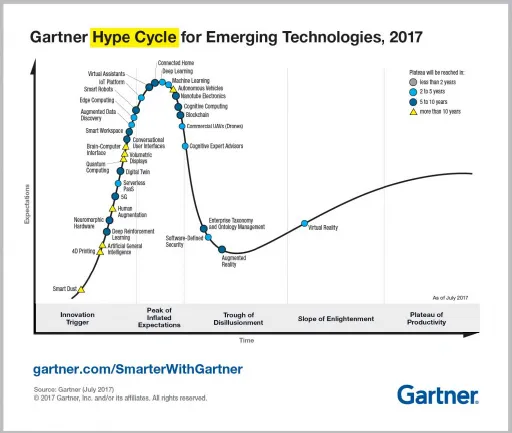
Figure 1.1. Courbe de Hype 2017. For a color version of this figure, see www.iste.co.uk/arnaldi/virtual.zip
A careful analysis, however, shows us that where industrial applications (and these alone) are concerned, augmented reality has already entered the next phase, the “Slope of Enlightenment”, with market stability expected in the next two-to-five years.
1.1.3. VR-AR for industrial renewal
Before we get into a detailed examination of the impact VR-AR technologies have had on the world of business, let us listen to a voice from the industry – Stéphane Klein, Deputy Director of STX (Chantiers de l’Atlantique) and head of the RetD. He offers a succinct summary of the pragmatic steps taken by several leading industrialists and the impact that they have observed:
“Innovation is in the DNA of the STX France shipyard in Saint-Nazaire. This is probably why it is the last remaining large maritime construction company and why it is seeing, today, an unprecedented resurgence in activity, with the order-book completely full for the next five years! Keen to offer its clients ever more innovative products, at the cutting edge of technology, STX has constantly upgraded its production system in order to remain on the offensive in a highly competitive global market. The use of virtual reality in association with a new 3D CAD has certainly been among the most significant changes in the STX research department over the last five years. Just a few years ago, Virtual Reality was nothing but a simple “Work Package” in a R&D project – but it has rapidly become an integral and indispensable part of STX study processes and marketing. Today it is mature and systematically used. STX is now looking to use Augmen...
Table of contents
- Cover
- Table of Contents
- Title
- Copyright
- Preface
- Introduction
- 1 New Applications
- 2 The Democratization of VR-AR
- 3 Complexity and Scientific Challenges
- 4 Towards VE that are More Closely Related to the Real World
- 5 Scientific and Technical Prospects
- 6 The Challenges and Risks of Democratization of VR-AR
- Conclusion: Where Will VR-AR be in 10 Years?
- Postface
- Glossary
- List of Authors
- Index
- End User License Agreement
Trusted by 375,005 students
Access to over 1.5 million titles for a fair monthly price.
Study more efficiently using our study tools.
Frequently asked questions
Yes, you can cancel anytime from the Subscription tab in your account settings on the Perlego website. Your subscription will stay active until the end of your current billing period. Learn how to cancel your subscription
No, books cannot be downloaded as external files, such as PDFs, for use outside of Perlego. However, you can download books within the Perlego app for offline reading on mobile or tablet. Learn how to download books offline
Perlego offers two plans: Essential and Complete
- Essential is ideal for learners and professionals who enjoy exploring a wide range of subjects. Access the Essential Library with 800,000+ trusted titles and best-sellers across business, personal growth, and the humanities. Includes unlimited reading time and Standard Read Aloud voice.
- Complete: Perfect for advanced learners and researchers needing full, unrestricted access. Unlock 1.5M+ books across hundreds of subjects, including academic and specialized titles. The Complete Plan also includes advanced features like Premium Read Aloud and Research Assistant.
We are an online textbook subscription service, where you can get access to an entire online library for less than the price of a single book per month. With over 1.5 million books across 990+ topics, we’ve got you covered! Learn about our mission
Look out for the read-aloud symbol on your next book to see if you can listen to it. The read-aloud tool reads text aloud for you, highlighting the text as it is being read. You can pause it, speed it up and slow it down. Learn more about Read Aloud
Yes! You can use the Perlego app on both iOS and Android devices to read anytime, anywhere — even offline. Perfect for commutes or when you’re on the go.
Please note we cannot support devices running on iOS 13 and Android 7 or earlier. Learn more about using the app
Please note we cannot support devices running on iOS 13 and Android 7 or earlier. Learn more about using the app
Yes, you can access Virtual Reality and Augmented Reality by Bruno Arnaldi, Pascal Guitton, Guillaume Moreau, Bruno Arnaldi,Pascal Guitton,Guillaume Moreau in PDF and/or ePUB format, as well as other popular books in Computer Science & Data Visualisation. We have over 1.5 million books available in our catalogue for you to explore.