- Thoroughly reviews our current understanding of malarial biology
- Explores the subject with insights from post-genomic technologies
- Looks broadly at the disease, vectors of infection, and treatment and prevention strategies
- A timely publication with chapters written by global researchers leaders
eBook - ePub
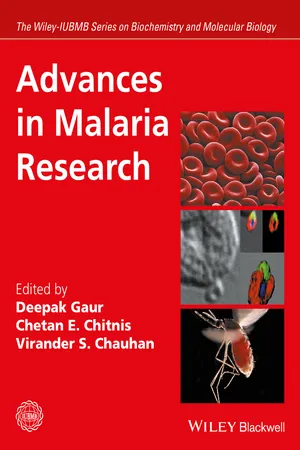
Advances in Malaria Research
- English
- ePUB (mobile friendly)
- Available on iOS & Android
eBook - ePub
Advances in Malaria Research
About this book
Information
CHAPTER 1
Introduction: An overview of malaria and Plasmodium
Virander S. Chauhan1, Chetan E. Chitnis1,2, and Deepak Gaur3
1International Centre for Genetic Engineering and Biotechnology, New Delhi, India
2Department of Parasites and Insect Vectors, Institut Pasteur, Paris, France
3School of Biotechnology, Jawaharlal Nehru University, New Delhi, India
History
Malaria has threatened the human race for centuries. Ancient medical records from early civilizations based in India, China, and Mesopotamia have reported malaria as a disease characterized by intermittent fevers (Desowitz 1991; Cox 2002). In the fifth century BCE, the Greek physician Hippocrates classified the fever according to periodicity—febris tertian (every third day) and febris quartana (every fourth day)—and its association with splenomegaly (Cox 2002; Desowitz 1991; Pappas 2008). In the Middle Ages, the Romans coined the name malaria for the disease (Medieval Italian mal, “bad,” and aria “air”) because it was believed that the illness occurred due to toxic fumes and vapors arising from the marshy lands. This belief was further strengthened by the subsequent decline in malaria cases after the swamps were drained (Desowitz 1991).
It was only in 1880 that the true causative agent of the disease was identified when Alphonse Laveran (1845–1922), a military physician based in Algeria, first reported the crescent‐shaped malaria parasites in the blood of a soldier suffering from intermittent fevers (Laveran 1881; Bruce‐Chwatt 1981). He also observed motile filamentous structures emerging from a round spherical body, which he reported as appearing like an animal parasite. Laveran thus called this microscopic organism as Oscillaria malariae (Laveran 1881). Through his clinical examinations, he further observed that when he failed to detect the crescent structures there were no disease symptoms. He also observed that these microscopic organisms are cleared by quinine treatment.
Laveran’s findings were further confirmed in 1885 by Ettore Marchiafava and Amico Bignami, who, using eosin‐stained blood stains, also observed amoeboid movement of the organism (Marciafava and Bignami 1894). In 1886, Camillo Golgi was able to differentiate between tertian and quartan malaria and also defined the morphological differences of parasites responsible for the two types of malaria (Golgi 1886). He reported that the parasite underwent asexual reproduction and that fever was closely associated with lysis of the red cells and release of parasites. In 1890, Grassi and Feletti named the two different species Plasmodium vivax and Plasmodium malariae (Grassi and Feletti 1890). Sakharov (1889) and Marchiafava and Celli (1890) independently identified Plasmodium falciparum (Grassi 1900; Cox 2002; Cox 2010). Thus by 1890, it was known that malaria was caused by a protozoan parasite that invaded and multiplied in erythrocytes. Based on their periodic specificities and other characteristics, species specific for causing benign tertian (Plasmodium vivax), malignant tertian (Plasmodium falciparum), and quartan malaria (Plasmodium malariae) had been discovered (Cox 2010).
The next major question was: How does malaria transmission occur? This question was answered by the efforts of Sir Ronald Ross and Giovanni Battista Grassi. The idea that mosquitoes could transmit human disease first arose from the classical work of Sir Patrick Manson, who could be considered the father of tropical medicine and was also the mentor of Ross. In 1878, Manson was the first to demonstrate that a parasite (in this case the filarial worm) that causes human disease (elephantiasis) could infect a mosquito (Manson 1878). Ross, who was born in India, returned to India in 1895 and set about to prove the hypothesis of Laveran and Manson that mosquitoes were associated with malaria transmission.
Finally on August 20, 1897, in Secunderabad, Ross made his landmark discovery in which he observed the malaria parasite in the stomach of an Anopheles mosquito fed four days previously on a malaria patient, Husein Khan, who was suffering from intermittent fevers. Ross thus established the role of Anopheles mosquitoes in the transmission of human malaria parasites (Ross 1898). Ross was clearly on the verge of demonstrating the Anopheles mosquitoes to be responsible for human malaria transmission, but unfortunately he was unable to do so because at that stage he was transferred to Calcutta, a place with much less malaria.
He thus turned his attention to the avian malaria parasite, now known as Plasmodium relictum, which is commonly found in several bird species and which was a more convenient experimental model for malaria research. He discovered that the avian malaria parasite was transmitted by the gray (culicine) mosquito, Culex fatigans. Ross demonstrated malaria parasites in mosquitoes that had been fed on infected birds; the parasites developed and migrated to the mosquitoes’ salivary glands, thus allowing the mosquitoes to infect other birds during subsequent blood meals. Thus, in 1897, Sir Ronald Ross elucidated the complete sexual‐stage life cycle of Plasmodium relictum on the gut wall Culex fatigans (Ross 1898).
However, the actual evidence for the transmission of human malaria by Anopheles mosquitoes came from Bignami and Grassi in 1898, who had access to the malarial disease prevalent near Rome and Sicily. They showed that Anopheles claviger mosquitoes that fed on malaria‐infected patients could via their bite transmit the disease to uninfected individuals (Grassi 1899). The Italians further went on to prove that it was only the female Anopheles mosquito that could transmit malaria, and they comprehensively described the blood stage mosquito life cycles of P. vivax, P. falciparum, and P. malariae (Grassi 1900). Later in 1899, Ross, during his posting in Sierra Leone, also demonstrated the development of the three Plasmodium species parasites in the Anopheles mosquitoes (Dobson 1999). Plasmodium ovale was discovered much later in 1918 by John Stephens (Cox 2010; Sutherland 2010).
Thus, the mode of malaria transmission through the Anopheles mosquito vector had been discovered and, in a great advancement to the field, provided a major method of protecting against the disease by reducing contact with the insect vector. The huge impact of this work was recognized when in 1902 Ronald Ross was awarded the Nobel Prize and in 1907 Charles Alphonse Laveran received the prize for establishing the role of protozoans as causative agents of human disease. In 1927, Julius Wagner‐Jauregg was awarded the Nobel Prize for treating neurosyphilis by infecting patients with Plasmodium vivax (White 2011). This treatment was abandoned because it killed 15% of the patients. The fact that mosquito control was critical led to the development of several insecticides, including DDT, for whose discovery Paul Hermann Müller was awarded the Nobel Prize in 1948.
The complete life cycle of the Plasmodium parasites in humans was still not fully understood, especially the liver stages of development were not known at the time, and it remained a puzzle as to where the parasites resided for the first ten days after infection when they could not be observed in the blood. Although there were some suggestions that the parasites underwent another stage of development besides...
Table of contents
- Cover
- Title Page
- Table of Contents
- List of contributors
- Foreword
- Preface
- CHAPTER 1: Introduction
- CHAPTER 2: Exoerythrocytic development of Plasmodium parasites
- CHAPTER 3: Molecular basis of erythrocyte invasion by Plasmodium merozoites
- CHAPTER 4: The biology of malaria transmission
- CHAPTER 5: Comparative and functional genomics of malaria parasites
- CHAPTER 6: Gene regulation
- CHAPTER 7: Molecular genetic approaches to malaria research
- CHAPTER 8: Transcriptomics and proteomics
- CHAPTER 9: The biochemistry of Plasmodium falciparum
- CHAPTER 10: Signaling in malaria parasites
- CHAPTER 11: Membrane transport proteins as therapeutic targets in malaria
- CHAPTER 12: The proteolytic repertoire of malaria parasites
- CHAPTER 13: Development of medicines for the control and elimination of malaria
- CHAPTER 14: Antimalarial drug resistance
- CHAPTER 15: Epidemiology of Plasmodium falciparum malaria
- CHAPTER 16: Malaria pathogenesis
- CHAPTER 17: Host genetics
- CHAPTER 18: The immune response in mild and severe malaria
- CHAPTER 19: Progress in development of malaria vaccines
- CHAPTER 20: Plasmodium vivax
- Index
- End User License Agreement
Trusted by 375,005 students
Access to over 1.5 million titles for a fair monthly price.
Study more efficiently using our study tools.
Frequently asked questions
Yes, you can cancel anytime from the Subscription tab in your account settings on the Perlego website. Your subscription will stay active until the end of your current billing period. Learn how to cancel your subscription
No, books cannot be downloaded as external files, such as PDFs, for use outside of Perlego. However, you can download books within the Perlego app for offline reading on mobile or tablet. Learn how to download books offline
Perlego offers two plans: Essential and Complete
- Essential is ideal for learners and professionals who enjoy exploring a wide range of subjects. Access the Essential Library with 800,000+ trusted titles and best-sellers across business, personal growth, and the humanities. Includes unlimited reading time and Standard Read Aloud voice.
- Complete: Perfect for advanced learners and researchers needing full, unrestricted access. Unlock 1.5M+ books across hundreds of subjects, including academic and specialized titles. The Complete Plan also includes advanced features like Premium Read Aloud and Research Assistant.
We are an online textbook subscription service, where you can get access to an entire online library for less than the price of a single book per month. With over 1.5 million books across 990+ topics, we’ve got you covered! Learn about our mission
Look out for the read-aloud symbol on your next book to see if you can listen to it. The read-aloud tool reads text aloud for you, highlighting the text as it is being read. You can pause it, speed it up and slow it down. Learn more about Read Aloud
Yes! You can use the Perlego app on both iOS and Android devices to read anytime, anywhere — even offline. Perfect for commutes or when you’re on the go.
Please note we cannot support devices running on iOS 13 and Android 7 or earlier. Learn more about using the app
Please note we cannot support devices running on iOS 13 and Android 7 or earlier. Learn more about using the app
Yes, you can access Advances in Malaria Research by Deepak Gaur, Chetan E. Chitnis, Virander S. Chauhan, Deepak Gaur,Chetan E. Chitnis,Virander S. Chauhan in PDF and/or ePUB format, as well as other popular books in Biological Sciences & Microbiology. We have over 1.5 million books available in our catalogue for you to explore.