Sea Ice
eBook - ePub

Sea Ice

  1. English
  2. ePUB (mobile friendly)
  3. Available on iOS & Android
eBook - ePub

About this book

Over the past 20 years the study of the frozen Arctic and Southern Oceans and sub-arctic seas has progressed at a remarkable pace. This third edition of Sea Ice gives insight into the very latest understanding of the how sea ice is formed, how we measure (and model) its extent, the biology that lives within and associated with sea ice and the effect of climate change on its distribution. How sea ice influences the oceanography of underlying waters and the influences that sea ice has on humans living in Arctic regions are also discussed.  

Featuring twelve new chapters, this edition follows two previous editions (2001 and 2010), and the need for this latest update exhibits just how rapidly the science of sea ice is developing. The 27 chapters are written by a team of more than 50 of the worlds' leading experts in their fields. These combine to make the book the most comprehensive introduction to the physics, chemistry, biology and geology of sea ice that there is.

This third edition of Sea Ice will be a key resource for all policy makers, researchers and students who work with the frozen oceans and seas.
Trusted by 375,005 students

Access to over 1 million titles for a fair monthly price.

Study more efficiently using our study tools.

Information

Chapter 1
Overview of sea ice growth and properties

Chris Petrich1 and Hajo Eicken2
1Northern Research Institute Narvik, Narvik, Norway
2University of Alaska Fairbanks, Fairbanks, AK, USA

1.1 Introduction

A recent, substantial reduction in summer Arctic sea ice extent and its potential ecological and geopolitical impacts generated a lot of attention in the media and among the general public. The satellite remote-sensing data documenting such recent changes in ice coverage are collected at coarse spatial scales (Chapter 9) and typically cannot resolve details finer than about 10km in lateral extent. However, many of the processes that make sea ice such an important aspect of the polar oceans occur at much smaller scales, ranging from the sub-millimetre to the metre scale. An understanding of how large-scale behaviour of sea ice monitored by satellite relates to and depends on the processes driving ice growth and decay requires an understanding of the evolution of ice structure and properties at these finer scales and this is the subject of this chapter.
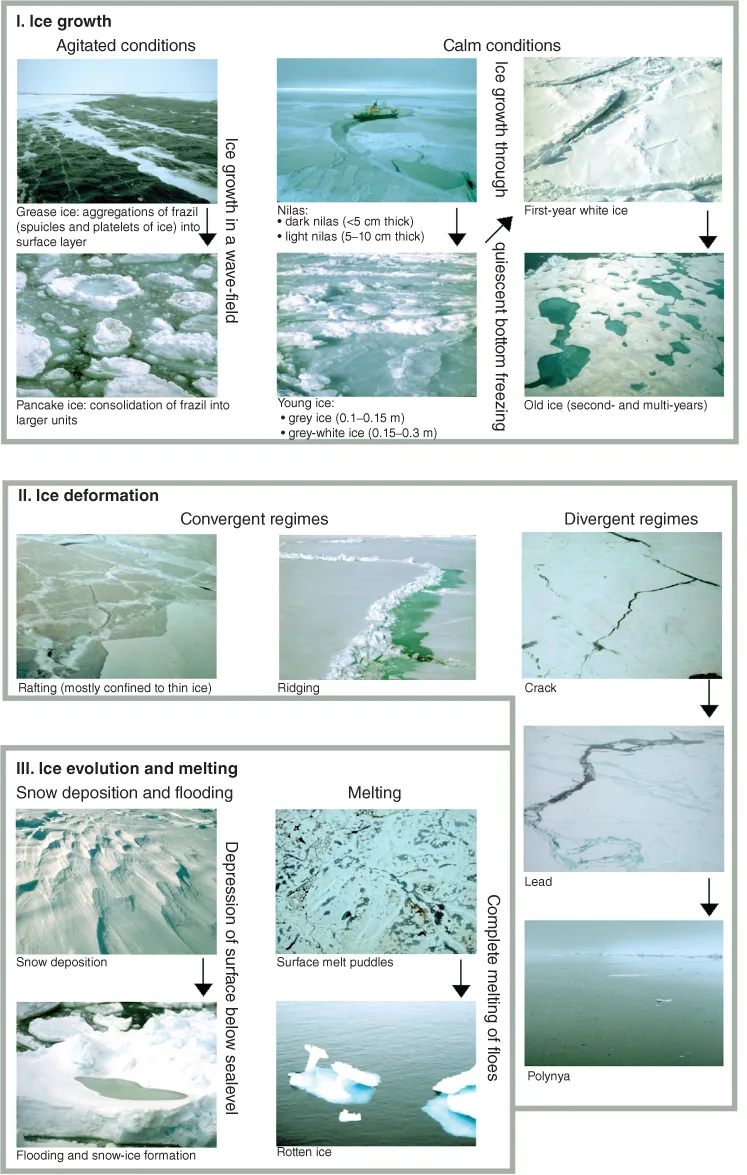
The macroscopic properties of sea ice are of interest in many practical applications discussed in this book. They are derived from microscopic properties as continuum properties averaged over a specific volume (representative elementary volume) or mass of sea ice. This is not unlike macroscopic temperature and can be derived from microscopic molecular movement. The macroscopic properties of sea ice are determined by the microscopic structure of the ice, i.e. the distribution, size and morphology of ice crystals and inclusions. The challenge is to see both the forest (i.e. the role of sea ice in the environment) and the trees (i.e. the way in which the constituents of sea ice control key properties and processes). In order to understand and project how the forest will respond to changes in its environment, we have to understand the life cycle of its constituents, the trees. Here, we will adopt a bottom-up approach, starting with the trees, characterizing microscopic properties and processes and how they determine macroscopic properties, to lay the groundwork for understanding the forest. In using this approach, we will build up from the sub-millimetre scale and conclude with the larger scales shown in Figure 1.1.
Three process diagrams for I. Ice growth, II. Ice deformation and III. Ice evolution and melting. Each process diagram has digital captures titled and connected by arrows.
Figure 1.1 Ice types, pack ice features and growth, melt and deformation processes.
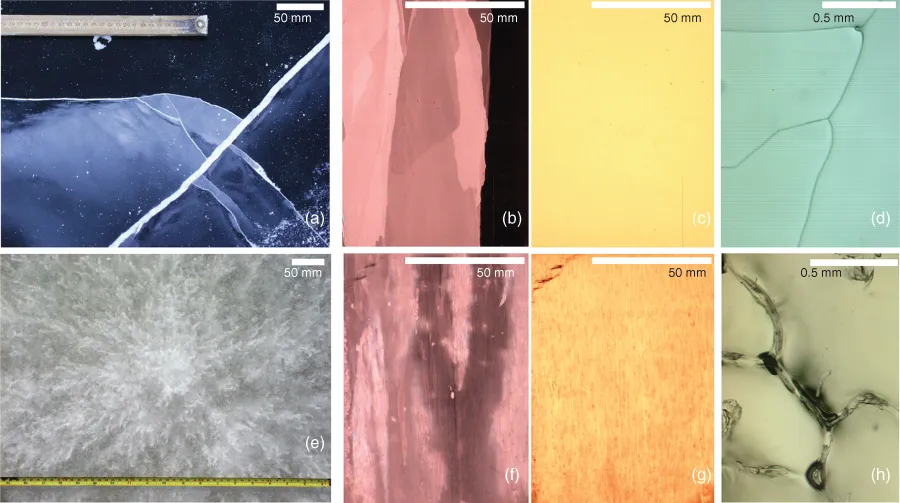
Image described by caption and surrounding text.
Figure 1.2 Surface appearance and microstructure of winter lake ice (Imikpuk Lake, top, panels a–d) and sea ice (Chukchi Sea landfast ice, bottom, panels e–h) near Barrow, Alaska. The bright features apparent in the lake ice are cracks that penetrate all the way to the bottom of the ice cover (close to 1m thick), while the clear, uncracked ice appears completely black (a, top). (e) The sea ice surface photograph shows a network of brine channels that join into a few feeder channels. (b, c, f, g) Photographs of vertical thin sections from the two ice covers, with (b) and (f) recorded between crossed polarizers, highlighting different ice crystals in different colours. Panels (c) and (g) show the same section as (b) and (f) in plain transmitted light, demonstrating the effect of brine inclusions on transparency of the ice. (d, h) Photomicrographs showing the typical pore structure at a temperature of −5°C (lake ice) and −15°C (sea ice), with few thin inclusions along grain boundaries in lake ice (d) and a network of thicker brine inclusions in sea ice (h).
Sea ice would not be sea ice without salt. In fact, take away the salt and we are left with lake ice, differing in almost all aspects that we discuss in this chapter. The microscopic and macroscopic redistribution of ions opens the path to understanding all other macroscopic properties of sea ice. We will therefore start in Section 1.2 by looking at the influence of ions on ice growth at the scale of individual ice crystals, in sea ice growing under both rough and quiescent conditions. We will continue in Section 1.3 by looking at the dynamic feedback system between fluid dynamics and pore volume, both microscopically and at the continuum scale. We will point out that our knowledge is far from exhaustive in this fundamental aspect. However, armed with a basic understanding of crystal structure, phase equilibria and pore structure, we can shed light on ice optical, dielectric and thermal properties and macroscopic ice strength in Section 1.4. One of the most discussed aspects of sea ice is its presence or absence. We wi...

Table of contents

  1. Cover
  2. Title Page
  3. Copyright
  4. Table of Contents
  5. List of contributors
  6. Preface
  7. Chapter 1: Overview of sea ice growth and properties
  8. Chapter 2: Sea ice thickness distribution
  9. Chapter 3: Snow in the sea ice system: friend or foe?
  10. Chapter 4: Sea ice and sunlight
  11. Chapter 5: The sea ice–ocean boundary layer
  12. Chapter 6: The atmosphere over sea ice
  13. Chapter 7: Sea ice and Arctic Ocean oceanography
  14. Chapter 8: Oceanography and sea ice in the Southern Ocean
  15. Chapter 9: Methods of satellite remote sensing of sea ice
  16. Chapter 10: Gaining (and losing) Antarctic sea ice: variability, trends and mechanisms
  17. Chapter 11: Losing Arctic sea ice: observations of the recent decline and the long-term context
  18. Chapter 12: Sea ice in Earth system models
  19. Chapter 13: Sea ice as a habitat for Bacteria, Archaea and viruses
  20. Chapter 14: Sea ice as a habitat for primary producers
  21. Chapter 15: Sea ice as a habitat for micrograzers
  22. Chapter 16: Sea ice as a habitat for macrograzers
  23. Chapter 17: Dynamics of nutrients, dissolved organic matter and exopolymers in sea ice
  24. Chapter 18: Gases in sea ice
  25. Chapter 19: Transport and transformation of contaminants in sea ice
  26. Chapter 20: Numerical models of sea ice biogeochemistry
  27. Chapter 21: Arctic marine mammals and sea ice
  28. Chapter 22: Antarctic marine mammals and sea ice
  29. Chapter 23: A feathered perspective: the influence of sea ice on Arctic marine birds
  30. Chapter 24: Birds and Antarctic sea ice
  31. Chapter 25: Sea ice is our beautiful garden: indigenous perspectives on sea ice in the Arctic
  32. Chapter 26: Advances in palaeo sea ice estimation
  33. Chapter 27: Ice in subarctic seas
  34. Index
  35. End User License Agreement

Frequently asked questions

Yes, you can cancel anytime from the Subscription tab in your account settings on the Perlego website. Your subscription will stay active until the end of your current billing period. Learn how to cancel your subscription
No, books cannot be downloaded as external files, such as PDFs, for use outside of Perlego. However, you can download books within the Perlego app for offline reading on mobile or tablet. Learn how to download books offline
Perlego offers two plans: Essential and Complete
  • Essential is ideal for learners and professionals who enjoy exploring a wide range of subjects. Access the Essential Library with 800,000+ trusted titles and best-sellers across business, personal growth, and the humanities. Includes unlimited reading time and Standard Read Aloud voice.
  • Complete: Perfect for advanced learners and researchers needing full, unrestricted access. Unlock 1.4M+ books across hundreds of subjects, including academic and specialized titles. The Complete Plan also includes advanced features like Premium Read Aloud and Research Assistant.
Both plans are available with monthly, semester, or annual billing cycles.
We are an online textbook subscription service, where you can get access to an entire online library for less than the price of a single book per month. With over 1 million books across 990+ topics, we’ve got you covered! Learn about our mission
Look out for the read-aloud symbol on your next book to see if you can listen to it. The read-aloud tool reads text aloud for you, highlighting the text as it is being read. You can pause it, speed it up and slow it down. Learn more about Read Aloud
Yes! You can use the Perlego app on both iOS and Android devices to read anytime, anywhere — even offline. Perfect for commutes or when you’re on the go.
Please note we cannot support devices running on iOS 13 and Android 7 or earlier. Learn more about using the app
Yes, you can access Sea Ice by David N. Thomas in PDF and/or ePUB format, as well as other popular books in Biological Sciences & Ecology. We have over one million books available in our catalogue for you to explore.