Banach, Fréchet, Hilbert and Neumann Spaces
eBook - ePub

Banach, Fréchet, Hilbert and Neumann Spaces

  1. English
  2. ePUB (mobile friendly)
  3. Available on iOS & Android
eBook - ePub

Banach, Fréchet, Hilbert and Neumann Spaces

About this book

This book is the first of a set dedicated to the mathematical tools used in partial differential equations derived from physics.

Its focus is on normed or semi-normed vector spaces, including the spaces of Banach, Fréchet and Hilbert, with new developments on Neumann spaces, but also on extractable spaces.

The author presents the main properties of these spaces, which are useful for the construction of Lebesgue and Sobolev distributions with real or vector values and for solving partial differential equations. Differential calculus is also extended to semi-normed spaces.

Simple methods, semi-norms, sequential properties and others are discussed, making these tools accessible to the greatest number of students – doctoral students, postgraduate students – engineers and researchers without restricting or generalizing the results.

Frequently asked questions

Yes, you can cancel anytime from the Subscription tab in your account settings on the Perlego website. Your subscription will stay active until the end of your current billing period. Learn how to cancel your subscription.
At the moment all of our mobile-responsive ePub books are available to download via the app. Most of our PDFs are also available to download and we're working on making the final remaining ones downloadable now. Learn more here.
Perlego offers two plans: Essential and Complete
  • Essential is ideal for learners and professionals who enjoy exploring a wide range of subjects. Access the Essential Library with 800,000+ trusted titles and best-sellers across business, personal growth, and the humanities. Includes unlimited reading time and Standard Read Aloud voice.
  • Complete: Perfect for advanced learners and researchers needing full, unrestricted access. Unlock 1.4M+ books across hundreds of subjects, including academic and specialized titles. The Complete Plan also includes advanced features like Premium Read Aloud and Research Assistant.
Both plans are available with monthly, semester, or annual billing cycles.
We are an online textbook subscription service, where you can get access to an entire online library for less than the price of a single book per month. With over 1 million books across 1000+ topics, we’ve got you covered! Learn more here.
Look out for the read-aloud symbol on your next book to see if you can listen to it. The read-aloud tool reads text aloud for you, highlighting the text as it is being read. You can pause it, speed it up and slow it down. Learn more here.
Yes! You can use the Perlego app on both iOS or Android devices to read anytime, anywhere — even offline. Perfect for commutes or when you’re on the go.
Please note we cannot support devices running on iOS 13 and Android 7 or earlier. Learn more about using the app.
Yes, you can access Banach, Fréchet, Hilbert and Neumann Spaces by Jacques Simon in PDF and/or ePUB format, as well as other popular books in Matematica & Matematica generale. We have over one million books available in our catalogue for you to explore.

Information

Publisher
Wiley-ISTE
Year
2017
Print ISBN
9781786300096
eBook ISBN
9781119426530
Edition
1

Chapter 1
Prerequisites

The purpose of this preliminary chapter is to clarify terminology and notation and to recall elementary properties of countability and of real numbers. The heart of the matter begins in Chapter 2, p. 11.

1.1. Sets, mappings, orders

Set theory notations. We utilize the usual notations of set theory1, namely = for “is equal to”, ∈ for “is an element of”, ∀ for “for all”, ∃ for “there exists”, ⇒ for “implies”, ⇐ for “results from”, ⇔ for “is equivalent to”. A barred symbol designates the negation of the property, for example ≠ means “is not equal to”.
We denote {a, b, …, z} the set consisting of a, b, … and z, {a : P(a)} or {a}P(a) the set of the a having the property P(a), and ∅ the empty set. We denote ⊂ set inclusion, ∩ their union and ∩ their intersection. We denote ⊃ for “is a superset of” and U \ V = {uU : uV}.
We denote (a, b, …, z) the ordered set composed of a, b, … and z. Therefore, (a, b) ≠ (b, a) if a≠ b. On the contrary, {a, b} = {b, a} always holds.
We denote U1× U2× ·· × Ud = { (u1, u2, …, ud) : uiUi for all i} the product2 of the sets U1,… , Ud and denote Ud = { (u1, u2, …, ud) : uiU for every i}. In particular, U2 = U × U.
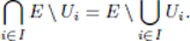
Given a set I and for each iI, a set Ui, we denote ⋃iI Ui the union of all the Ui, ⋂i ∈ I Ui their intersection and ∏iI Ui = {(ui)iI:uiUi, ∀ iI} their product. These quantities are related by De Morgan’s laws3:
(1.1)
image
(1.2)
image
The axiomatic construction of the set theory is, for instance, achieved in [SCHWARTZ, 100, chap. I] or [BOURBAKI, 16].
Mappings. A mapping T from a set X into a set Y is the data, for each uX, of an element T(u)Y. It is said that T is defined on X and that T(u) is the image by T of the point u. The image4 by T of a subset U of X is the se...
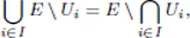
Table of contents

  1. Cover
  2. Table of Contents
  3. Title
  4. Copyright
  5. Introduction
  6. Familiarization with Semi-normed Spaces
  7. Notations
  8. Chapter 1: Prerequisites
  9. PART 1: SEMI-NORMED SPACES
  10. PART 2: CONTINUOUS MAPPINGS
  11. PART 3: WEAK TOPOLOGIES
  12. PART 4: DIFFERENTIAL CALCULUS
  13. Bibliography
  14. Cited Authors
  15. Index
  16. End User License Agreement