
Building Brains
eBook - ePub

Building Brains

An Introduction to Neural Development

  1. English
  2. ePUB (mobile friendly)
  3. Available on iOS & Android
eBook - ePub

Building Brains

An Introduction to Neural Development

About this book

Provides a highly visual, readily accessible introduction to the main events that occur during neural development and their mechanisms

Building Brains: An Introduction to Neural Development, 2ndĀ EditionĀ describes how brains construct themselves, from simple beginnings in the early embryo to become the most complex living structures on the planet. It explains how cells first become neural, how their proliferation is controlled, what regulates the types of neural cells they become, how neurons connect to each other, how these connections are later refined under the influence of neural activity, and why some neurons normally die. This student-friendly guide stresses and justifies the generally-held belief that a greater knowledge of how nervous systems construct themselves will help us find new ways of treating diseases of the nervous system that are thought to originate from faulty development, such as autism spectrum disorders, epilepsy, and schizophrenia.

  • A concise, illustrated guide focusing on core elements and emphasizing common principles of developmental mechanisms, supplemented by suggestions for further reading
  • Text boxes provide detail on major advances, issues of particular uncertainty or controversy, and examples of human diseases that result from abnormal development
  • Introduces the methods for studying neural development, allowing the reader to understand the main evidence underlying research advances
  • Offers a balanced mammalian/non-mammalian perspective (and emphasizes mechanisms that are conserved across species), drawing on examples from model organisms like the fruit fly, nematode worm, frog, zebrafish, chick, mouse and human
  • Associated Website includes all the figures from the textbook and explanatory movies

Filled with full-colorartwork that reinforces important concepts; an extensive glossary and definitions that help readers from different backgrounds; and chapter summaries that stress important points and aid revision,Ā Building Brains: An Introduction to Neural Development, 2ndĀ EditionĀ is perfect for undergraduate students and postgraduates who may not have a background in neuroscience and/or molecular genetics.

"This elegant book ranges with ease and authority over the vast field of developmental neuroscience. This excellent textbook should be on the shelf of every neuroscientist, as well as on the reading list of every neuroscience student."Ā 
—Sir Colin Blakemore, Oxford University

"With an extensive use of clear and colorful illustrations, this book makes accessible to undergraduates the beauty and complexity of neural development. The book fills a void in undergraduate neuroscience curricula."
—Professor Mark Bear, Picower Institute, MIT.

Highly Commended, British Medical Association Medical Book Awards 2012

Published with the New York Academy of Sciences
Frequently asked questions

Yes, you can cancel anytime from the Subscription tab in your account settings on the Perlego website. Your subscription will stay active until the end of your current billing period. Learn how to cancel your subscription.
At the moment all of our mobile-responsive ePub books are available to download via the app. Most of our PDFs are also available to download and we're working on making the final remaining ones downloadable now. Learn more here.
Perlego offers two plans: Essential and Complete
  • Essential is ideal for learners and professionals who enjoy exploring a wide range of subjects. Access the Essential Library with 800,000+ trusted titles and best-sellers across business, personal growth, and the humanities. Includes unlimited reading time and Standard Read Aloud voice.
  • Complete: Perfect for advanced learners and researchers needing full, unrestricted access. Unlock 1.4M+ books across hundreds of subjects, including academic and specialized titles. The Complete Plan also includes advanced features like Premium Read Aloud and Research Assistant.
Both plans are available with monthly, semester, or annual billing cycles.
We are an online textbook subscription service, where you can get access to an entire online library for less than the price of a single book per month. With over 1 million books across 1000+ topics, we’ve got you covered! Learn more here.
Look out for the read-aloud symbol on your next book to see if you can listen to it. The read-aloud tool reads text aloud for you, highlighting the text as it is being read. You can pause it, speed it up and slow it down. Learn more here.
Yes! You can use the Perlego app on both iOS or Android devices to read anytime, anywhere — even offline. Perfect for commutes or when you’re on the go.
Please note we cannot support devices running on iOS 13 and Android 7 or earlier. Learn more about using the app.
Yes, you can access Building Brains by David J. Price,Andrew P. Jarman,John O. Mason,Peter C. Kind in PDF and/or ePUB format, as well as other popular books in Biological Sciences & Neuroscience. We have over one million books available in our catalogue for you to explore.

Information

Publisher
Wiley
Year
2017
Print ISBN
9781119293880
eBook ISBN
9781119293712

1
Models and Methods for Studying Neural Development

1.1 What is neural development?

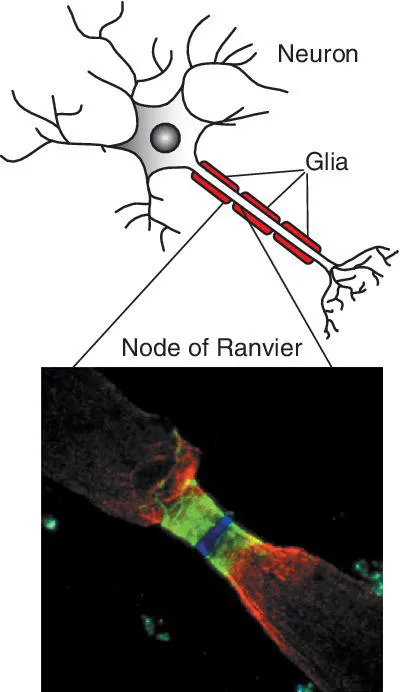
Neural development is the process by which the nervous system grows from its first beginnings in the embryo to its completion as a mature functioning system. The mature nervous system contains two classes of specialized and closely interacting cells: neurons and glia. Neurons transmit signals to, from and within the brain: their axons transmit electrical signals and they communicate with other cells via synapses. There are many types of neuron with specialized shapes and functions, with cell bodies that vary in diameter from only a few micrometers to around 100 micrometers and with axons whose lengths vary from a few micrometers to more than 1 meter. There are also different types of glial cell. The interactions between neurons and glia are very precise and they allow the nervous system to function efficiently. Figure 1.1 shows a beautiful example of the complex structures created by interacting neurons and glia, in this case a microscopic view of a labelled node of Ranvier, which allows rapid signalling in the nervous system.
Image described by caption and surrounding text.
Figure 1.1 A node of Ranvier: these highly organized structures, formed as a result of interactions between axons and glia, are essential for speeding up the transmission of electrical signals along axons. In this single fibre from the mouse spinal cord, sodium channels (blue) are sandwiched between the regions where axons and glia form junctions (called axoglial junctions) (green), which are, in turn, flanked by potassium channels (red). This picture is courtesy of Peter Brophy and Anne Desmazieres, University of Edinburgh, UK.
The great molecular, structural and functional diversity of neurons and glia is acquired in an organized way through processes that build on differences between the relatively small numbers of cells in the early embryo. As more and more cells are generated in a growing organism, new cells diversify in specific ways as a result of interactions with pre‐existing cells, continually adding to the organism’s complexity in a highly regulated manner. The development of an organism is a bit like the development of human civilization (allowing for the obvious difference that organismal development repeats over and over again). In both, population size and sophistication (be it humans on earth or cells in an organism) grow hand‐in‐hand, each stage adding further layers of complexity to previously generated structures, functions and interactions. The mechanisms that regulate cellular actions and interactions during development are often described using terms commonly applied to human activities. We shall highlight this at several places throughout the book where analogies might be helpful.
To understand how organisms develop we need to know how cells in each part of the embryo develop in specific and reproducible ways as a result of their own internal mechanisms interacting with an expanding array of stimuli from outside the cell. Many laboratories around the world are researching this area. Why?

1.2 Why research neural development?

1.2.1 The uncertainty of current understanding

One reason for researching neural development is that we still know relatively little about it. In this book we shall try to explain some of the main events that occur during neural development and, in particular, the mechanisms by which those events are brought about, in so far as we understand them. It is important, however, to appreciate that much of what we present, particularly our understanding of molecular mechanisms, is best thought of as continually evolving hypotheses rather than established facts. The biologist Konrad Lorenz once stated that ā€˜truth in science can be defined as the working hypothesis best suited to open the way to the next better one’; this is highly appropriate in developmental neurobiology.
Some of our understanding is incomplete or may be shown by future experiments to be inaccurate. We have tried to highlight issues of particular uncertainty or controversy and to indicate the limits of our knowledge, since it is at least as important and interesting to acknowledge what we do not know as it is to learn what we do know. Much of the excitement of developmental neurobiology arises from the mystery that surrounds Nature’s remarkable ability to create efficiently and reproducibly neural structures of great power.
One reason that we still know relatively little about the mechanisms of neural development is the sheer size and complexity of the finished product in higher animals. During the development of the human brain, for example, about 100 billion cells are generated with about 1000 trillion connections between them; if this number of connections is hard to visualize then consider that it might roughly equal the number of grains of sand on a small beach. Although cells and connections with similar properties can be grouped together, there is still great variation in their molecular make‐ups, morphologies and functions throughout the nervous system. In reading this book you will see that many of our hypotheses about neural development are formulated at the level of tissues or populations of cells rather than individual cells and their connections, particularly in higher mammals. Only in very simple organisms containing a few hundred neurons (e.g. in some worms) do we fully understand where each cell of the adult nervous system comes from and even then we do not know for sure what mechanisms determine how each cell and its connections develop. We still have a long way to go to gain a profound understanding of the molecular and cellular rules that govern the emergence of cells of the right types in the right numbers at the right places with the right connections between them functioning in the right ways.

1.2.2 Implications for human health

Just because we do not know much about a subject is not sufficient reason to want to invest time and resources in researching it further. However, there are many practical reasons for wanting to know more about the ways in which the nervous system develops. A better understanding should help us to tackle currently incurable diseases of the nervous system. Many congenital diseases affect neural development1 but their causes are often unknown; some examples of such diseases will be given later in this and in subsequent chapters. Numerous relatively common psychiatric and neurological diseases, such as schizophrenia, intellectual disabilities, autisms and some for...

Table of contents

  1. Cover
  2. Title Page
  3. Table of Contents
  4. Preface to Second Edition
  5. Preface to First Edition
  6. Conventions and Commonly used Abbreviations
  7. Introduction
  8. About the Companion Website
  9. 1 Models and Methods for Studying Neural Development
  10. 2 The Anatomy of Developing Nervous Systems
  11. 3 Neural Induction: An Example of How Intercellular Signalling Determines Cell Fates
  12. 4 Patterning the Neuroectoderm
  13. 5 Neurogenesis: Generating Neural Cells
  14. 6 How Neurons Develop Their Shapes
  15. 7 Neuronal Migration
  16. 8 Axon Guidance
  17. 9 Life and Death in the Developing Nervous System
  18. 10 Map Formation
  19. 11 Maturation of Functional Properties
  20. 12 Experience‐Dependent Development
  21. Glossary
  22. Index
  23. End User License Agreement