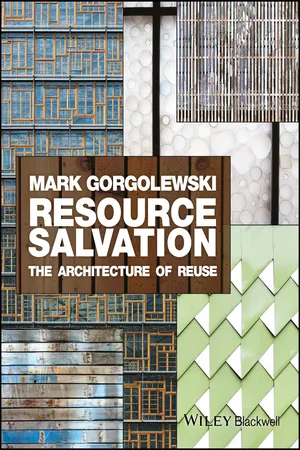
Resource Salvation
eBook - ePub

Resource Salvation

The Architecture of Reuse

  1. English
  2. ePUB (mobile friendly)
  3. Available on iOS & Android
eBook - ePub

Resource Salvation

The Architecture of Reuse

About this book

A valuable source of information, insight, and fresh ideas about a crucial aspect of the growing sustainable design movement

Mounting resource shortages worldwide coupled with skyrocketing extraction costs for new materials have made the prospect of materials reuse and recycling an issue of paramount importance. A fundamental goal of the sustainable design movement is to derive utmost use from construction materials and components, including energy, water, materials, building components, whole structures, and even entire infrastructures. Written by an expert with many years of experience in both industry and academe, this book explores a wide range of sustainable design strategies which designers around the globe are using to create efficient and aesthetically pleasing buildings from waste streams and discarded items. Emphasizing performance issues, design considerations and process constraints, it describes numerous fully realized projects, and explores theoretical applications still on the drawing board.

There is a growing awareness worldwide of the need for cyclical systems of materials reuse. Pioneering efforts at "closed-loop" design date as far back as 1960s, but only recently have architects and designers begun to focus on the opportunities which discarded materials can provide for creating high performance structures. A source of insight and fresh ideas for architects, engineers, and designers, Resource Salvation:

  • Reviews the theory and practice of building material and waste reuse and describes best practices in that area worldwide
  • Describes projects that use closed-loop thinking to influence and inspire the design of components, interiors, whole buildings, or urban landscapes
  • Illustrates how using discarded materials and focusing on closed loops can lead to new concepts in architecture, building science, and urban design
  • Demonstrates how designers have developed aesthetically compelling solutions to the demands of rigorous performance standards 

Resource Salvation is a source of information and inspiration for architects, civil engineers, green building professionals, building materials suppliers, landscape designers, urban designers, and government policymakers. It is certain to become required reading in university courses in sustainable architecture, as well as materials engineering and environmental engineering curricula with a sustainable design component. 

Trusted by 375,005 students

Access to over 1.5 million titles for a fair monthly price.

Study more efficiently using our study tools.

Information

Year
2017
Print ISBN
9781118928776
Edition
1
eBook ISBN
9781118928790

Chapter 1
Introduction

Our whole economy has become a waste economy, in which things must be almost as quickly devoured and discarded as they have appeared in the world, if the process itself is not to come to a sudden catastrophic end.
(Hannah Arendt1)
Today buildings are a graveyard for materials – once used they rarely have a further life. We hear that increasing percentages of demolition waste is ‘recycled’, but what value comes from this? Most recycling actually means crushing and use as road base or for other low value uses. Much of the usefulness and financial value is lost. Yet existing buildings and industrial waste streams are huge reservoirs of materials and components that can potentially be mined to provide much needed construction resources. There is increasing recognition that a building at the end of its life is an asset to be valued and that innovation and imaginative design can offer new opportunities for using discarded materials and components as valuable parts of buildings. In the developed world we can learn from ecological systems and from resource strategies in poorer parts of the world, where materials are more precious and salvaged items are more highly valued. This may help to create material systems for construction that replicate and integrate with the cyclical features of nature.
But what would our cities look like if our buildings were to be built from locally available, renewable and salvaged resources? What sort of new urban vernacular may emerge if we focus on previously used materials and components that come from the local area and do not need large amounts of energy and other primary resources? How does value in old materials get transformed and reconceptualized into new value? How can we transfer heritage value in components and not just whole buildings? Will the process of designing and constructing buildings need to change if it is based on a harvest of local, salvaged materials? What infrastructure is required to make this happen?
Today there is increasing interest in exploring how buildings are made and un-made, and in finding new business models that make use of discarded materials, components, and buildings (Figure 1.1). The above questions are addressed in this book, which draws on the experience of practitioners and case study projects to explore the potential for a new type of architecture that places a high economic, social and ecological value on existing materials and treats the urban environment as a transient store of resources that should be redeployed once their initial use is complete. The book focuses on the experience of designers who have started to explore ways to close resource loops, attempting to create systems where less is wasted. Materials destined for landfill are put back to use, with positive effects on the economy, society and the environment. As architect Jeanne Gang put it, they have begun to explore an ‘architecture originated in the material itself rather than in a formal language or design concept’.2
image
Figure 1.1 The TAXI building in Denver, CO, was entirely modernized by tres birds workshop using reclaimed materials, including a thermal exterior wall system fabricated from 21 000 recycled PET plastic water bottles.

Box 1.1 Venice Architecture Biennale 2016

For the 2016 Venice Architecture Biennale, Chilean architect Alejandro Aravena created two introductory rooms using over 90 tonnes of waste generated by the previous year's art biennale in Venice. Short lengths of previously used crumpled metal channelling were suspended vertically, creating a unique ceiling using waste. Also, the walls were covered by 10 000 m2 (100 000 sq. ft.) of multicoloured leftover plasterboard (drywall) pieces which were stacked to create a moulded surface that included protruding display shelves.
image

1.1 Background

Architecture in its traditional role is probably a dying profession. Today, architects must work with systems; they must design new ways of living and working in which buildings play a key role. We desperately need mediators between human need and the enduring cycles of nature. Architects can, and must inhabit this new role.
(Paul Hawken3)
Architecture is created from a fusion of concept and matter, what Louis Kahn called ‘the measurable and the unmeasurable’, and throughout history architecture has been shaped by a dialogue between ideas and materials. Kieran and Timberlake in their book Refabricating Architecture state that ‘architecture requires control, deep control, not merely of the idea, but also of the stuff we use to give form to the idea’.4 Traditionally this has led to a fascination with the newest and most innovative materials, and the evolution in architectural history has a strong association with new technology. Today the vast majority of materials used to create the built environment are new and pristine, and our consumer culture leads us to assume that new is best. At the same time, most materials are unrelated to place, and predominantly come from all over the world – aluminium may come from South America, steel from Russia, glass from China, timber from Canada and so on.
Material and component selection is a vital part of architecture because it holds such potential to communicate meaning in our built environment. In the developed world today we do not normally conceive of buildings as being made from local, salvaged, pre-used materials. We are used to the off-the-shelf method of choosing materials (and technologies). But up until the twentieth century many building components were custom designed by architects. Windows, columns and so on were not standardized. More recently, architects have come to rely on a readily available architectural palette of standardized components from catalogues or web sites. Information such as specifications, dimensions, and standard details for globally produced building components are readily available and their use is facilitated by digital technologies. Design and construction for most buildings is organized as a process of integration of appropriate components. This has isolated designers from a better understanding of materials and their tectonic potential and has removed some creative possibilities and discovery from design.
Furthermore, the quantity of these materials that we use has grown hugely. In the last 50 years the world population has doubled yet our use of some engineering materials has grown by 4–15 times.5 This huge increase has enabled us to increase our living standards, creating and servicing a huge urban infrastructure connected by extensive transport networks. But, as architect Thomas Rau has pointed out, unlike energy, which is widely available from the sun (we just need to implement appropriate technologies for harvesting it), access to materials is effectively limited by what is available on earth, and for some materials we have consumed most of the easily obtainable supply.
In a world faced with climate change, increased resource scarcity, and other environmental, social and economic challenges, access to new material resources and disposal of waste are becoming far more costly and constrained. Growing concerns about the loss of useful resources and physical limits of the earth's capacity to provide new resources and absorb the mountains of waste accumulating in landfills, as well as the increasing cost of disposal, are leading some to a rethink how we deal with resources.6 The United Nations Environment Programme (UNEP) has noted that ‘As global population continues to rise, and the demand for resources continues to grow, there is significant poten...

Table of contents

  1. Cover
  2. Title Page
  3. Copyright
  4. Table of Contents
  5. Foreword
  6. Acknowledgements
  7. Definitions
  8. Chapter 1: Introduction
  9. Chapter 2: Concepts Supporting Reuse
  10. Chapter 3: Case Studies
  11. Chapter 4: Materials Investigations
  12. Chapter 5: Practitioners
  13. Chapter 6: Implications For Design
  14. Bibliography
  15. Index
  16. End User License Agreement

Frequently asked questions

Yes, you can cancel anytime from the Subscription tab in your account settings on the Perlego website. Your subscription will stay active until the end of your current billing period. Learn how to cancel your subscription
No, books cannot be downloaded as external files, such as PDFs, for use outside of Perlego. However, you can download books within the Perlego app for offline reading on mobile or tablet. Learn how to download books offline
Perlego offers two plans: Essential and Complete
  • Essential is ideal for learners and professionals who enjoy exploring a wide range of subjects. Access the Essential Library with 800,000+ trusted titles and best-sellers across business, personal growth, and the humanities. Includes unlimited reading time and Standard Read Aloud voice.
  • Complete: Perfect for advanced learners and researchers needing full, unrestricted access. Unlock 1.5M+ books across hundreds of subjects, including academic and specialized titles. The Complete Plan also includes advanced features like Premium Read Aloud and Research Assistant.
Both plans are available with monthly, semester, or annual billing cycles.
We are an online textbook subscription service, where you can get access to an entire online library for less than the price of a single book per month. With over 1.5 million books across 990+ topics, we’ve got you covered! Learn about our mission
Look out for the read-aloud symbol on your next book to see if you can listen to it. The read-aloud tool reads text aloud for you, highlighting the text as it is being read. You can pause it, speed it up and slow it down. Learn more about Read Aloud
Yes! You can use the Perlego app on both iOS and Android devices to read anytime, anywhere — even offline. Perfect for commutes or when you’re on the go.
Please note we cannot support devices running on iOS 13 and Android 7 or earlier. Learn more about using the app
Yes, you can access Resource Salvation by Mark Gorgolewski in PDF and/or ePUB format, as well as other popular books in Economics & Sustainable Development. We have over 1.5 million books available in our catalogue for you to explore.