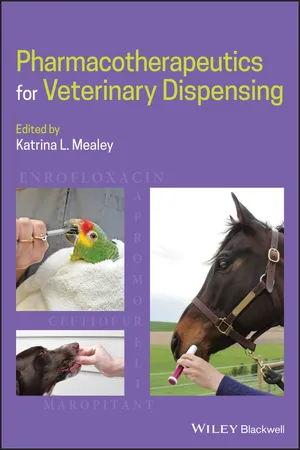
Delivers the foundational and practical knowledge required for pharmacists to become an integral part of the veterinary health care team, improving therapeutic outcome while preventing serious adverse drug reactions in veterinary patients
Pharmacotherapeutics for Veterinary Dispensing enables pharmacists and pharmacy students to expand the breadth of their pharmacological knowledge to include common veterinary species. The book offers a practical yet complete resource for dispensing drugs for canine and feline patients, with additional chapters on horses, birds, reptiles, small mammals, and food animals. Edited by a globally recognized expert in veterinary pharmacology, and including chapters written by veterinarians with expertise in pharmacotherapy and pharmacists with expertise in veterinary medicine, this book is designed to help pharmacists enhance the quality of veterinary patient care.
This book is the first to combine the expertise of both veterinarians and pharmacists to enable pharmacists to apply their knowledge and skills to assure optimal therapeutic outcomes for patients of all species. Pharmacotherapeutics for Veterinary Dispensing:
Puts the information needed to safely dispense prescription and OTC drugs for veterinary patients at the pharmacists' fingertips
Focuses on crucial details of canine and feline pharmacotherapeutics
Helps pharmacists avoid adverse drug reactions including pharmacogenomic and breed-related drug sensitivities
Offers an authoritative resource written by leading veterinary pharmacy experts designed to integrate pharmacists into the veterinary healthcare team
Includes crucial regulatory information unique to veterinary drug dispensing and compounding
Pharmacotherapeutics for Veterinary Dispensing is an essential reference for all pharmacists and pharmacy students that might find themselves dispensing drugs to veterinary patients, as well as for veterinarians and others involved with dispensing veterinary drugs.
"Pharmacotherapeutics for Veterinary Dispensing is a book long overdue for the pharmacy profession....Whether you have practiced veterinary pharmacy your whole career or have never practiced veterinary pharmacy, this book has much to offer. Veterinarians are encouraged to suggest this book to pharmacists with whom they work and interact." - JAVMA Vol 255 No. 6
Clinical Pharmacy Services, College of Veterinary Medicine, North Carolina State University, Raleigh, NC, USA
Key Points
Several organizations exist that support veterinary pharmacy practice, including a training and credentialing process that culminates in the designation of Diplomate, International College of Veterinary Pharmacy (ICVP).
Veterinary pharmacists are uniquely trained specialists that provide competent care and drug products to nonhuman species and can be resources for community pharmacists dispensing drugs to animals.
Veterinary pharmacotherapy is rapidly entering the mainstream of pharmacy practice, despite the fact that most pharmacists are not adequately trained in the field.
Veterinary drug law is significantly different from human drug law. For example, there is not currently a legal avenue for pharmacists to recommend human over‐the‐counter (OTC) drug products for veterinary patients.
Veterinary pharmacy residency training programs have grown substantially since 1989.
Core competencies for veterinary pharmacy education must be standardized and uniformly implemented across pharmacy school curricula.
1.1 Introduction
Although the practice of providing medicinal therapy to animals dates back to the Mesopotamian healer Urlugaledinna in 3000 BCE (Royal College of Veterinary Surgeons 2017), it took society nearly 5000 years to realize that pharmacists were well‐placed medical professionals that could provide safe and effective pharmacotherapy and monitoring to animal patients as well as to humans. In 1761, the first college of veterinary medicine was established in Lyon, France (Larkin 2010); and from that time until the mid‐twentieth century, the preparation, dispensing, and monitoring of medicinal agents for animals were almost exclusively performed by veterinarians. In the late twentieth century, the practice of clinical pharmacy for human medicine was established, and veterinary professionals began to recognize the unique therapeutic contributions made by clinically trained Doctors of Pharmacy. Veterinary pharmacy, which is practiced by pharmacists, is unique from the field of veterinary pharmacology, which is practiced by veterinarians, because it encompasses a three‐pronged approach that utilizes medicinal chemistry, pharmacology, and species‐specific pharmacotherapeutics to evaluate the best action plan for a specific patient. Beginning with a handful of pharmacists interested in veterinary medicine, veterinary pharmacy has now evolved into a globally impactful specialty area of pharmacy practice and residency training programs and encompasses a broad spectrum of practice settings, including veterinary teaching hospitals, veterinary medical practices, community pharmacies, governmental agencies, and the pharmaceutical industry.
While most pharmacists are not trained as veterinary pharmacy specialists, most community pharmacists will encounter prescriptions for nonhuman patients in their practice. A survey of more than 13 000 licensed pharmacists in North Carolina revealed that 77% of respondents filled prescriptions for animal patients in their practice (Sorah et al. 2015). A similar survey of pharmacists in Oregon also revealed that 77% of respondents filled prescriptions for veterinary patients (Mingura 2017). Pharmacists are the only healthcare professionals expected by society – and legally permitted by regulatory authorities – to provide pharmaceutical care and drug products for all species. Yet despite this unique position, only 4% of pharmacy students who graduated in 2015 reported receiving any training in veterinary pharmacotherapy (Arnish et al. 2015). In fact, the pharmacy oath (Figure 1.1) does not distinguish between human patients and veterinary patients. Despite the lack of standardized education in veterinary pharmacy, a US Food and Drug Administration (FDA) guidance document released in 2015 estimated that 75 000 pharmacies fill 6 350 000 compounded prescriptions for animal patients annually (FDA 2015). It is important to note that this estimate was only for compounded veterinary prescriptions and did not account for the number of all prescriptions dispensed from pharmacies to animals. Because most pharmacists have not received adequate training in comparative pharmacology and veterinary pharmacotherapeutics, one would have to question whether pharmacists are fulfilling the oath's obligations when it comes to dispensing drugs to veterinary patients.
Figure 1.1 The pharmacist's oath.
Drugs that achieve desired therapeutic effects in humans do not always produce the same effects in nonhuman patients, and vice versa. Using the wrong drug or the wrong dose of medications in animals can result in therapeutic failure or serious adverse events. In addition, statutes, regulations, rules, and guidance for drug use in animals are significantly different from those for humans, particularly with respect to animal species whose tissues or milk may be consumed by humans. Consequently, there is a critical need for community pharmacists to understand basic comparative pharmacology principles, laws surrounding drug use in food animal species, and pharmacotherapy of common veterinary diseases in order to serve the needs of the pet‐owning public. There is an additional need for a designated veterinary pharmacy specialty to meet the unique needs of providing legally compliant pharmaceutical products, compounds, counseling, and monitoring of veterinary patients on an in‐patient basis, as well as serving as a resource for community pharmacists outside of the veterinary practice setting.
1.1.1 History
Historically, the role of pharmacists in veterinary medicine was limited to incidental compounding of medications and dispensing human‐approved prescription drugs for pets within the community pharmacy practice. Veterinary pharmacy, as an exclusive practice, originated in colleges of veterinary medicine in North America. In 1965, Laurence Reed Enos, PharmD, became the first veterinary pharmacist when he was hired by the University of California (UC) Davis School of Veterinary Medicine (Laurence Reed Enos, personal communication, May 9, 2011; Jeanne Enos, personal communication, June 13, 2016). Clinical pharmacy was just beginning in human medicine at that time, and Dr. Enos was hired to serve a clinical role providing pharmaceutical care for veterinary patients and to provide education in pharmacotherapeutic principles to veterinary students. He held administrative, teaching, and service roles within both the School of Veterinary Medicine and the College of Pharmacy during his 37 years of practice there. His philosophy was to develop a strong clinical program in veterinary pharmacy that emphasized teaching, research, and therapeutics. In 1968, Faye Kernan, BSP, MTS, became Canada's first veterinary pharmacist, hired by the Western College of Veterinary Medicine at the University of Saskatchewan (Faye Kernan, personal communication, May 9, 2011). Like her US counterpart at UC Davis, Ms. Kernan established a model for veterinary pharmacy practice and earned tremendous respect from her veterinarian and pharmacist peers. Fifty years later, Kernan remains an active and vital contributor to veterinary pharmacy practice. Several other veterinary schools followed suit in hiring pharmacists in the late 1970s and early 1980s, and today all but one of the veterinary schools in the USA and Canada employ at least one pharmacist in a faculty, administrative, or professional staff position. In 1982, a group of veterinary pharmacists, including Kernan, met in Lincoln, Nebraska, to establish the Society of Veterina...
Table of contents
Cover
Table of Contents
List of Contributors
Preface
1 Introduction to Veterinary Pharmacy
2 Regulation of Veterinary Pharmaceuticals
3 Compounding for Animals
4 Comparative Pharmacokinetics and Pharmacodynamics
5 Breed Differences and Pharmacogenetics
6 Human Over‐the‐Counter (OTC) Products
7 Pharmacotherapy of Parasitic Disease
8 Pain Management in Veterinary Species
9 Pharmacotherapeutics of Infectious Disease
10 Cardiovascular Pharmacotherapeutics
11 Respiratory Pharmacotherapeutics
12 Gastrointestinal, Hepatic, and Pancreatic Pharmacotherapeutics
13 Pharmacotherapy of Renal and Lower Urinary Tract Disease
14 Pharmacotherapeutics of Immune‐Mediated Disease
15 Endocrine Pharmacotherapeutics
16 Behavioral Pharmacotherapeutics
17 Pharmacotherapeutics of Neurological Disorders
18 Dermatologic Pharmacotherapeutics
19 Ophthalmic Pharmacotherapeutics
20 Pharmacotherapeutics of Cancer
21 Introduction to Equine Pharmacotherapy
22 Introduction to Food Animal Pharmacotherapy
23 Pharmacotherapeutics for Nontraditional Pets
24 Special Considerations for Service, Working, and Performance Animals
25 Counseling for Owners of Veterinary Patients
Appendix A: Veterinary Teaching Hospital Pharmacy Contact Information
Appendix B: Directional Anatomical Terminology of Bipeds Quadrupeds
Appendix C: Vital signs and potential monitoring parameters for dogs, cats, horses, and ferrets
Appendix D: Auxiliary Labels Cross‐referenced by Drug
Appendix E: FDA Adverse Event Reporting Form
Appendix F: Veterinary Pharmacogenetics Testing Laboratories with Counseling Expertise
Appendix G: Therapeutic Drug Monitoring Laboratories
Appendix H: Canine and Feline Body Surface Area Conversion Tables
Appendix I: Zoonotic Diseases of Dogs, Cats, and Horses
Index
End User License Agreement
Trusted by 375,005 students
Access to over 1.5 million titles for a fair monthly price.
Study more efficiently using our study tools.
Frequently asked questions
Yes, you can cancel anytime from the Subscription tab in your account settings on the Perlego website. Your subscription will stay active until the end of your current billing period. Learn how to cancel your subscription
No, books cannot be downloaded as external files, such as PDFs, for use outside of Perlego. However, you can download books within the Perlego app for offline reading on mobile or tablet. Learn how to download books offline
We are an online textbook subscription service, where you can get access to an entire online library for less than the price of a single book per month. With over 1.5 million books across 990+ topics, we’ve got you covered! Learn about our mission
Look out for the read-aloud symbol on your next book to see if you can listen to it. The read-aloud tool reads text aloud for you, highlighting the text as it is being read. You can pause it, speed it up and slow it down. Learn more about Read Aloud
Yes! You can use the Perlego app on both iOS and Android devices to read anytime, anywhere — even offline. Perfect for commutes or when you’re on the go. Please note we cannot support devices running on iOS 13 and Android 7 or earlier. Learn more about using the app
Yes, you can access Pharmacotherapeutics for Veterinary Dispensing by Katrina L. Mealey in PDF and/or ePUB format, as well as other popular books in Medicine & Veterinary Medicine. We have over 1.5 million books available in our catalogue for you to explore.