Innovate your way toward growth using practical, research-backed frameworks
The Art of Opportunity offers a path toward new growth, providing the perspective and methods you need to make innovation happen. Written by a team of experts with both academic and industry experience—and a client roster composed of some of the world's leading companies—this book provides you with the necessary tools to help you capture growth instead of chasing it.
The visual frameworks and research-based methodology presented in The Art of Opportunity merge business design thinking and strategic innovation to help you change your growth paradigm. You'll learn creative and practical methods for exploring growth opportunities and employ a new approach for identifying what "opportunity" looks like in the first place. Put aside the old school way of focusing on new products and new markets, to instead applying value creation to find your new opportunity, craft your offering, design your strategy and build new growth ventures.
The changing business ecosystem is increasingly pushing traditional thinking out to pasture. New consumers and the new marketplace are demanding a profound adjustment to the way companies plan and execute growth strategies. This book gives you the tools to create your roadmap toward the new state of growth, and gain invaluable insight into a new way of thinking.
The Art of Opportunity will help you to:
Start looking at business growth from a new perspective
Create value for the customers, company and ecosystem
Innovate strategically and design new business models
Develop a new active business design thinking approach to innovation
Your company's goal is to grow, and to turn non-customers into customers. The old ways are becoming less tenable and less cost-effective. The Art of Opportunity outlines the new growth paradigm and gives you a solid framework for putting new ideas into practice.
Frequently asked questions
Yes, you can cancel anytime from the Subscription tab in your account settings on the Perlego website. Your subscription will stay active until the end of your current billing period. Learn how to cancel your subscription.
No, books cannot be downloaded as external files, such as PDFs, for use outside of Perlego. However, you can download books within the Perlego app for offline reading on mobile or tablet. Learn more here.
Perlego offers two plans: Essential and Complete
Essential is ideal for learners and professionals who enjoy exploring a wide range of subjects. Access the Essential Library with 800,000+ trusted titles and best-sellers across business, personal growth, and the humanities. Includes unlimited reading time and Standard Read Aloud voice.
Complete: Perfect for advanced learners and researchers needing full, unrestricted access. Unlock 1.4M+ books across hundreds of subjects, including academic and specialized titles. The Complete Plan also includes advanced features like Premium Read Aloud and Research Assistant.
Both plans are available with monthly, semester, or annual billing cycles.
We are an online textbook subscription service, where you can get access to an entire online library for less than the price of a single book per month. With over 1 million books across 1000+ topics, we’ve got you covered! Learn more here.
Look out for the read-aloud symbol on your next book to see if you can listen to it. The read-aloud tool reads text aloud for you, highlighting the text as it is being read. You can pause it, speed it up and slow it down. Learn more here.
Yes! You can use the Perlego app on both iOS or Android devices to read anytime, anywhere — even offline. Perfect for commutes or when you’re on the go. Please note we cannot support devices running on iOS 13 and Android 7 or earlier. Learn more about using the app.
Yes, you can access The Art of Opportunity by Marc Sniukas,Parker Lee,Matt Morasky in PDF and/or ePUB format, as well as other popular books in Business & Business General. We have over one million books available in our catalogue for you to explore.
we seize growth opportunities in a targeted way and benefit from the dynamic development of new business areas in the long term.
— PROSIEBENSAT.1 MEDIA Annual Report 20141
Chapter 1
When Thomas Ebeling became the new CEO of ProSiebenSat.1 Media AG (Pro7) in 2009, he faced a familiar problem: how to grow the business. Pro7 was the leading media company in the German TV advertising market with their core business of free TV—financed by advertising. Mr. Ebeling's challenge was how to grow the business and achieve over €1 billion in incremental revenues by 2018. Resorting to traditional strategic moves, expanding existing businesses and offerings, would certainly not do the trick.
Pro7 crafted a unique strategy for a new business area making TV advertising available to start-ups, and small and medium-sized companies, two customer segments that traditionally couldn't afford TV advertising and were seen as unprofitable by the industry. One year after the new business had been launched, it had already generated €20 million in profit. Five years later, Pro7 had achieved tremendous success with its new strategy. In fact, the strategy worked so well that in 2015, the €1 billion plus target was increased to €1.85 billion.
Business professionals and scholars admire achievements like these and wonder how Pro7 tapped into new markets and developed new business areas. Finding and seizing opportunities for new growth is, after all, the Holy Grail of business. And if Pro7 didn't use traditional growth methods, exactly how did they arrive at new offerings, complete with innovative business models and revenue models, to reach entirely new customer segments?
What Is Strategic Innovation?
The Art of Opportunity is about how strategic innovation and business design thinking can grow existing businesses and create completely new ones by discovering opportunities for new growth and crafting strategies to seize these opportunities.
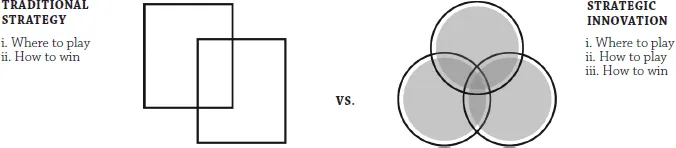
Strategy is essentially about making choices about where to play and how to win. Strategic management theories offer frameworks to guide our thinking, help develop answers to these questions, and make such choices. The approach and concepts of The Art of Opportunity provide fresh and modern ways to look at these questions, enabling you to come up with more innovative answers than yesterday's traditional strategic management approaches might offer.
Traditional Strategic Management
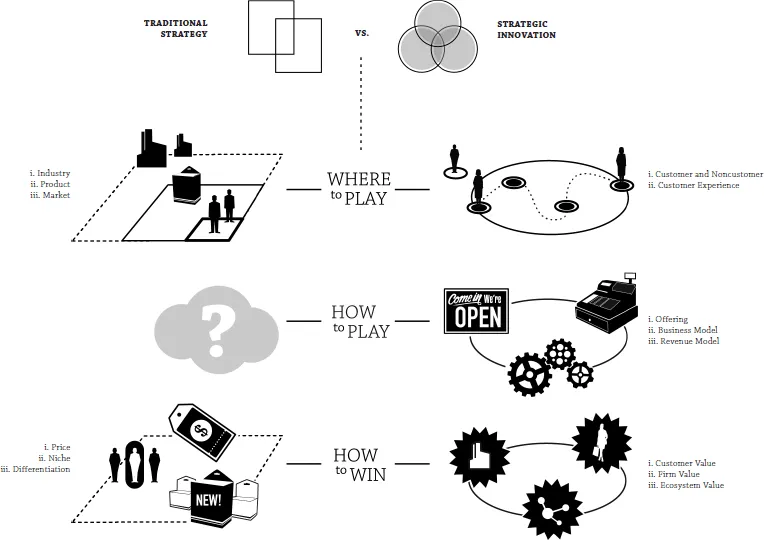
On a Business Level, traditional strategic management 2 is primarily concerned with where to play and how to win. Where to play is framed as a choice of industry and product/market combination. Simply speaking, you pick an industry, say air transportation, and a market, for example continental flights in the United States, and you define your offering within this market, for example low-cost direct city-to-city flights.
How to win is mostly defined as achieving competitive advantage. Michael Porter's classic generic choices 3 about how to achieve competitive advantage are to either (1) be a cost leader, (2) differentiate your offering, or (3) focus on a niche. Treacy and Wiersema4 offer three choices to win: (1) product leadership (offer the best product by focusing on product innovation); (2) operational excellence (be a price and convenience leader by focusing on low cost, lean and fast production, and speedy delivery); or (3) customer intimacy (win by creating loyal customers through tailored offerings and focusing on customer relationships).
Strategy development and execution thereby follow a linear process of analyzing the situation and environment, followed by developing a strategy, and finally executing it. The underlying principle is that the development of the strategy has to be completed before the strategy can be executed.
To be clear: we don't suggest that these traditional strategic management approaches do not work. For some organizations and in certain industries, they work extremely well, if applied in the right way. Yet a lot of companies also struggle when attempting to achieve their growth and innovation targets with these traditional frameworks.
Strategic Innovation
How Does our Take on strategic innovation differ from these more traditional approaches?
First of all, we shift the objective from focusing on achieving competitive advantage by simply being cheaper or different to finding and seizing opportunities by creating value. Traditional strategy is focused on the company, trying to position the company as being a cost leader, being different, focusing on a niche, or something similar, as we have seen. But being cheaper or different alone is simply no longer enough to be successful (if it ever was). The Art of Opportunity takes an entrepreneurial stance, looking beyond positioning your company to a larger holistic perspective that involves creating value for your customer, your firm, and your business ecosystem. Only by creating value for a multitude of stakeholders does your company have the potential to be successful. And creating value is achieved through more than simply offering a cheap or different product, to include products, services, the entire customer experience (CX), your business model, and your revenue model.
Having described the differences, let's examine The Art of Opportunity's approach to designing your strategy. The book offers a fresh perspective to look at three areas: (1) Where to play, (2) How to play, and (3) How to win.
...
Table of contents
Cover
Series Page
Title Page
Copyright
Dedication
Foreword
Acknowledgments
Introduction
Reader's Journey
Part 1: Artful Innovation
Part 2: Discover Your new Growth Opportunity
Part 3: Craft Your Strategy
Part 4: Launch Your New Growth Business
Part 5: Mastering the Art: Business Design Thinking