Advanced MaterialInterfaces is a state-of-the-art look at innovative methodologies and strategies adopted for interfaces and their applications. The 13 chapters are written by eminent researchers not only elaborate complex interfaces fashioned of solids, liquids, and gases, but also ensures cross-disciplinary mixture and blends of physics, chemistry, materials science, engineering and life sciences. Advanced interfaces operate fundamental roles in essentially all integrated devices. It is therefore of the utmost urgency to focus on how newly-discovered fundamental constituents and interfacial progressions can be materialized and used for precise purposes. Interfaces are associated in wide multiplicity of application spectrum from chemical catalysis to drug functions and the advancement is funnelled by fine-tuning of our fundamental understanding of the interface effects.
The modification of water/solid interfaces by adsorbed neutral or charged macromolecules is proved to provide an excellent environment for controlled protein loading and release. Advanced experimental methodologies that probe the structural details of planar interfaces at nanometer length scales are presented. The broad fields of polymers at interfaces and protein–polymer interactions in solutions are introduced as a lay ground for the central subject of proteins at polymer-modified interfaces. Important contributions to the literature are used as paradigms to highlight the main findings and open subjects in the field, and at the same time, the complementary use of experimental methods is illustrated. The different kinds of interactions of proteins with macromolecular layers of various conformations are broadly categorized, although the boundaries between cases are by no means strict.
Keywords: Polymer interfaces, protein–polymer interactions, polyelectrolyte multilayers, polyelectrolyte brushes, protein adsorption, counterion release, protein charge anisotropy
1.1 Introduction
Controlling the properties of interfaces is a major research challenge because of the numerous practical applications in nano-bio technologies [1]. Implant compatibility, protein separation and resistance, drug loading and release, tissue engineering, and antifouling are fields where the modern concepts can be exploited and generalized. Recent advances in experimental studies of well-defined systems lay the ground for better understanding and potential theoretical description of the complex problem of bio-molecules or nano-drugs near polymer-functionalized interfaces. Polymers at interfaces offer great versatility due to their possibility for selective immobilization of components and stimuli responsiveness [2].
In this chapter, the central concepts of protein interaction with polymer-modified interfaces are presented. The conformation of the surface-attached macromolecular chains and the steric, electrostatic, and hydrophobic forces are key players in the binding of proteins on polymers and polyelectrolytes. Hence, the most commonly used polymeric layers, e.g. polyelectrolyte multilayers and neutral polymer or polyelectrolyte brushes are presented together with the main experimental methods used for their characterization in the first part of the chapter [3, 4]. Additionally, the interaction of proteins with solid surfaces in contact with water is introduced.
The main part of the chapter deals with the complexation of proteins with neutral polymer or polyelectrolyte layers in the water/solid interface. The key methods for studying the conformational changes and distribution of chains and proteins upon protein complexation are presented through important contributions from the literature, as the neutron reflectivity study of the distribution of deuterated proteins within PEG brushes [5]. The mechanisms of counterion release and the role of protein charge anisotropy are described, as they have been under investigation in the past decade and are still an open field of research. Finally, works with potential for applications are highlighted.
1.2 Neutral and Charged Macromolecules at Interfaces
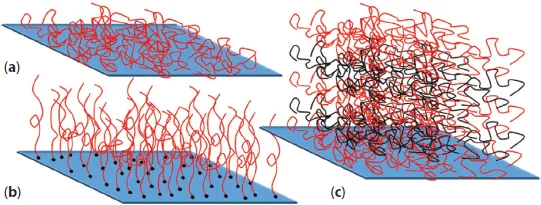
The formation of polymeric interfaces is a field with long tradition in soft-matter research [6] because of its tremendous importance in industrial applications, food science, and biomedical research [2]. This discipline has evolved to the study of stimuli responsive interfaces created by the presence of stimuli-responsive polymers. Since, in this chapter, the discussion will be focused on physical interactions between polymers and proteins, we will mainly discuss formation of polymeric interfaces from aqueous solutions. The formed layers can be very broadly categorized in (a) statistically adsorbed linear chains, (b) macromolecular brushes, and (c) polyelectrolyte multilayers (Figure 1.1).
Figure 1.1 Layers of macromolecular chains on surfaces: (a) statistically adsorbed linear chains, (b) macromolecular brushes (grafting points at the chain ends are depicted as black dots), and (c) polyelectrolyte multilayers (grey and black chain layers alternate).
Adsorption of macromolecular species from aqueous solutions in contact with an interface depends on the interface/macromolecule interactions inside water. When the macromolecule contains hydrophobic groups, then their tendency to reduce their contacts with water forces them to separate from solution and become attached to the surface [7]. This effect can be reinforced by increasing the hydrophobicity of the interface, e.g. by polystyrene (PS) modification of a silicon surface [8]. Although energetically it is favorable for all the hydrophobic groups of the chains to become attached on the surface, there are constraints [9] caused by the reduction of the chain conformational entropy (chain elasticity) and steric/electrostatic repulsions between chain segments near the interface. For homopolymer chains that contain segments with a moderate affinity to a surface entropic and steric restriction put a barrier to the amount of adsorbed polymer [10]. A random copolymer with hydrophilic and hydrophobic monomers is driven to the surface mostly due to its hydrophobic units [11]. In both cases, the segments bound to the surface are statistically distributed along the contour length (Figure 1.1a). The conformations are described by loops (free dangling chain parts between adsorbed segments), trains (continuous adsorbed chain parts), and tails free ends of adsorbed chains [6].
The conformation of adsorbed macromolecular chains is different than its conformation in solution. In a confined geometry the distances between monomers of different chains are fairly close, which increases the inter-chain interactions. Additionally, the interactions with the interface are very crucial since the last may create strong bonds for certain monomers, while others are free to move in solution. An example of great conformational change caused by confinement, due to interaction within a polymeric layer, is this of a macromolecular brush of chains in good solvent conditions (Figure 1.1b). The chains do not feel any strong attraction from the surface except that their one end is bound to it (end-attached chains). If the distance (on the interface plane) between neighboring attaching points is much higher than the dilute-solution radius of gyration of a single chain, then the monomer concentration within the layer is high enough to overcome the entropic cost for stretching the chains outwards [12, 13]. Macromolecular brushes are very effective in stabilizing colloidal dispersions, especially polyelectrolyte brushes in aqueous media [14]. This way they can also prevent protein adsorption due to the high content of molecular species that makes difficult for incoming ones (proteins) to penetrate and reach the surface.
In aqueous environments, the use of macromolecules with ionizable groups, i.e. polyelectrolytes is very popular since it offers a great variety of polymers (even otherwise intrinsically hydrophobic) to be used and also provides stimuli-responsive properties. In brushes made from end-attached strongly charged polyelectrolytes, the salt concentration of the solution acts as an external stimulus. Increasing the salt content, the electrostatic repulsions between monomers weaken, and the elasticity of the chains reduces the layer thickness. In particular, in a brush with high grafting density and high number concentration of counterions (osmotic brush), the salt content of the solution makes a difference to the brush characteristics only when it is higher than the counterion concentration within the brush. At low salt content, the counterions are localized within the brush and keep it fully extended by the high osmotic pressure they create [15]. This effect is a powerful way to prevent colloidal aggregation and flocculation even at relatively high salt concentrations where the electrostatic repulsions are too weak to provide stability.
As already discussed, except from the brush conformation, where chains can be chemically grafted or physically adsorbed by a hydrophobic group or block at the end of the chain (amphiphilic block architecture), homopolymers, or random copolymers can become physically adsorbed on an interface. In that case, polymeric layers can be produced, but the range of thicknesses and adsorbed amounts that can be achieved is limited. Especially in the case of polyelectrolyte adsorption, the long range repulsion between chains of a single species creates an energy barrier for new chains to reach contact with the surface that keeps the adsorbed amounts relatively low. A straight-forward way to create highly hydrated polyelectrolyte layers [16] of desirable thickness, and adsorbed amount is the layer-by-layer deposition (Figure 1.1c) of alternating positively and negatively charged polyelectrolytes, i.e. polyelectrolyte multilayers [17].
1.3 Interfacial Experimental Methods
One of the most powerful methods to investigate polymeric layers on solid/liquid [18, 19] and air/liquid interfaces [20] is neutron reflectivity (NR). As in all neutron scattering-related techniques, the scattering contrast is defined by the neutron scattering length density differences of the components in the system. The power of these methods is in the fact that chemically equivalent isotopic nuclei can have significantly different scattering lengths, e.g. hydrogen versus deuterium. Using a hydrogenated polymer in a deuterated solvent (D2O) creates adequate contrast for strong scattered intensity. Additionally, when labeling one component between others is feasible, for example, one polymeric species within a mixture or a certain block of diblock copolymers, selective deuteration is used [19]. This selective exchange of hydrogens with deuterons creates species of clearly different neutron scattering length densities. Mixing the hydrogenated and deuterated version of the solvent (contrast variation) can produce a solvent of the same scattering length density as one of the species (contrast matching). Making one of the species effectively “invisible” from neutrons allows the conformation of the other species to be independently characterized.
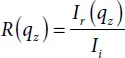
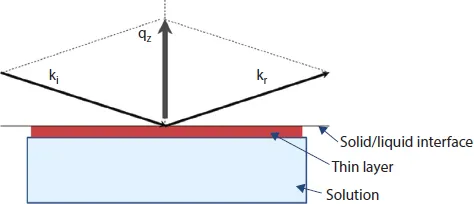
In NR, a collimated neutron beam (with intensity Ii) hits the interface and the reflected intensity Ir (Figure 1.2) is measured as a function of the momentum transfer (qz), i.e. the difference between the reflected and incident wave vectors. The measured quantity of interest is the reflectivity
. The x–y (interfacial plane) average of scattering lengh density profile ρ(z) defines R(qz). Hence, a reflectivity experiment [21] provides the scattering length density profile perpendicularly to the plane of incidence defined by the planar interface (z-direction of Figure 1.2).
Figure 1.2 Schematic representation of NR for the characterization of a layer on the solid/liquid interface.
Atomic force microscopy (AFM) provides the roughness profile of a surface or in other words the height profile z(x,y) by measuring the force between a probe tip (cantilever) and the surface. In the tapping mode, the perturbation on soft samples is minimal in contrast to the contact mode. The os...
Table of contents
Cover
Half Title page
Title page
Copyright page
Preface
Part 1: Interfaces Design, Fabrication, and Properties
Part 2: Functional Interfaces: Fundamentals and Frontiers
Index
Trusted by 375,005 students
Access to over 1.5 million titles for a fair monthly price.
Study more efficiently using our study tools.
Frequently asked questions
Yes, you can cancel anytime from the Subscription tab in your account settings on the Perlego website. Your subscription will stay active until the end of your current billing period. Learn how to cancel your subscription
No, books cannot be downloaded as external files, such as PDFs, for use outside of Perlego. However, you can download books within the Perlego app for offline reading on mobile or tablet. Learn how to download books offline
Perlego offers two plans: Essential and Complete
Essential is ideal for learners and professionals who enjoy exploring a wide range of subjects. Access the Essential Library with 800,000+ trusted titles and best-sellers across business, personal growth, and the humanities. Includes unlimited reading time and Standard Read Aloud voice.
Complete: Perfect for advanced learners and researchers needing full, unrestricted access. Unlock 1.5M+ books across hundreds of subjects, including academic and specialized titles. The Complete Plan also includes advanced features like Premium Read Aloud and Research Assistant.
Both plans are available with monthly, semester, or annual billing cycles.
We are an online textbook subscription service, where you can get access to an entire online library for less than the price of a single book per month. With over 1.5 million books across 990+ topics, we’ve got you covered! Learn about our mission
Look out for the read-aloud symbol on your next book to see if you can listen to it. The read-aloud tool reads text aloud for you, highlighting the text as it is being read. You can pause it, speed it up and slow it down. Learn more about Read Aloud
Yes! You can use the Perlego app on both iOS and Android devices to read anytime, anywhere — even offline. Perfect for commutes or when you’re on the go. Please note we cannot support devices running on iOS 13 and Android 7 or earlier. Learn more about using the app
Yes, you can access Advanced Materials Interfaces by Ashutosh Tiwari,Hirak K. Patra,Xuemei Wang in PDF and/or ePUB format, as well as other popular books in Technology & Engineering & Materials Science. We have over 1.5 million books available in our catalogue for you to explore.