Mechanics of Dislocation Fields
eBook - ePub

Mechanics of Dislocation Fields

  1. English
  2. ePUB (mobile friendly)
  3. Available on iOS & Android
eBook - ePub

Mechanics of Dislocation Fields

About this book

Accompanying the present trend of engineering systems aimed at size reduction and design at microscopic/nanoscopic length scales, Mechanics of Dislocation Fields describes the self-organization of dislocation ensembles at small length scales and its consequences on the overall mechanical behavior of crystalline bodies.

The account of the fundamental interactions between the dislocations and other microscopic crystal defects is based on the use of smooth field quantities and powerful tools from the mathematical theory of partial differential equations. The resulting theory is able to describe the emergence of dislocation microstructures and their evolution along complex loading paths. Scale transitions are performed between the properties of the dislocation ensembles and the mechanical behavior of the body.

Several variants of this overall scheme are examined which focus on dislocation cores, electromechanical interactions of dislocations with electric charges in dielectric materials, the intermittency and scale-invariance of dislocation activity, grain-to-grain interactions in polycrystals, size effects on mechanical behavior and path dependence of strain hardening.
Frequently asked questions

Yes, you can cancel anytime from the Subscription tab in your account settings on the Perlego website. Your subscription will stay active until the end of your current billing period. Learn how to cancel your subscription.
No, books cannot be downloaded as external files, such as PDFs, for use outside of Perlego. However, you can download books within the Perlego app for offline reading on mobile or tablet. Learn more here.
Perlego offers two plans: Essential and Complete
  • Essential is ideal for learners and professionals who enjoy exploring a wide range of subjects. Access the Essential Library with 800,000+ trusted titles and best-sellers across business, personal growth, and the humanities. Includes unlimited reading time and Standard Read Aloud voice.
  • Complete: Perfect for advanced learners and researchers needing full, unrestricted access. Unlock 1.4M+ books across hundreds of subjects, including academic and specialized titles. The Complete Plan also includes advanced features like Premium Read Aloud and Research Assistant.
Both plans are available with monthly, semester, or annual billing cycles.
We are an online textbook subscription service, where you can get access to an entire online library for less than the price of a single book per month. With over 1 million books across 1000+ topics, we’ve got you covered! Learn more here.
Look out for the read-aloud symbol on your next book to see if you can listen to it. The read-aloud tool reads text aloud for you, highlighting the text as it is being read. You can pause it, speed it up and slow it down. Learn more here.
Yes! You can use the Perlego app on both iOS or Android devices to read anytime, anywhere — even offline. Perfect for commutes or when you’re on the go.
Please note we cannot support devices running on iOS 13 and Android 7 or earlier. Learn more about using the app.
Yes, you can access Mechanics of Dislocation Fields by Claude Fressengeas in PDF and/or ePUB format, as well as other popular books in Technology & Engineering & Materials Science. We have over one million books available in our catalogue for you to explore.

1
Continuous Dislocation Modeling

1.1. Introduction

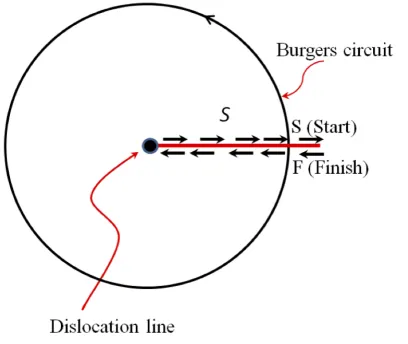
Dislocations are conventionally viewed in the Volterra construct as discontinuities of the elastic displacement across bounded surfaces terminating at the dislocation line [VOL 07], as sketched in Figure 1.1. However, it is rather well known in the world of physics modeling that defects viewed at sufficiently small scales do not involve discontinuities and singularities, but instead appropriately localized smooth fields. The Peierls-Nabarro model is such a paradigmatic model in the field of dislocation mechanics [NAB 47, PEI 40]. If only from the point of view of mathematical analysis and numerical computation, smooth localized representations of dislocations are essential to build regular sets of partial differential equations leading to their dynamics through the solution of well-posed boundary value problems. As line defects, dislocations imply a duality between the terminating curve of discontinuity of the elastic displacement field on a bounded surface and the smooth incompatibility of its “gradient” field, i.e. the elastic distortion field. Following this idea, the plan developed in this chapter is that geometrically defined incompatibility fields allow smooth modeling of the line defects supporting the singularity.
image
Figure 1.1. Cross-section view of a dislocation line terminating the elastic displacement discontinuity across a bounded surface S. S and F are the starting and finishing points of an oriented closed Burgers circuit. For a color version of this figure, see www.iste.co.uk/fressengeas/dislocation.zip

1.2. Lattice incompatibility

The continuous description of a crystalline body B containing lattice defects such as dislocations and grain boundaries, and possibly submitted to loads on its external boundaries, consists of a set of points, perhaps coincident with atom sites, of vectors connecting these points and of continuous mappings and transformations relating these objects. The fixed set of atoms composing B lies, at any given time t, in a region of space called a configuration B(t). Each spatial point P of the initial configuration B0 = B(0) corresponding to the as-received state of the body B at time t = 0 is associated with a “material particle”...

Table of contents

  1. Cover
  2. Table of Contents
  3. Title
  4. Copyright
  5. Acknowledgements
  6. Introduction
  7. 1 Continuous Dislocation Modeling
  8. 2 Elasto-static Field Equations
  9. 3 Dislocation Transport
  10. 4 Constitutive Relations
  11. 5 Elasto-plastic Field Equations
  12. 6 Case Studies
  13. 7 Review and Conclusions
  14. Appendix: Complements
  15. Bibliography
  16. Index
  17. End User License Agreement