The definitive guide to organic coatings, thoroughly revised and updated—now with coverage of a range of topics not covered in previous editions
Organic Coatings: Science and Technology, Fourth Edition offers unparalleled coverageof organic coatings technology and its many applications. Written by three leading industry experts (including a new, internationally-recognized coatings scientist) it presents a systematic survey of the field, revises and updates the material from the previous edition, and features new or additional treatment of such topics as superhydrophobic, ice-phobic, antimicrobial, and self-healing coatings; sustainability, artist paints, and exterior architectural primers. making it even more relevant and useful for scientists and engineers in the field, as well as for students in coatings courses.
The book incorporates up-to-date coverage of recent developments in the field with detailed discussions of the principles underlying the technology and their applications in the development, production, and uses of organic coatings. All chapters in this new edition have been updated to assure consistency and to enable extensive cross-referencing. The material presented is also applicable to the related areas of printing inks and adhesives, as well as areas within the plastics industry.
This new edition
Completely revises outdated chapters to ensure consistency and to enable extensive cross-referencing
Correlates the empirical technology of coatings with the underlying science throughout
Provides expert troubleshooting guidance for coatings scientists and technologists
Features hundreds of illustrative figures and extensive references to the literature
A new, internationally-recognized coatings scientist brings fresh perspective to the content.
Providing a broad overview for beginners in the field of organic coatings and a handy reference for seasoned professionals, Organic Coatings: Science and Technology, Fourth Edition, gives you the information and answers you need, when you need them.
Coatings have been used since prehistoric times to protect objects and convey information, and they are ubiquitous in modern society as they serve to both protect substrates and impart aesthetic qualities to improve objects’ appearance. If you are reading this text in a traditional paper book, the paper is coated. Look up and the walls of your room are coated, as are the windows. If you are wearing glasses, the lenses are likely coated to improve the plastic’s scratch resistance and absorb UV radiation. If you are reading this text on a computer screen, the screen is coated to prevent glare and perhaps reduce fingerprints. The CPU inside your computer exists because of coatings used during the printing of nanometer‐sized circuits. If you are outside, the buildings, cars, airplanes, roads, and bridges are all coated. Objects without coatings are less common than those with coatings!
Just because coatings science is an ancient technology does not mean that innovation has ceased. Today many coatings scientists and formulators are working diligently to improve the performance of coatings, reduce the environmental impact of their manufacture and application, and create coatings that provide functionality beyond today’s coatings.
1.1 DEFINITIONS AND SCOPE
Coatings are typically thought of as thin layers that are applied to an object, which is often referred to as the substrate. Thus, one of the defining characteristics of a coating is its thinness. While the thickness of a coating depends on the purpose it serves, typical coating thicknesses range from a few microns to a few hundred microns, but of course, exceptions to this are common. Historically, the thickness of a coating was often quoted in terms of mils, where 1 mil equals one thousandth of an inch or 25.4 µm.
While coatings can be made from any material, this book is primarily concerned with organic coatings. Thus, we leave for other books coatings such as the zinc coatings used to galvanize steel, ceramic coatings that are formed from metal oxides or when metals such as aluminum are anodized, and the many other inorganic coatings used to impart hardness, scratch resistance, or corrosion protection. While these coatings are both technically and economically important, they lie mostly beyond the scope of this book.
Organic coatings are often composite materials in that they are composed of more than one distinct phase. The matrix, called the binder, holds the other components of the coating composition together and typically forms the continuous phase in the dry coating. As stated previously, we are mostly concerned with organic coatings, where the binder is typically an organic polymer.
A confusing situation results from multiple meanings of the term coating. As a noun coating is used to describe both the material (usually a liquid) that is applied to a substrate and the resultant “dry” film. As a verb, coating means the process of application. Usually, the intended meaning of the word coating can be inferred from the context. The terms paint and finish often mean the same thing as coating and also are used both as nouns and verbs. What is the difference between a coating and a paint? Not much—the terms are often used interchangeably. However, it is fairly common practice to use “coatings” as the broader term and to restrict “paints” to the familiar architectural and household coatings and sometimes to maintenance coatings for bridges and tanks. Some prefer to call sophisticated materials that are used to coat automobiles and computer components “coatings,” and others call them “paints.” Consumers are often familiar with the terms varnish or stain. These are types of coatings that are used to protect and beautify wood and are certainly within the scope of this book as they are typically made from polymeric binders with or without pigments.
Because we are limiting the scope of this book to organic coatings that are historically associated with paints, we are also choosing not to cover important materials such as coatings applied to paper and fabrics, decals, laminates and cosmetics, and printing inks, even though one could argue that these coatings share much in common with traditional paints. However, readers interested in those materials will find that many of the basic principles discussed in this text are applicable to such materials. Restrictions of scope are necessary if the book is to be kept to a reasonable length, but our restrictions are not entirely arbitrary. The way in which we are defining coatings is based on common usage of the term in worldwide business. For classification purposes, coatings are often divided into three categories: architectural coatings, original equipment manufacturer (OEM) coatings, and special purpose coatings.
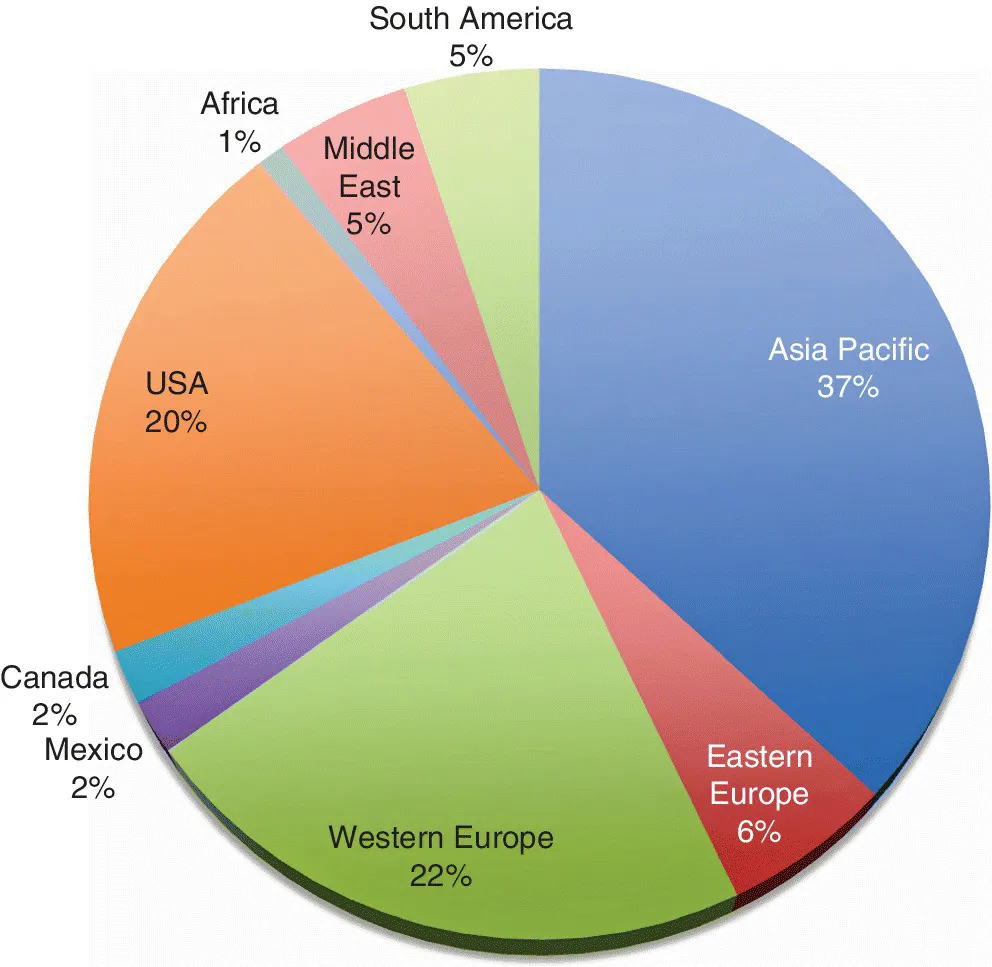
As the coatings industry is a relatively mature industry, its growth rate typically paces that of the general economy. Like many other industries, growth has slowed in North America and Europe and has dramatically increased in Asia and South America as those economies have boomed. An estimate of the value of coatings used in each region is shown in Figure 1.1. The total value of the global coatings market was estimated to be approximately $112 billion in 2014 (American Coatings Association and Chemquest Group, 2015).
Figure 1.1 The value of coatings used in 2014.
Source: Reproduced with permission of American Coatings Association.
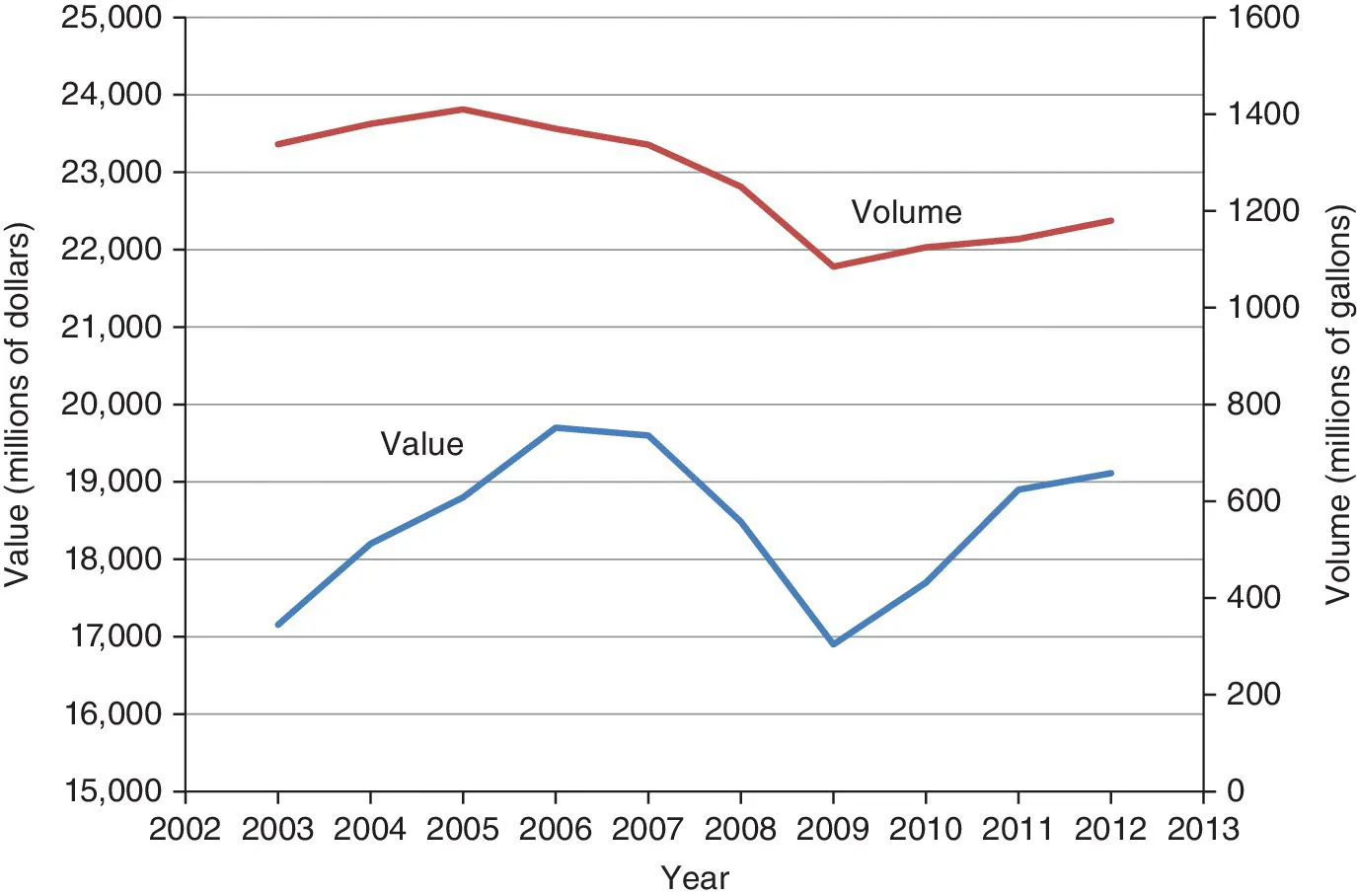
Figure 1.2 summarizes the estimated value and volume of coating shipments in the United States for a recent 10‐year period. The effect of the economic downturn in 2008–2009 is evident (Data from American Coatings Association and Chemquest Group, 2015).
Figure 1.2 Ten‐year trend in coating shipments in the United States (both gallons and dollar value).
Source: Reproduced with permission of American Coatings Association.
1.2 TYPES OF COATINGS
Architectural coatings include paints and varnishes (transparent paints) used to decorate and protect buildings, outside and inside. They also include other paints and varnishes sold for use in the home and by small businesses for application to such things as cabinets and household furniture (not those sold to furniture factories). Architectural coatings are often called trade sales paints. They are sold directly to painting contractors and do‐it‐yourself users through paint stores and other retail outlets. In 2014 in the United States, architectural coatings accounted for about 60% of the total volume of coatings; however, the unit value of these coatings was lower than for the other categories, so they made up about 49% of the total value. This market is the least cyclical of the three categories. While the annual amount of new construction drops during recessions, the resulting decrease in paint requirements tends to be offset by increased repainting of older housing, furniture, and so forth during at least mild recessions. Latex‐based coatings make up about 77% of architectural coatings. Interior paints are approximately 2/3 of all architectural coatings, exterior paints 23%, and stains 7%, with the remained split among varnishes, clear coats, and others.
OEM coatings are applied in factories on products such as automobiles, appliances, magnet wire, aircraft, furniture, metal cans, and chewing gum wrappers—the list is almost endless. In 2014 in the United States, product coatings were about 29% of the volume and 31% of the value of all coatings. The volume of product coatings depends directly on the level of manufacturing activity. This category of the business is cyclical, varying with OEM cycles. Often, product coatings are custom designed for a particular customer’s manufacturing conditions and performance requirements. The number of different types of products in this category is much larger than in the others; research and development (R&D) requirements are also high.
Special purpose coatings are industrial coatings that are applied outside a factory, along with a few miscellaneous coatings, such as coatings packed in aerosol containers. This category includes refinish coatings for cars and trucks that are applied outside the OEM factory (usually in body repair shop...
Table of contents
Cover
Title Page
Table of Contents
Preface
Chapter 1: Introduction to Coatings
Chapter 2: Polymerization and Film Formation
Chapter 3: Flow
Chapter 4: Mechanical Properties
Chapter 5: Exterior Durability
Chapter 6: Adhesion
Chapter 7: Corrosion Protection by Coatings
Chapter 8: Acrylic Resins
Chapter 9: Latexes
Chapter 10: Polyester Resins
Chapter 11: Amino Resins
Chapter 12: Polyurethanes and Polyisocyanates
Chapter 13: Epoxy and Phenolic Resins
Chapter 14: Drying Oils
Chapter 15: Alkyd Resins
Chapter 16: Silicon Derivatives
Chapter 17: Other Resins and Cross‐Linkers
Chapter 18: Solvents
Chapter 19: Color and Appearance
Chapter 20: Pigments
Chapter 21: Pigment Dispersion
Chapter 22: Effect of Pigments on Coating Properties
Chapter 23: Application Methods
Chapter 24: Film Defects
Chapter 25: Solventborne and High Solids Coatings
Chapter 26: Waterborne Coatings
Chapter 27: Electrodeposition Coatings
Chapter 28: Powder Coatings
Chapter 29: Radiation Cure Coatings
Chapter 30: Product Coatings for Metal Substrates
Chapter 31: Product Coatings for Nonmetallic Substrates
Chapter 32: Architectural Coatings
Chapter 33: Special Purpose Coatings
Chapter 34: Functional Coatings
Index
End User License Agreement
Trusted by 375,005 students
Access to over 1.5 million titles for a fair monthly price.
Study more efficiently using our study tools.
Frequently asked questions
Yes, you can cancel anytime from the Subscription tab in your account settings on the Perlego website. Your subscription will stay active until the end of your current billing period. Learn how to cancel your subscription
No, books cannot be downloaded as external files, such as PDFs, for use outside of Perlego. However, you can download books within the Perlego app for offline reading on mobile or tablet. Learn how to download books offline
We are an online textbook subscription service, where you can get access to an entire online library for less than the price of a single book per month. With over 1.5 million books across 990+ topics, we’ve got you covered! Learn about our mission
Look out for the read-aloud symbol on your next book to see if you can listen to it. The read-aloud tool reads text aloud for you, highlighting the text as it is being read. You can pause it, speed it up and slow it down. Learn more about Read Aloud
Yes! You can use the Perlego app on both iOS and Android devices to read anytime, anywhere — even offline. Perfect for commutes or when you’re on the go. Please note we cannot support devices running on iOS 13 and Android 7 or earlier. Learn more about using the app
Yes, you can access Organic Coatings by Frank N. Jones,Mark E. Nichols,Socrates Peter Pappas in PDF and/or ePUB format, as well as other popular books in Physical Sciences & Industrial & Technical Chemistry. We have over 1.5 million books available in our catalogue for you to explore.