Provides a revolutionary conceptual framework and practical tools to quantify uncertainty and recognize the value of flexibility in real estate development
This book takes a practical "engineering" approach to the valuation of options and flexibility in real estate. It presents simple simulation models built in universal spreadsheet software such as Microsoft Excel®. These realistically reflect the varying and erratic sources of uncertainty and price dynamics that uniquely characterize real estate. The text covers new analytic procedures that are valuable for existing properties and enable a new, more profitable perspective on the planning, design, operation, and evaluation of large-scale, multi-phase development projects. The book thereby aims to significantly improve valuation and investment decision making.
Flexibility and Real Estate Valuation under Uncertainty: A Practical Guide for Developers is presented at 3 levels. First, it introduces and explains the concepts underlying the approach at a basic level accessible to non-technical and non-specialized readers. Its introductory and concluding chapters present the important "big picture" implications of the analysis for economics and valuation and for project design and investment decision making.
At a second level, the book presents a framework, a roadmap for the prospective analyst. It describes the practical tools in detail, taking care to go through the elements of the approach step-by-step for clarity and easy reference.
The third level includes more technical details and specific models. An Appendix discusses the technical details of real estate price dynamics. Associated web pages provide electronic spreadsheet templates for the models used as examples in the book.
Some features of the book include:
• Concepts and tools that are simple and accessible to a broad audience of practitioners;
• An approach relevant for all development projects;
• Complementarity with the author's Commercial Real Estate Analysis & Investments—the most-cited real estate investments textbook on the market.
Flexibility and Real Estate Valuation under Uncertainty: A Practical Guide for Developers is for everyone studying or concerned with the implementation of large-scale or multi-phase real estate development projects, as well as property investment and valuation more generally.
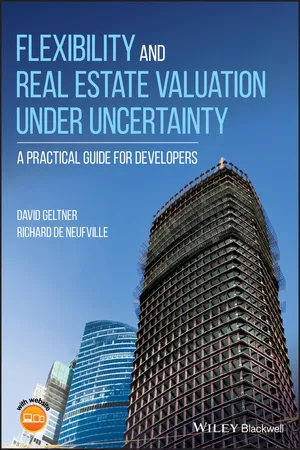
eBook - ePub
Flexibility and Real Estate Valuation under Uncertainty
A Practical Guide for Developers
- English
- ePUB (mobile friendly)
- Available on iOS & Android
eBook - ePub
Flexibility and Real Estate Valuation under Uncertainty
A Practical Guide for Developers
About this book
Information
1
Discounted Cash Flow Valuation: The Basic Procedures and Concepts Underlying Spreadsheet Valuation Constitute the Springboard to our Approach of Analyzing Flexibility Under Uncertainty
LEARNING OBJECTIVES
- Share the reasons why we focus on the discounted cash flow (DCF) model;
- Establish the basic terminology and setup that we use throughout the text;
- Review the mechanics of the DCF valuation model;
- Understand the use of the DCF model for prospective (ex‐ante) and retrospective (ex‐post) valuations.
OUTLINE OF THE CHAPTER
- 1.1 Why the Focus on the Discounted Cash Flow Model?
- 1.2 Structure of a Discounted Cash Flow Spreadsheet
- 1.3 The Cash Flow Projection
- 1.4 Discount Rate
- 1.5 Market Value and Forward‐Looking (Ex‐Ante) Analysis
- 1.6 Backward‐Looking (Ex‐Post) Analysis
- 1.7 Conclusion
The focus of this book is on the valuation of properties and development projects in the face of uncertainty. We concentrate particularly on management and design flexibility, which is the ability to respond to circumstances in order to reduce downside risks and take advantage of upside opportunities.
To this end, everything in this book builds on and uses the basic discounted cash flow (DCF) model. So, to ensure we’re all on the same page, and using the same terminology and basic understanding about this tool, this first chapter introduces and reviews the DCF model, and thereby sets the stage for all that follows.
First, we discuss why it makes sense for us to focus on the DCF model. What makes the DCF model so appropriate for our purpose? (See Section 1.1.)
Second, we describe the essential elements of the DCF model. We define both the terminology and structure of the model that we use throughout the book. We do this to establish a common vocabulary and to avoid confusion that might arise from different professional practices. This quick review also introduces DCF modeling for those who might not be familiar with the procedure (see Sections 1.2–1.4).
Third, we illustrate the two basic ways to use the DCF model to value projects. We can use it to value projects prospectively—in advance of making investments, as an aid to decision‐making. We can also use it retrospectively—to assess the actual past performance of a real estate asset and investment, to help diagnose the causes of success and failure (see Sections 1.5 and 1.6).
1.1 Why the Focus on the Discounted Cash Flow Model?
Three factors make the DCF model the most appropriate basis for valuation of real estate properties and developments in the face of uncertainty:
- DCF is based on fundamental financial economic theory, explicitly recognizing and valuing, based on opportunity cost, the three seminal considerations in investment: cash flow, time, and risk.
- The DCF model is already the analytic workhorse for valuation of real estate investments. Many of you are probably already familiar with it.
- Implemented in modern computer spreadsheet software, the DCF model is very efficient and widely applicable. The relevant calculations usually take seconds or less. And the model can realistically represent a wide range of complex situations useful for valuing flexibility under uncertainty.
Allow us to elaborate briefly on these three points.
The focus of DCF on cash contrasts with a focus on accounting metrics such as net income. Of course, such accounting metrics are very important, and DCF models often include and use accounting metrics. Nevertheless, cash is what you can actually use—in investments, in business, in life. The accounting metrics are indirect representatives, reflections, or predictors of the existing or future cash flow that ultimately matters.
The “D” part of “DCF” is how we account for time and risk in the valuation. Future money is worth less than present money for two reasons:
- You could be using the money in the meantime (maybe to spend on consumption, maybe to earn returns in investment); and
- The future money might not materialize in full or at all, since the future is uncertain (no one has a crystal ball).
The discount rate by which the DCF procedure reduces future expected cash flow to present value (PV) accounts for both of these considerations. It does this accounting based on the fundamental economic principle of opportunity cost, using a discount rate that reflects what the investor could expect to earn by investing in a similar investment of similar risk. In short, the DCF model is solid, elegant, and intuitive.
The DCF model is not just sound from an economic theory perspective—its use too is widespread. DCF models operate using computer spreadsheets, which are a common way to organize data for valuation analysis. Spreadsheets are everywhere in financial analysis. Business analysts and decision‐makers worldwide use common spreadsheet programs such as Microsoft Excel®. Such spreadsheet software is, in effect, a common language in the business and financial world. This can greatly facilitate communication, transparency, understanding, and use.
Finally, DCF models based on computer spreadsheets have tremendous range and flexibility in what they can do for us analytically, especially in our quest to bring uncertainty and flexibility explicitly into valuation. Spreadsheets take in numerical data and calculate outputs, allowing us to easily change one or more entries and recalculate to see the results instantaneously. Spreadsheets have two special capabilities that enable us to represent uncertainty and flexibility. These capabilities are easy to implement and use, and are essential to the approach we present in this book.
- First, we can easily use spreadsheets to calculate thousands of variations of the same problem automatically, in seconds. This feature allows us to deal with the range of possible economic and other variations that could affect the performance of an investment and hence the valuation of the real estate. This frees us from the need to confine our analysis to just a few estimates of the possible future. It enables us to look at probabilistic distributions of possibilities in detail, such as the effects of business cycles and market movements—a step that is necessary for the proper valuation of flexibility. This capability is available through the random number generation capability and the “data table” function in Microsoft Excel®.
- Second, we can set up the spreadsheet to represent the actions of a decision‐maker choosing to take appropriate actions under the conditions we specify. In effect, we can create an analog model of the investment and decision‐making process. Thus, we can program potential decisions to take advantage of the flexibility to sell a property under favorable circumstances, or to delay development in a down economic cycle, for example. This capability enables us to represent and quantify the advantages of certain options and certain types of decision flexibility. This approach also enables us to value several options simultaneously, a capability largely beyond the ability of many of the formal academic models o...
Table of contents
- Cover
- Title Page
- Table of Contents
- Foreword
- Authors’ Preface
- Acknowledgments
- About the Companion Website
- 1 Discounted Cash Flow Valuation
- 2 Economics of the Discounted Cash Flow Valuation Model
- 3 Future Scenarios Matter
- 4 Scenario Analysis
- 5 Future Outcomes Cover a Range of Possibilities
- 6 Simulation of Outcomes
- 7 Modeling Price Dynamics
- 8 Interpreting Simulation Results
- 9 Resale Timing Decision: Analysis
- 10 Resale Timing Decision: Discussion
- 11 Development Project Valuation
- 12 Basic Flexibility in Development Projects
- 13 Option Dichotomies
- 14 Product Options in Development
- 15 Timing Options in Development
- 16 Garden City: An Example Multi‐Asset Development Project
- 17 Effect of Uncertainty without Flexibility in Development Project Evaluation
- 18 Project Start‐Delay Flexibility
- 19 Decision Rules and Value Implications
- 20 Modular Production Timing Flexibility
- 21 Product Mix Flexibility
- 22 Project Phasing Flexibility
- 23 Optimal Phasing
- 24 Overall Summary
- Appendix Quantifying Real Estate Uncertainty
- Glossary
- Acronyms and Symbols
- Index
- End User License Agreement
Trusted by 375,005 students
Access to over 1.5 million titles for a fair monthly price.
Study more efficiently using our study tools.
Frequently asked questions
Yes, you can cancel anytime from the Subscription tab in your account settings on the Perlego website. Your subscription will stay active until the end of your current billing period. Learn how to cancel your subscription
No, books cannot be downloaded as external files, such as PDFs, for use outside of Perlego. However, you can download books within the Perlego app for offline reading on mobile or tablet. Learn how to download books offline
Perlego offers two plans: Essential and Complete
- Essential is ideal for learners and professionals who enjoy exploring a wide range of subjects. Access the Essential Library with 800,000+ trusted titles and best-sellers across business, personal growth, and the humanities. Includes unlimited reading time and Standard Read Aloud voice.
- Complete: Perfect for advanced learners and researchers needing full, unrestricted access. Unlock 1.5M+ books across hundreds of subjects, including academic and specialized titles. The Complete Plan also includes advanced features like Premium Read Aloud and Research Assistant.
We are an online textbook subscription service, where you can get access to an entire online library for less than the price of a single book per month. With over 1.5 million books across 990+ topics, we’ve got you covered! Learn about our mission
Look out for the read-aloud symbol on your next book to see if you can listen to it. The read-aloud tool reads text aloud for you, highlighting the text as it is being read. You can pause it, speed it up and slow it down. Learn more about Read Aloud
Yes! You can use the Perlego app on both iOS and Android devices to read anytime, anywhere — even offline. Perfect for commutes or when you’re on the go.
Please note we cannot support devices running on iOS 13 and Android 7 or earlier. Learn more about using the app
Please note we cannot support devices running on iOS 13 and Android 7 or earlier. Learn more about using the app
Yes, you can access Flexibility and Real Estate Valuation under Uncertainty by David Geltner,Richard de Neufville in PDF and/or ePUB format, as well as other popular books in Business & Real Estate. We have over 1.5 million books available in our catalogue for you to explore.