Merger Arbitrage
eBook - ePub

Merger Arbitrage

How to Profit from Global Event-Driven Arbitrage

  1. English
  2. ePUB (mobile friendly)
  3. Available on iOS & Android
eBook - ePub

Merger Arbitrage

How to Profit from Global Event-Driven Arbitrage

About this book

Mitigate risk and increase returns with an alternative hedge fund strategy

Merger Arbitrage: How to Profit from Event-Driven Arbitrage, Second Edition is the definitive guide to the ins and outs of the burgeoning merger arbitrage hedge fund strategy, with real-world examples that illustrate how mergers work and how to take advantage of them. Author Thomas Kirchner, founder of the Pennsylvania Avenue Event-Driven Fund, discusses the factors that drove him to invest solely in merger arbitrage and other event-driven strategies, and details the methods used to incorporate merger arbitrage into traditional investment strategies.

And while there is always a risk that a deal will fall through, the book explains how minimal such risks really are when the potential upside is factored in. Early chapters of the book focus on the basics of the merger arbitrage strategy, including an examination of mergers and the incorporation of risk into the arbitrage decision. Following chapters detail deal structures, financing, and legal aspects to provide the type of in-depth knowledge required to execute an effective investment strategy. The updated second edition stresses new, increasingly relevant information like:

  • Worldwide legal deal regimes
  • UK takeover code
  • UK takeover code global offspring
  • Regulators around the world

The book provides clear, concise guidance on critical considerations including leverage and options, shorting stocks, and legal recourse for inadequate merger consideration, allowing readers to feel confident about trying a new investment strategy. With simple benefits including diversification of risk and return streams, this alternative hedge fund strategy has a place in even the most traditional plan. Merger Arbitrage: How to Profit from Event-Driven Arbitrage, Second Edition provides the information that gives investors an edge in the merger arbitrage arena.

Trusted by 375,005 students

Access to over 1.5 million titles for a fair monthly price.

Study more efficiently using our study tools.

Information

Publisher
Wiley
Year
2016
Print ISBN
9781118736357
Edition
2
eBook ISBN
9781118736661
Subtopic
Finance

Part One
The Arbitrage Process

Chapter 1
Introduction to Merger Arbitrage

Arbitrage is one of the oldest forms of commercial activity. One of the earliest published definitions of the term arbitrage can be found in Wyndham Beaves's seminal Lex Mercatoria,1 first published in 1685, which trained several generations of European merchants until its last edition of 1803. One will be hard pressed to find a finance book today that has been in print for over a century. In the 1734 edition, Beaves writes about arbitrage:
ARBITRATION (a Construction of the French Word Arbitrage) in Exchanges has been variously defined by the several Authors who have treated of it.
One says it is a Combination or Conjunction made of many Exchanges, to find Out what Place is the most advantageous to remit or draw on.
Another describes it, by saying it is only the Foresight of a considerable Advantage which a Merchant shall receive from a Remis or Draught, made on one Place preferably to another.
A third construes it to be a Truck which two Bankers mutually make of their Bills upon different Parts, at a conditional Price and Course of Exchange.
According to a fourth, it is the Negociation of a Sum in Exchange, once or oftener repeated, on which a Person does not determine till after having examined by several Rules which Method will turn best to Account.
Lex Mercatoria, 1734, p. 387
Around that time also appeared in Basel the first book dedicated to arbitrage, J. Wiertz's 1725 oeuvre Traite des Arbitrages de Change,2 which discusses various calculation methods to convert one currency into another. All of these early forms of arbitrage involved currency arbitrage. Patrick Kelly describes a typical nineteenth-century arbitrage in his 1811 book The Universal Cambist, and Commercial Instructor: Being a General Treatise on Exchange, Including the Monies, Coins, Weights and Measures of All Trading Nations and Their Colonies: with an Account of Their Banks and Paper Currencies,3 which took over from Beaves's Lex Mercatoria as the obligatory text book for merchants in the nineteenth century:
Arbitration of Exchange
Arbitration of Exchange is a comparison between the course of exchange of several places, in order to ascertain the most advantageous method of drawing or remitting Bills. It is distinguished into simple and compound arbitration: the former comprehends the exchanges of three places only, and the latter of more than three places.
Simple Arbitration
Is a comparison between the exchanges of two places with respect to a third—that is to say, it is a method of finding such a rate of exchange between two places as shall be in proportion with the rates quoted between each of them and a third place. The exchange thus determined is called the Arbitrated Price, and also Proportional Exchange.
If, for example, the course between London and Paris be 24 Francs for £1 sterling, and between Paris and Amsterdam 54d. Flemish for 3 Francs, (that is, 36s. Flemish for 24 Francs,) the arbitrated price between London and Amsterdam through Paris, is evidently 36s. Flemish for £1 sterling: for as 3 Fr. : 54d. Flem. :: 24 Fr. : 36s. Flem.
Now, when the actual or direct price (as seen by a quotation of otherwise advised) is found to differ from the arbitrated price, advantage may be made by drawing or remitting indirectly; that is, by drawing on one place through another, as on Amsterdam through Paris; […]
To exemplify this by familiar illustrations, suppose the arbitrated price between London and Amsterdam to be, as before stated, 36s. Flemish for £1 sterling; and suppose the direct course, as given in Lloyd's list, to be 37s. Flemish, then London, by drawing directly on Amsterdam, must give 37s. Flemish for £1 sterling; whereas, by drawing through Paris he will give only 36s. Flemish for £1 sterling; it is, therefore, the interest of London to draw indirectly on Amsterdam through Paris.
As securities markets began to develop and expand globally during the nineteenth century, arbitrage began to expand beyond simple currency exchanges. This is reflected in how Otto Swoboda expands the definition of arbitrage in his book Börse und Actien, first published in Cologne in the year 1869:4
Under arbitrage, that is decision, we understand the comparison of notations of any one place with those of another in order to use any arising difference, relative to exchange rates as well as security quotes, and thereby those who enter into such arbitrages (bring together) differences in prices between to places in their favor. […] Ear...
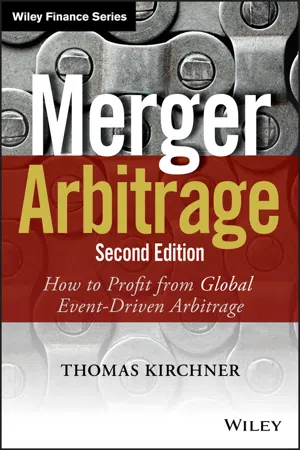
Table of contents

  1. Cover
  2. Series Page
  3. Title Page
  4. Copyright
  5. Table of Contents
  6. Preface
  7. Acknowledgments
  8. Part One: The Arbitrage Process
  9. Part Two: Pitfalls of Merger Arbitrage
  10. Part Three: Investing in Merger Arbitrage
  11. About the Author
  12. Exercises
  13. Index
  14. End User License Agreement

Frequently asked questions

Yes, you can cancel anytime from the Subscription tab in your account settings on the Perlego website. Your subscription will stay active until the end of your current billing period. Learn how to cancel your subscription
No, books cannot be downloaded as external files, such as PDFs, for use outside of Perlego. However, you can download books within the Perlego app for offline reading on mobile or tablet. Learn how to download books offline
Perlego offers two plans: Essential and Complete
  • Essential is ideal for learners and professionals who enjoy exploring a wide range of subjects. Access the Essential Library with 800,000+ trusted titles and best-sellers across business, personal growth, and the humanities. Includes unlimited reading time and Standard Read Aloud voice.
  • Complete: Perfect for advanced learners and researchers needing full, unrestricted access. Unlock 1.5M+ books across hundreds of subjects, including academic and specialized titles. The Complete Plan also includes advanced features like Premium Read Aloud and Research Assistant.
Both plans are available with monthly, semester, or annual billing cycles.
We are an online textbook subscription service, where you can get access to an entire online library for less than the price of a single book per month. With over 1.5 million books across 990+ topics, we’ve got you covered! Learn about our mission
Look out for the read-aloud symbol on your next book to see if you can listen to it. The read-aloud tool reads text aloud for you, highlighting the text as it is being read. You can pause it, speed it up and slow it down. Learn more about Read Aloud
Yes! You can use the Perlego app on both iOS and Android devices to read anytime, anywhere — even offline. Perfect for commutes or when you’re on the go.
Please note we cannot support devices running on iOS 13 and Android 7 or earlier. Learn more about using the app
Yes, you can access Merger Arbitrage by Thomas Kirchner in PDF and/or ePUB format, as well as other popular books in Business & Finance. We have over 1.5 million books available in our catalogue for you to explore.