The Strategy Pathfinder
eBook - ePub

The Strategy Pathfinder

Core Concepts and Live Cases

  1. English
  2. ePUB (mobile friendly)
  3. Available on iOS & Android
eBook - ePub

The Strategy Pathfinder

Core Concepts and Live Cases

About this book

Real-world strategic management practice in an interactive micro-case format

The Strategy Pathfinder presents an innovative, dynamic guide to strategic thinking and practice. Using real-world case examples from companies like Apple, the BBC, Hyundai, LEGO, McDonalds, Nike and SpaceX to illustrate critical concepts, this book enables readers to actively participate in real-world strategy dilemmas and create their own solutions. Strategy Pathfinder's 'live' micro-cases provoke discussion about business models, value creation, new ventures and more, while its complimentary instructional content introduces you to the best 'classic' and new tools of strategic management.

Rather than passively reproducing past and current ideas, Strategy Pathfinder encourages strategic thinkers to learn by doing. The book is designed to help the reader to develop a clear understanding of key concepts while shifting your thought processes towards real strategic action and innovation by enabling you to:

  • Use strategy theories and frameworks to engage in analytical and creative discussions about key strategic issues facing real companies today
  • Form strategic views for yourself, and test them against the views of others
  • Effectively make and communicate recommendations based on solid strategic analysis that stand up to scrutiny from multiple stakeholders
  • Become an active producer of new strategic ideas rather than a passive receiver of past wisdom

This third edition has been updated with new chapters and cases to reflect the latest, cutting-edge issues in strategic thinking and practice.  And the updated companion website offers students, instructors and managers more resources to facilitate understanding, interaction and innovation.

As an active learning experience, The Strategy Pathfinder 3rd Edition engages the reader in the work of strategy practitioners. By arming you with the empirical research you need, and the best strategic management theories and frameworks to better analyse situations you're likely to encounter or already facing in your career, The Strategy Pathfinder teaches you how to improve your strategic thinking and practice, and develop your own strategic pathways for the future.
Frequently asked questions

Yes, you can cancel anytime from the Subscription tab in your account settings on the Perlego website. Your subscription will stay active until the end of your current billing period. Learn how to cancel your subscription.
No, books cannot be downloaded as external files, such as PDFs, for use outside of Perlego. However, you can download books within the Perlego app for offline reading on mobile or tablet. Learn more here.
Perlego offers two plans: Essential and Complete
  • Essential is ideal for learners and professionals who enjoy exploring a wide range of subjects. Access the Essential Library with 800,000+ trusted titles and best-sellers across business, personal growth, and the humanities. Includes unlimited reading time and Standard Read Aloud voice.
  • Complete: Perfect for advanced learners and researchers needing full, unrestricted access. Unlock 1.4M+ books across hundreds of subjects, including academic and specialized titles. The Complete Plan also includes advanced features like Premium Read Aloud and Research Assistant.
Both plans are available with monthly, semester, or annual billing cycles.
We are an online textbook subscription service, where you can get access to an entire online library for less than the price of a single book per month. With over 1 million books across 1000+ topics, we’ve got you covered! Learn more here.
Look out for the read-aloud symbol on your next book to see if you can listen to it. The read-aloud tool reads text aloud for you, highlighting the text as it is being read. You can pause it, speed it up and slow it down. Learn more here.
Yes! You can use the Perlego app on both iOS or Android devices to read anytime, anywhere — even offline. Perfect for commutes or when you’re on the go.
Please note we cannot support devices running on iOS 13 and Android 7 or earlier. Learn more about using the app.
Yes, you can access The Strategy Pathfinder by Duncan Angwin,Stephen Cummings in PDF and/or ePUB format, as well as other popular books in Business & Decision Making. We have over one million books available in our catalogue for you to explore.

Information

Publisher
Wiley
Year
2017
Print ISBN
9781119311843
eBook ISBN
9781119311898
Edition
3

1
Strategic Purpose

I have a dream ...
Martin Luther King
The most widely used Strategy Tool in the world is the SWOT analysis, which stands for Strengths, Weaknesses, Opportunities and Threats – and it has been so for 60 years. And yet many using it are disappointed with their results.
Why?
The problem is often that the SWOT analysis isn’t aimed at anything. It only works if you know where you are trying to go. As Lewis Carroll’s Alice asks the Cheshire Cat: “Would you please tell me which way to go from here?” To which the Cat replies: “That depends on where you want to get to.” Opportunities only have meaning if you know where you are going. Weaknesses are only strategic weaknesses if they make it difficult to achieve what you are striving for. Defining elements of SWOT without articulating your purpose is a pointless exercise. So without first articulating what your aim is, what purpose you are trying to achieve, or what winning looks like, a SWOT analysis can be time consuming, frustrating and ultimately unfruitful.
Knowing where to go is the point of Martin Luther King Jnr’s famous “I Have a Dream” speech, which painted an aspirational picture of the aim of the American Civil Rights movement: a picture of a country living up to the creed of its founders (that all humans are created equal) and a nation enacting its better nature. It greatly helped his followers and his organisation, and inspired others around the world concentrating on civil rights to stay focused, see the big picture when times were tough and develop strategies that would lead toward the achievement of this aim.
King’s example of the importance of clarity of strategic purpose is supported by other inspirational characters such as Yogi Berra who said, in his distinctive style, “You’ve got to be careful if you don’t know where you’re going, because you might not get there”, and Abraham Lincoln: “If we could first know where we are, and whither we are tending, we could then better judge what to do, and how to do it” – an excellent synopsis of an effective strategy process.
All of these quotes indicate that any really effective strategy development process starts with a dream, a purpose. Without this, any discussion about what strategies should be followed can lead, as it did for Alice, to a lot of energy being expended for the sake of going around in circles. Indeed a loss of purpose can also lead to organisational decline and failure – a situation LEGO found itself in, after years of strong growth, with huge losses in 2004.
In this, our first chapter, we discuss what an organisation’s strategic purpose might be, the vehicles (such as vision or mission statements, corporate philosophies etc.) that organisations can use to articulate what winning looks like for them in this sense, the key stakeholders and advisors who can influence and determine an organisation’s purpose and the constraints upon their power, and how such stakeholder interests can best be managed.

It’s Not Just About the Money

While the majority of strategy research has been focused upon determining the key variables that lead to positive financial outcomes in the short term (with limited success, it has to be said), organisations in practice are more complex with a plurality of purposes. Organisations may have loftier aims than just short-term performance, aiming to help a community, improve the environment and advance sustainability, increase human knowledge and/or create new ideas and products. And indeed, focusing exclusively on short-term financial goals can be detrimental to the creation of long-term value in these other respects.
For example, world famous ice-cream maker Ben and Jerry’s website says, “If you’ve ever enjoyed our Chocolate Fudge Brownie or Half-Baked™ ice cream flavours, then you’ve already had a taste of Greyston’s greatness. We first tried their incredible brownies back in the late 1980s, and we’ve been ordering tons of them ever since.” Best known for producing the brownies in the famous Ben and Jerry’s ice creams, the Greyston Bakery is a New York-based for-profit business that has been running profitably for over 30 years.
What is the purpose of the Greyston Bakery business?
In our experience of teaching business students around the world over the past 30 years, the majority will have responded that it is “to maximise profit for shareholders” – a classic response derived from the famous economist Milton Friedman’s work at the Chicago School of Economics in the 1970s. Some in the class may look slightly perturbed and only a few may disagree, although they would be right to question the assumption. But we do sense that things are starting to change, and we would like to advance a broader perspective as exemplified by Greyston Bakery.
The Greyston Bakery is located in the poor neighbourhood of Yonkers, New York, where there is a need to create jobs for “hard to employ” people – the homeless, those with poor employment histories, prison records and past substance-abuse problems. Radically, they use an “open hiring” practice that continues today, in which anybody who applies for a job has an opportunity to work, on a first-come, first-hired basis. According to CEO Julius Walls, “The company provides opportunities and resources to its employees so they can be successful not only in the workplace but in their personal lives. We don’t hire people to bake brownies; we bake brownies to hire people.” Success is when an employee moves on to a new job using their new skills. With expansion, the bakery has realised that providing jobs to the community is not enough and so now provides permanent housing for homeless people, after-school care, health services and community-run gardens. As CEO Steven Brown said: “Really, we were a benefit corporation long before the term was coined. You’re in business for a much larger community that has a stake in what you are doing. Creating value and opportunity is the path out of distress for communities.”
The Greyston Bakery example shows that organisations can have purposes broader than just making a profit for shareholders and that to assess any organisation it is important at the outset to establish what its purpose is.

Vehicles for Strategic Purpose

The strategic purpose of an organisation matters. Indeed when the toy maker LEGO was facing a crisis after years of expansion and poor financial results, the CEO realised that the company had lost its direction. The key to turning around LEGO was to rediscover what its purpose was. If the purpose of an organisation is not clear to stakeholders, whether inside or outside, then they will form their own views – and these may cause confusion and may even lead to negative interpretations. In stock market terms this can lead to share prices being downgraded and for employees and other stakeholders this can have a demotivating effect. However, a clearly defined and expressed purpose can be highly motivating to all stakeholders. Purpose can be captured in an organisation’s vision, mission, core values and objectives.

Vision

A vision articulates a view of what the organisation wants to achieve or the future it is aiming for. Vision is “big picture” thinking that helps people feel what the organisation is trying to do. It tends to be enduring and often is short. For instance, the Ford Motor Company’s vision when established by Henry Ford was “To make the automobile accessible to every American” and Starbucks successfully drove its strategy with the vision: “2000 stores by the year 2000”.
Good visions generally adhere to five principles. They are:
  • Brief (not long-winded “hero sandwiches of good intentions”, as Peter Drucker said)
  • True to the particular organisation’s identity and focus
  • Easily understandable to all employees
  • Inspirational, and
  • Verifiable so that progress and ultimately success can be determined.

Mission

Mission statements should also adhere to the tenets above but there is a subtle but important difference between a mission and a vision. The root of the word vision is the Latin vide (to see) whereas mission’s root means “to send”. Consequently, a mission is not so much a goal or a picture of where you want to get to in the future, but rather a philosophy, or way of moving towards the vision in the present. Organisations can therefore have both a vision and a mission. For example, LEGO’s vision is “Inventing the future of play”, while its mission is to “Inspire and develop the builders of tomorrow”. Other classic missions include: Walt Disney’s “To make people happy” and Tesco’s “Every little helps”.

Core values

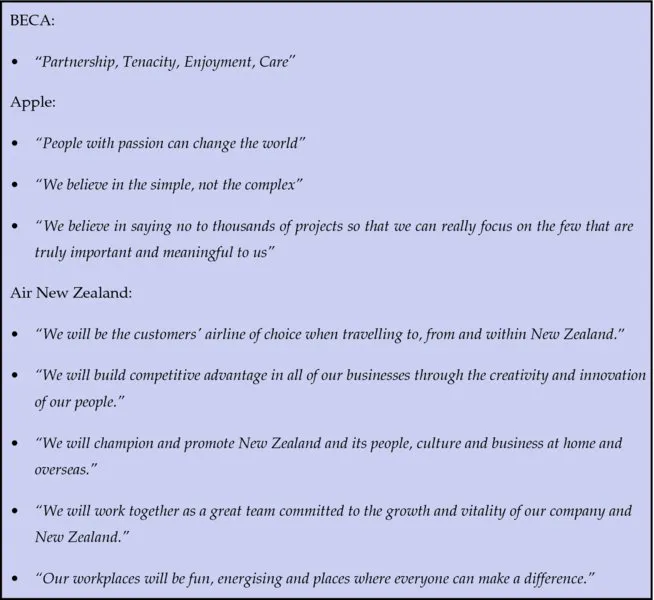
Organisations often list a number of core values, beliefs or principles that guide their decision-making. Previously derided for being bland and generic, organisations are now striving to make these more specific, more interesting and hence more useful from the point of view of encapsulating a corporate identity that can drive a strategy (see Figure 1.1).
Figure 1.1 Company Core Values
Organisational values need to be enduring and so a question should always be asked: would these values change if external situations changed? If the answer is “yes” then they are not core values.

Objectives

Strategic objectives are precise measurable outcomes of a strategy. They might be sales, profits, share price, consumer satisfaction scores and s...

Table of contents

  1. Cover
  2. Praise
  3. Title Page
  4. Copyright
  5. Dedication
  6. The Strategy Pathfinder Map
  7. Pathways to Strategy
  8. About the Creators
  9. 1: Strategic Purpose
  10. Part I The Strategic Environment
  11. Part II Strategic Advantage
  12. Part III Strategic Growth
  13. Part IV Maverick Strategies
  14. Appendices
  15. References
  16. Glossary of Core Strategic Management Concepts
  17. Acknowledgements
  18. Index
  19. EULA