eBook - ePub
Biomaterials from Nature for Advanced Devices and Therapies
- English
- ePUB (mobile friendly)
- Available on iOS & Android
eBook - ePub
Biomaterials from Nature for Advanced Devices and Therapies
About this book
In-depth information on natural biomaterials and their applications for translational medicine!
- Undiluted expertise: edited by world-leading experts with contributions from top-notch international scientists, collating experience and cutting-edge knowledge on natural biomaterials from all over the world
- A must-have on the shelf in every biomaterials lab: graduate and PhD students beginning their career in biomaterials science and experienced researchers and practitioners alike will turn to this comprehensive reference in their daily work
- Link to clinical practice: chapters on translational research make readers aware of what needs to be considered when a biomaterial leaves the lab to be routinely used
Frequently asked questions
Yes, you can cancel anytime from the Subscription tab in your account settings on the Perlego website. Your subscription will stay active until the end of your current billing period. Learn how to cancel your subscription.
At the moment all of our mobile-responsive ePub books are available to download via the app. Most of our PDFs are also available to download and we're working on making the final remaining ones downloadable now. Learn more here.
Perlego offers two plans: Essential and Complete
- Essential is ideal for learners and professionals who enjoy exploring a wide range of subjects. Access the Essential Library with 800,000+ trusted titles and best-sellers across business, personal growth, and the humanities. Includes unlimited reading time and Standard Read Aloud voice.
- Complete: Perfect for advanced learners and researchers needing full, unrestricted access. Unlock 1.4M+ books across hundreds of subjects, including academic and specialized titles. The Complete Plan also includes advanced features like Premium Read Aloud and Research Assistant.
We are an online textbook subscription service, where you can get access to an entire online library for less than the price of a single book per month. With over 1 million books across 1000+ topics, we’ve got you covered! Learn more here.
Look out for the read-aloud symbol on your next book to see if you can listen to it. The read-aloud tool reads text aloud for you, highlighting the text as it is being read. You can pause it, speed it up and slow it down. Learn more here.
Yes! You can use the Perlego app on both iOS or Android devices to read anytime, anywhere — even offline. Perfect for commutes or when you’re on the go.
Please note we cannot support devices running on iOS 13 and Android 7 or earlier. Learn more about using the app.
Yes, you can access Biomaterials from Nature for Advanced Devices and Therapies by Nuno M. Neves, Rui L. Reis, Nuno M. Neves,Rui L. Reis in PDF and/or ePUB format, as well as other popular books in Technology & Engineering & Materials Science. We have over one million books available in our catalogue for you to explore.
Information
Part I
1
Collagen-Based Porous Scaffolds for Tissue Engineering
Guoping Chen and Naoki Kawazoe
Tissue Regeneration Materials Group, International Center for Materials Nanoarchitectonics, National Institute for Materials Science, 1-1 Namiki, Tsukuba, Ibaraki 305-0044, Japan
1.1 Introduction
Collagen is one of the main components of extracellular matrices that provide mechanical support and biological signals to cells for cellular activities [1]. Collagen has attracted wide attention for biomedical applications because of its versatile property [2–5]. It has been used to construct scaffolds in different forms either with or without hybridization with other biodegradable synthetic or naturally derived materials for tissue engineering. Collagen-based porous scaffolds have been developed through many methods and widely used for tissue engineering of a variety of tissues and organs such as skin [3], bone [5], cartilage [6], ligament [7], blood vessel [8] and nerve [9]. Their pore structures have been well designed and controlled to meet the requirements for cell distribution and cell interaction to promote functional tissue regeneration [10–15]. Hybridization of collagen with mechanically strong synthetic polymers has also developed to improve its mechanical property. Some of the latest developments of collagen-based scaffolds with controlled pore structures and composite structures are summarized and highlighted in this chapter.
1.2 Collagen Sponges
Collagen is a water-soluble polymer and is very easy to prepare its porous sponge by using freeze-drying method [16]. Collagen aqueous solution or collagen gel can be frozen at a low temperature, subsequently freeze-dried at a low pressure and finally cross-linked to prepare collagen porous sponges. During freezing process, freezing temperature may affect the formation and growth of ice crystals in the aqueous solution. Therefore, controlling of freezing temperature has been used to control the porous structure of collagen sponges. Fast freezing at a lower temperature induces cracking, uniform small channels and formation of a fibrous structure. Slow freezing at a higher temperature results in nonuniformity and large pores with more collapsed pores than continuous channels. A unidirectional freezing-drying method has been developed to prepare unidirectionally structured collagen sponge [17]. Collagen sponge resembling the extracellular matrix structure of a particular tissue has been prepared by specific freezing regimes [18]. Although some methods have been deve-loped to prepare collagen sponges with partially controlled pore structures, it has been pursued by many researchers to make the sponge pore open and increase the interconnectivity. Recently a method by using embossing ice particulates as a temperature to precisely control the pore structure of collagen sponges has been developed [10].
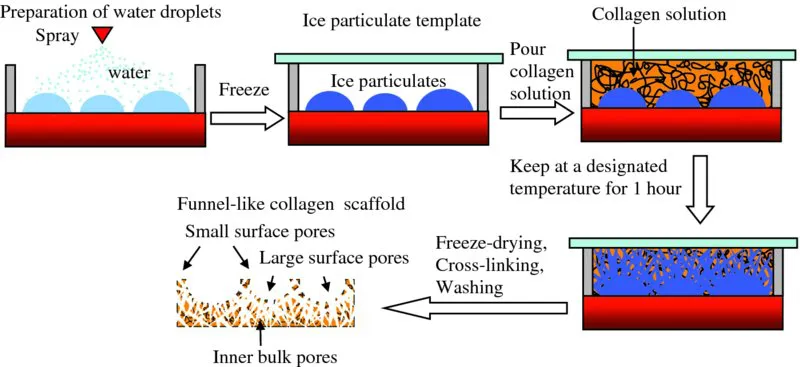
The preparation scheme using embossing ice particulates is shown in Figure 1.1. At first, water droplets are prepared by spraying pure water on the surface of a hydrophobic film and water droplets are formed on the surface. The size of the water droplets can be controlled by spraying condition such as spraying speed and spraying time. Or the water droplet can be printed on the hydrophobic surface by a dispenser and the size of the ice droplets can be controlled by the volume of injected volume of water. Subsequently, the water droplets are frozen at a low temperature to form ice particulates embossing the membrane surface. The size and density of embossing ice particulates are controllable. Finally, collagen aqueous solution is eluted onto the embossing ice particulates, frozen, freeze-dried and cross-linked to prepare collagen sponges with a controlled pore structure. Usually the temperature of ice particulates and collagen aqueous solution should be balanced before eluting collagen aqueous solution onto the ice particulates. The prepared collagen porous sponges have large open pores on the surface and interconnected bulk pores underlying the large surface pores. Such structure is very similar to a funnel and therefore the collagen sponges prepared by this method are referred as funnel-like collagen sponges.

Figure 1.1 Preparation scheme of the funnel-like collagen sponge using embossing ice particulates. Adapted and reproduced from Ref. 10 (DOI: 10.1177/0883911510370002).
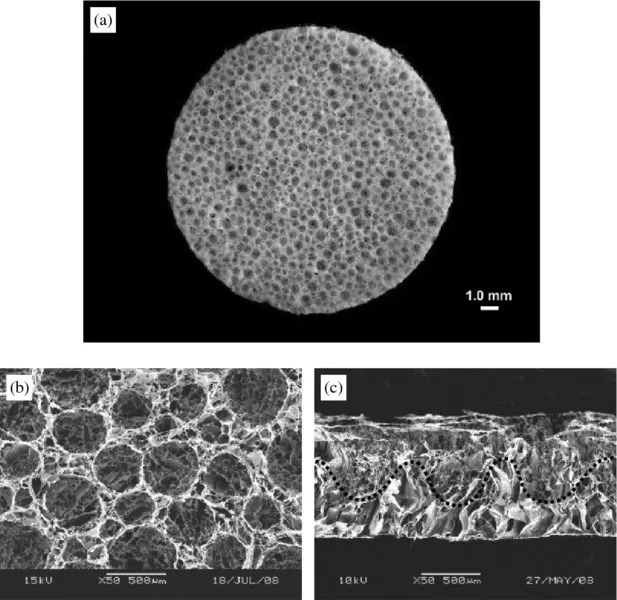
The photo of funnel-like collagen sponge prepared with 398 μm-diameter ice particulates and 1.0% collagen aqueous solution shows clear large pores are evenly distributed on the surface of the collagen sponge (Fig. 1.2a). Scanning electron microscopy images show that large pores are formed on the top surface and interconnected bulk pores are formed beneath the surface pores (Fig. 1.2b and c). The mean diameter of the large surface pores is almost the same as that of the embossing ice particulates which are used as templates because the large surface pores should be the replicas of the embossing ice particulates.

Figure 1.2 Photograph (a) and SEM photomicrographs (b, c) of top surface (b) and cross-section (c) of funnel-like collagen sponge prepared with 398 μm-diameter ice particulate template at –3°C. Adapted and reproduced from Ref. 10 (DOI: 10.1177/0883911510370002).
The underlying bulk pores are interconnected with the large surface pores and extend into the bulk body of the sponge from the surface pores. The underlying bulk pores are the replicas of the ice crystals that are formed during freeze-drying. Therefore, the pore structure of the funnel-like collagen sponges is mainly dependent on the size and density of embossing ice particulates and the freezing temperature. The size and density of surface large pores are determined by the size and density of embossing ice particulates. The size and interconnectivity of underlying bulk pores are dependent on the freezing temperature. Funnel-like collagen sponges prepared with the same size of ice particulates (398 μm) but four different freezin...
Table of contents
- Cover
- Wiley - Society for Biomaterials
- Title Page
- Copyright
- Contributors
- Preface
- Part I
- Part II
- Part III
- Part IV
- Part V
- Part VI
- Index
- EULA