The Handbook of Financial Communication and Investor Relations
eBook - ePub

The Handbook of Financial Communication and Investor Relations

  1. English
  2. ePUB (mobile friendly)
  3. Available on iOS & Android
eBook - ePub

The Handbook of Financial Communication and Investor Relations

About this book

The first book to offer a global look at the state-of-the-art thinking and practice in investor relations and financial communication

Featuring contributions from leading scholars and practitioners in financial communication and related fields—including public relations, corporate communications, finance, and accounting— this volume in the critically acclaimed "Handbooks in Communication and Media" seriesprovides readers with a comprehensive, up-to-date picture of investor relations and financial communications as they are practiced in North America and around the world.

The Handbook of Financial Communication and Investor Relations provides an overview of the past, present, and future of investor relations and financial communications as a profession. It identifies the central issues of contemporary investor relations and financial communications practice, including financial information versus non-financial information, intangibles, risk, value, and growth. Authors address key topics of concern to contemporary practitioners, such as socially responsible investing, corporate governance, shareholder activism, ethics, and professionalism. In addition, the book arms readers with metrics and proven techniques for reliably measuring and evaluating the effectiveness of investor relations and financial communications.

Bringing together the most up-to-date research on investor relations and financial communication and the insights and expertise of an all-star team of practitioners, The Handbook of Financial Communication and Investor Relations:

  • Explores how the profession is practiced in various regions of the globe, including North America, South America, Europe, the Middle East, India, Australia, and other areas
  • Provides a unique look at financial communication as it is practiced beyond the corporate world, including in families, the medical profession, government, and the not-for-profit sector
  • Addresses "big-picture" strategies as well as specific tactics for financial communication during crises, the use of social media, dealing with shareholder activism, integrated reporting and CSR, and more

This book makes an ideal reference resource for undergrads and graduate students, scholars, and practitioners studying or researching investor relations and financial communication across schools of communication, journalism, business, and management. It also offers professionals an up-to-date, uniquely holistic look at best practices in financial communication investor relations worldwide.

Frequently asked questions

Yes, you can cancel anytime from the Subscription tab in your account settings on the Perlego website. Your subscription will stay active until the end of your current billing period. Learn how to cancel your subscription.
No, books cannot be downloaded as external files, such as PDFs, for use outside of Perlego. However, you can download books within the Perlego app for offline reading on mobile or tablet. Learn more here.
Perlego offers two plans: Essential and Complete
  • Essential is ideal for learners and professionals who enjoy exploring a wide range of subjects. Access the Essential Library with 800,000+ trusted titles and best-sellers across business, personal growth, and the humanities. Includes unlimited reading time and Standard Read Aloud voice.
  • Complete: Perfect for advanced learners and researchers needing full, unrestricted access. Unlock 1.4M+ books across hundreds of subjects, including academic and specialized titles. The Complete Plan also includes advanced features like Premium Read Aloud and Research Assistant.
Both plans are available with monthly, semester, or annual billing cycles.
We are an online textbook subscription service, where you can get access to an entire online library for less than the price of a single book per month. With over 1 million books across 1000+ topics, we’ve got you covered! Learn more here.
Look out for the read-aloud symbol on your next book to see if you can listen to it. The read-aloud tool reads text aloud for you, highlighting the text as it is being read. You can pause it, speed it up and slow it down. Learn more here.
Yes! You can use the Perlego app on both iOS or Android devices to read anytime, anywhere — even offline. Perfect for commutes or when you’re on the go.
Please note we cannot support devices running on iOS 13 and Android 7 or earlier. Learn more about using the app.
Yes, you can access The Handbook of Financial Communication and Investor Relations by Alexander V. Laskin in PDF and/or ePUB format, as well as other popular books in Languages & Linguistics & Communication Studies. We have over one million books available in our catalogue for you to explore.

Part I
The Foundations of Financial Communication and Investor Relations: Theory and Industry

1
Investor Relations and Financial Communication: The Evolution of the Profession

Alexander V. Laskin
Sorkin (2016) calls publicly traded companies in the United States “a dying breed” (p. B6). Indeed, based on statistics from the National Bureau of Economic Research, between 1996 and 2012 the number of publicly traded companies decreased almost by half—from 8,025 to 4,101. The number of initial public offerings decreased from an average of 436 a year in 1990s to just 120 in 2015 (Colvin, 2016). The reason for the demise? According to the leaders of the financial sector—representing such companies as Berkshire Hathaway, BlackRock, JPMorgan Chase, T. Rowe Price, Vanguard, and others—there is “too little trust and connection between shareholders and management” (Sorkin, 2016, p. B6). In other words, there is too little of exactly what the investor relations professionals are responsible for!
Why do investor relations officers (IROs) fail at their jobs? Why do they fail at building trust and connection between their companies and their shareholders? The answer to this question is not simple; in fact, there may not be a one-size-fits-all answer at all. But one of the areas where we can start looking for answers to this question is public relations and strategic communication and, specifically, underutilization of public relations and strategic communication expertise in modern investor relations.
Trust is a key focus of public relations and strategic communication activities. Richard Edelman, the CEO and president of Edelman, the largest public relations agency in the world, underscores the importance of working on building and maintaining trust in all public relations programs: “Trust in institutions and their license to operate is no longer automatically granted on the basis of hierarchy or title; rather, in today's world, trust must be earned” (Edelman, 2016, p. 16). But do investor relations professionals see their jobs as aimed at building trust?
This handbook, focused on financial communication and investor relations, provides an in-depth overview and analysis of the profession from the communication standpoint. As a result, it describes and analyses financial communication and investor relations’ history, main activities and key players, theoretical considerations, practical implications, future outlooks and concerns, and, perhaps most importantly, recommendations on how to move forward.

Definitions

Return on Expectations

The first step is, of course, agreeing on a definition. What do we mean when we say “investor relations and financial communication”? Many investor relations professionals, undeniably, will point to a definition of investor relations adopted by the National Investor Relations Institute's (NIRI) Board of Directors in March 2003: “a strategic management responsibility that integrates finance, communication, marketing and securities law compliance to enable the most effective two-way communication between a company, the financial community, and other constituencies, which ultimately contributes to a company's securities achieving fair valuation” (cited in NIRI Board of Directors, n.d.).
Other practitioners of financial communication may suggest that investors are just one of many types of publics that corporations need to communicate with; these practitioners point to a wider definition: “a strategic communication process that builds mutually beneficial relationships between organizations and their publics” (Public Relations Society of America [PRSA], 2016). Here, of course, the word “publics” is used generically and can be replaced with a specific public depending on the function—for example, for investor relations, it would be investors, and the definition then would become: “a strategic communication process that builds mutually beneficial relationships between organizations and their investors”; for employee relations, it would be employees, and the definition then would become “a strategic communication process that builds mutually beneficial relationships between organizations and their employees”; for donor relations, it would be donors, and the definition would then become “a strategic communication process that builds mutually beneficial relationships between organizations and their donors”; and so on.
Public relations and communication scholars may suggest the classic definition of public relations by Cutlip, Center, and Broom (2000): “Public relations is a management function that establishes and maintains mutually beneficial relationships between an organization and the publics on whom its success or failure depends” (p. 5). Once again, the generic word “publics” here can be replaced with the specific publics of individual specializations, such as investors. What is unique about this definition is that instead of word “communication” we see the word “management.” It could be argued that one cannot build and maintain relationships based on communications alone—actions are perhaps as important as words, or even more important. As a result, it is not enough to communicate; it is also important to act in a certain way, and for this investor relations professionals must have access to the top management of the organization and be able to influence the strategic direction of the company's development. This is why the word “management” replaced the word “communication” in this definition.
In the end, all of these definitions are correct in highlighting the importance of investor relations and financial communication for modern-day organizations. However, the NIRI's definition and the definitions of the PRSA and Cutlip et al. have very different final goals: the former talks about fair valuation of security and the latter talk about relationships. Laskin (2011) conducted a Delphi study of experts in the investor relations profession to find out what should be the final measure of investor relations’ contribution to corporate value. Most of the experts rejected share price as a legitimate metric. In another study, “respondents strongly rebuked … the notion of using company share price as a valid measure of the success of investor relations” (Ragas, Laskin, & Brusch, 2014, p. 186). Instead of driving the share price, investor relations improves the availability and quality of information, helping investors and analysts to develop more reliable expectations about share prices, and this may be a better measure of investor relations’ contribution.
Relationships, on the other hand, scored significantly higher among the experts. However, they were cautious about possibility of objectively measuring and evaluating the quality of relationships (Laskin, 2011). The same was also true in Ragas, Laskin, and Brush's study (2014). Experts highlighted that it may not be relationships per se that are significant but the expectations that they help to create, which make it easier to ignore temporarily blips in performance.
As a result, a definition of investor relations and financial communication may instead focus on expectations as the key outcome: Investor relations is a function of managing expectations. This managing of expectations is a two-way street—investor relations professionals manage the expectations of investors and financial analysts about the company's past and future performance, but they also manage the expectations of the organization's executive team about the financial community's evaluation of the company and their reactions to the corporate news. The long-known equation of “return on equity,” then, is being transformed into “return on expectations,” and managing these expectations is becoming a key part of investor relations programs.

Efficient Market Hypothesis

The modern concept of investor relations is part of the efficient market hypothesis. The efficient market hypothesis is primarily associated with research by Fama (1970) and states: “A market in which prices always ‘fully reflect’ available information is called ‘efficient’” (p. 383). Such a market is in equilibrium: all securities are fairly priced, according to their risks and returns. No investors can consistently outperform, or beat, the market, and thus there is no reason to constantly buy and sell shares of companies in an attempt to outperform the average market return.
The efficient market hypothesis, however, requires key assumptions to be met: All relevant information about the company and its performance must be publicly available, all market participants must have equal access to such information on a timely basis, and all investors must be rational and capable of evaluating the information available to them. Fama (1965, 1970) talked about three levels of market efficiency: weak, semistrong, and strong. In the weak form of market efficiency, not all information is available to all market participants and, as a result, some investors can outperform others, taking advantage of better or faster access to information. In the semistrong form of efficiency, all public information is equally available to everyone and, as a result, already reflected in the stock price; however, there may be other, nonpublic, information that is not reflected in the stock price and, as a result, somebody with access to such information through, for example, insider trading can beat the market. And, finally, in the strong form of market efficiency, all information is reflected in the stock price and all investors—internal and external—have the same access to information and the same knowledge and understanding of the company.
Once again, investor relations, a function charged with providing information about a company to shareholders, financial analysts, and other market participants, is at the very foundation of the efficient market hypothesis. In fact, investor relations has become a key activity not just for particular companies but also for the whole modern economy. The sur...
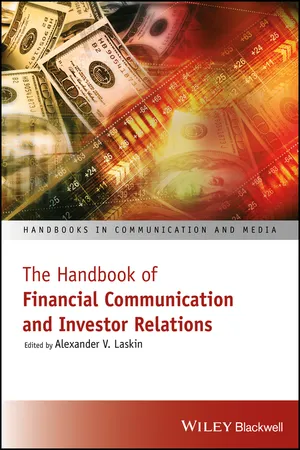
Table of contents

  1. Cover
  2. Series
  3. Title Page
  4. Copyright
  5. Notes on Contributors
  6. Part I: The Foundations of Financial Communication and Investor Relations: Theory and Industry
  7. Part II: The Practice of Financial Communication and Investor Relations: Strategies and Tactics
  8. Part III: Financial Communication Outside the Corporate Context: From Governments to Families
  9. Part IV: Financial Communication and Investor Relations Around the World
  10. Index
  11. EULA