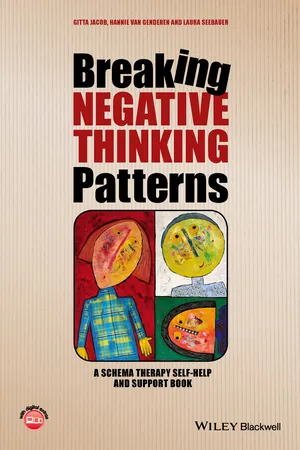
Breaking Negative Thinking Patterns
eBook - ePub

Breaking Negative Thinking Patterns

A Schema Therapy Self-Help and Support Book

  1. English
  2. ePUB (mobile friendly)
  3. Available on iOS & Android
eBook - ePub

Breaking Negative Thinking Patterns

A Schema Therapy Self-Help and Support Book

About this book

Breaking Negative Thinking Patterns is the first schema-mode focused resource guide aimed at schema therapy patients and self-help readers seeking to understand and overcome negative patterns of thinking and behaviour.

  • Represents the first resource for general readers on the mode approach to schema therapy
  • Features a wealth of case studies that serve to clarify schemas and modes and illustrate techniques for overcoming dysfunctional modes and behavior patterns
  • Offers a series of exercises that readers can immediately apply to real-world challenges and emotional problems as well as the complex difficulties typically tackled with schema therapy
  • Includes original illustrations that demonstrate the modes and approaches in action, along with 20 self-help mode materials which are also available online
  • Written by authors closely associated with the development of schema therapy and the schema mode approach

Frequently asked questions

Yes, you can cancel anytime from the Subscription tab in your account settings on the Perlego website. Your subscription will stay active until the end of your current billing period. Learn how to cancel your subscription.
At the moment all of our mobile-responsive ePub books are available to download via the app. Most of our PDFs are also available to download and we're working on making the final remaining ones downloadable now. Learn more here.
Perlego offers two plans: Essential and Complete
  • Essential is ideal for learners and professionals who enjoy exploring a wide range of subjects. Access the Essential Library with 800,000+ trusted titles and best-sellers across business, personal growth, and the humanities. Includes unlimited reading time and Standard Read Aloud voice.
  • Complete: Perfect for advanced learners and researchers needing full, unrestricted access. Unlock 1.4M+ books across hundreds of subjects, including academic and specialized titles. The Complete Plan also includes advanced features like Premium Read Aloud and Research Assistant.
Both plans are available with monthly, semester, or annual billing cycles.
We are an online textbook subscription service, where you can get access to an entire online library for less than the price of a single book per month. With over 1 million books across 1000+ topics, we’ve got you covered! Learn more here.
Look out for the read-aloud symbol on your next book to see if you can listen to it. The read-aloud tool reads text aloud for you, highlighting the text as it is being read. You can pause it, speed it up and slow it down. Learn more here.
Yes! You can use the Perlego app on both iOS or Android devices to read anytime, anywhere — even offline. Perfect for commutes or when you’re on the go.
Please note we cannot support devices running on iOS 13 and Android 7 or earlier. Learn more about using the app.
Yes, you can access Breaking Negative Thinking Patterns by Gitta Jacob,Hannie van Genderen,Laura Seebauer in PDF and/or ePUB format, as well as other popular books in Psychology & Clinical Psychology. We have over one million books available in our catalogue for you to explore.

Information

1
Introduction

Case Example “Exclusion”

Carol is a 34-year-old mother of a 4-year-old son, in a stable relationship. She works part-time as a bank assistant. She could be quite satisfied with her life, but minor incidents sometimes trigger severe feelings of exclusion or rejection. This may happen, for example, when her colleagues who work full-time make an “insider joke” she doesn’t get. Most often, she reacts by drawing back from them. But she may also respond like a stroppy child to her colleagues, in particular when she is having a bad day anyway. Then she is not only annoyed by her colleagues, but also feels ashamed of her own reaction.
Carol has had this kind of problem all her life… maybe it has something to do with her childhood. Because of her father’s frequent job changes, she was forced to move and start all over again several times. Facing a new school class, she often made the experience of feeling excluded. At the age of 12, she even experienced severe mobbing in school.
Does that sound familiar to you? Persistent patterns you just cannot get rid of? The same kind of feelings mixing up your life over and over again?
If you want to change your patterns, you should first understand and recognize which patterns are bothering you right now in your daily life. Find out how these patterns developed over your life and why they are so persistent. In the first part of this book we explain how you can explore the origins of your patterns. You will also discover your real needs and how you can meet them better.
In Part II we will introduce methods to change your patterns step by step and in the way that you want. You can either deal with this by yourself, using the advice in this book, or, if and when this seems too difficult, you might consider seeking help from a therapist.
The therapy that’s aiming to change your patterns is called schema therapy. The central concept in schema therapy is called “schema mode” or simply “Mode.” A Mode is a persistent pattern of behaving and feeling that always causes the same type of problems. In fact, it is a state of mind that is connected to bad experiences in your youth or childhood.
In this book we will explain the schema Modes we know about and the ways that you can change them. You can use this book both as a self-help guide and as a support during a schema therapy. If you decide to change your Modes by yourself we recommend that you get someone you trust to discuss your patterns with you. We also recommend that you read this book step by step. Think about each chapter you read before going ahead. In this way you will learn to deal better with difficult situations, your negative feelings will diminish and you will fulfill your needs in a healthier way.
1.1 What Is Schema Therapy?

Schema therapy is one of the latest advances in psychotherapy. It is a development of cognitive behavior therapy, combining ideas from various psychotherapeutic approaches. Box 1.1 lists psychotherapy approaches that have been influential on schema therapy.

Box 1.1: Approaches That Have Influenced Schema Therapy

Cognitive behavioral therapy: Focusing on changes in thoughts and behavior in concrete, current life problems.
Depth psychology: Most psychological problems have their origin in experiences in childhood and youth.
Psychodrama and Gestalt therapy: Techniques to change problematic emotions.
Humanistic therapy/ Client-centered therapy: Focusing on human needs and on their importance for mental health.
Emotions play the most important role in schema therapy. Both positive and negative childhood experiences form our adult emotional reactions. Imagine that you have been humiliated as a child, because your clothes were different or your nose was extraordinarily big. If you often felt rejected and humiliated as a child, it’s very likely that you will easily feel rejected or humiliated as an adult, too – even if nobody means to make you suffer this way. Such feelings typically lead to many problems: for instance, you might not make contact with others easily and thus not be able to establish healthy and close relationships; or you might react aggressively to prevent further humiliation, even if your action is not at all appropriate.
Therefore, the very first step of schema therapy is always to understand your negative feelings and their origin in your biography. Then, all current negative consequences of these feelings and childhood experiences are explored. The second step is to support you in changing your feelings and your dysfunctional behaviors. Thus, you will more satisfied and better able to fulfill your needs in a healthy and appropriate way.

1.2 Understanding the Origin of Your Patterns

A basic principle of the Mode concept is that everyone experience themselves differently at different moments. While you may feel very healthy and relaxed in one moment, you may feel vulnerable and sad in another. In some other situation you may rather be emotionally cold and feel nothing. Such different states are called “Modes.” In schema therapy we define the following Modes:
  • Vulnerable and Angry Child Modes. Most people are familiar with feelings of weakness, inferiority, sadness or intense rage, defiance or anger, in which they do not feel grown up. In schema therapy such states are called “Child Modes.” We call them Child Modes because we assume that when important needs are not met in someone’s childhood, they will have emotional parts that cannot grow up.
  • Dysfunctional Parent Modes. People with intense Child Modes often tend to devalue themselves or to put excessive pressure upon themselves. These Modes are called Dysfunctional Parent Modes, as they have often been “modeled” by devaluing or abusive parents, or bullying class mates or siblings. The term parent in Parent Modes does not only relate to real parents, but also to any other important maladaptive attachment figure.
  • Coping Modes. When someone is affected by negative feelings they tend to use one or more favored strategies to reduce those feelings or to hide them from others. The technical term for such psychological “survival strategies” is “Coping Mode.” Such coping includes avoidant behaviors like social retreat or cannabis use in order to calm down negative feelings. Another way of coping with negative feelings is to behave aggressively or excessively self-confidently when actually feeling weak or inferior.
  • Healthy Adult Mode. Of course we do not only have dysfunctional or immature modes: we also have healthy parts with high-level functioning, healthy connections with other people, and positive emotions. The part that is able to organize your life, solve problems and take care of good relationships is called the “Healthy Adult Mode.”
  • Happy Child Mode. All people – both children and adults – have a need for fun, happiness and easiness. The Happy Child Mode is related to these feelings.

1.2.1 Recognizing your Modes

The first part of this book is all about becoming familiar with your Modes. It will describe and explain all the Modes. It includes many examples illustrating how to detect Modes in yourself and in others. We will find out how strong the different Modes are in your life. How did they develop in your life and why are some Modes more significant than others? We will focus on how your Modes make you feel and what type of situations cause them to pop up.

1.2.2 Changing your Modes

In the second part of the book you will learn strategies and exercises which can help you to change your Modes. The general aim is to enable you to cope with difficult situations in the way that suits you. You’ll get to know your own needs better and learn how to fulfill them. These exercises and changes are related to three different levels of human experience:
  • Thoughts (Cognitive level). On the cognitive level it’s most relevant to learn everything about your Modes and to reflect on the appropriateness of the cognitions related to your Modes. On this level you also work out realistic plans about what you want to change. Protocols and worksheets will guide and help you with this.
  • Feelings (Emotional level). You will find many suggestions on how to change distressing emotions. Imagery exercises are powerful emotional techniques. In these exercises you imagine yourself in a certain situation, and think about what you need and what you want to change. Next, you imagine that you behave in a certain way to change the situation....

Table of contents

  1. Cover
  2. Title page
  3. Copyright page
  4. Preface
  5. Credit for Images
  6. 1 Introduction
  7. Part I: Become Familiar with Your Modes
  8. Part II: Change Your Modes
  9. Glossary
  10. References and Further Reading
  11. Index
  12. Access to Companion Site
  13. End User License Agreement