1.1.1. Introduction
In physics, a field can be defined as an area of influence. We are immersed in the Earth’s gravitational field (the area within which the Earth attracts objects) and in electromagnetic fields (areas within which we can pick up television broadcasts and mobile phone signals, for example).
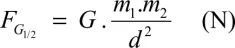
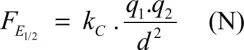
Gravity acts between two bodies that have a mass, while an electric field acts on positive or negative electric charges (electric charge is a fundamental property of matter, along with mass). These interactions are due to forces whose intensity is proportional to the mass of the objects or to the value of the electric charges. They decrease with the square of the distance that separates them and cancel each other out ad infinitum. The expression of these forces is identical. Their intensity in Newton (N) is given, respectively, by the law of gravitation and by Coulomb’s law (in classical physics):
- – law of gravitation between two masses m1 and m2:
- – Coulomb’s law between two electric charges q1 and q2:
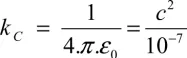
where d is the distance in meters between the two objects, G is the universal gravitational constant, and:
Coulomb’s constant (N·m2·C–2), and “c” is the speed of light (≈ 3 × 10+8 m·s–1). εo is a constant that will be introduced later on. If we refer to the Earth, FG1/2 represents the weight and [1.1a] becomes simply P = m·g with g = 9.81 m·s–2.
Unlike the gravitational force, which always attracts objects, the electric force attracts opposite charges and repels them if they have the same sign. The force is directed according to the straight line between the two masses or charges.
Thus, the field is the area where forces can exert themselves remotely, without there necessarily being any propagation of matter or energy. Unlike electric fields, the Earth’s gravity has the advantage of being directly perceived by living organisms.
The concept of the field enables us to introduce physical (vectorial)1 quantities, values associated with a unit, to quantify these phenomena and put them into an equation for the purposes of analysis and prediction.
The physical quantity associated with electric charges is the electric field.
1.1.2. Electric fields
The electric field is introduced into Coulomb’s law [1.1b] as follows:
E1/2 is the electric field created by the charge q1 in the place of q2 (the symbol E is reserved for the quantity that is the electric field). An electric field appears as soon as there is an electric charge. Generally, knowledge of E makes it possible to calculate the force exerted on any charge.
In practice, an electric field is created by an inequality of charges between two distinct points. This inequality may be due to a difference in potential or volt...