Edited by foremost leaders in chemical research together with a number of distinguished international authors, this fourth volume summarizes the most important and promising recent developments in synthesis, polymer chemistry and supramolecular chemistry.
Interdisciplinary and application-oriented, this ready reference focuses on innovative methods, covering new developments in catalysis, synthesis, polymers and more.
1 Polymerization‐Induced Self‐assembly of Block Copolymer Nano‐objects via Green RAFT Polymerization
Shinji Sugihara
University of Fukui, Graduate School of Engineering, Department of Applied Chemistry and Biotechnology, 3‐9‐1 Bunkyo, Fukui, 910‐8507, Japan
1.1 Introduction
Many biomolecules have specific three‐dimensional structures in water or hydrophobic environments, and form higher order structures with high functions. To construct a highly functionalized and higher order structure with a synthetic polymer, it is necessary to examine the fundamental formulation to control the polymer's primary structure and to build the polymers up into a higher order structure. From this point of view, this chapter focuses on block copolymer synthesis as a molecular technology for self‐organization. The key technology is in situ “polymerization‐induced self‐assembly (PISA).”
1.2 Block Copolymer Solution
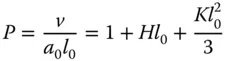
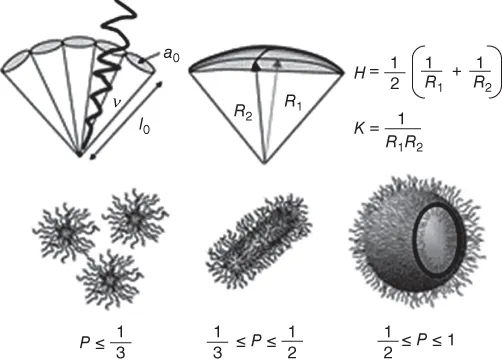
Self‐assembly of AB diblock, ABA, or ABC triblock copolymers to form a variety of macromolecular nanostructures is well known in both the solid state and in dilute solutions, with various prominent functions stemming from the structure [1–21]. In particular, amphiphilic AB diblock copolymers have been demonstrated to form a variety of self‐assembled aggregate structures in dilute solutions, where the solvent preferentially solvates one of the blocks. Thus, the basic driving force for solution self‐assembly is the solvophobic effect (hydrophobic effect in aqueous solution). These are well documented in other reviews [ 1–5]. For the amphiphilic AB diblock copolymer in a block‐selective solvent, the precise nanostructure, i.e. morphology, is primarily a result of the inherent molecular curvature described by its mean curvature H and its Gaussian curvature K, which are given by the two radii of curvatures R1 and R2 in Figure 1.1. The curvature is related to the surfactant packing parameter, P, which is given by Eq. (1.1). The value of P depends on the relative core‐block volume (v), the effective interfacial area (a0) at the core–shell/solvent interface, and the chain length normal to the surface per molecule (l0).
1.1
Figure 1.1 Various self‐assemblies formed by solvophilic block copolymers in a block‐selective solvent. The type of structure formed is due to the inherent curvature of the molecule, which can be estimated through calculation of its dimensionless packing parameter, P.
The regions of spherical micelles are favored when P ≤ 0.33, cylindrical micelles are produced when 0.33 < P ≤ 0.50, and vesicles are formed when 0.50 < P ≤ 1.00. Although vesicles are flexible bilayer aggregates, the planar bilayer of lamellae is ideally favored when P = 1. This concept was originally introduced by Israelachvili et al. [22,23] to explain self‐assembly of small‐molecule surfactants, and was later extended to include diblock copolymer self‐assembly by Antonietti and Förster [24].
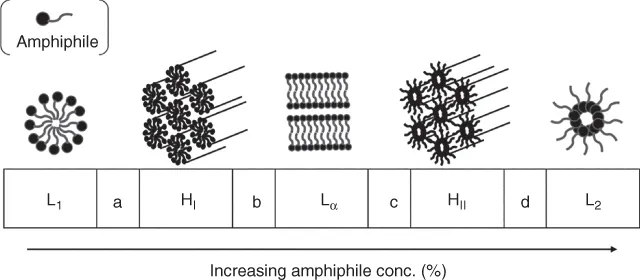
In practice, morphology is controlled by various factors, especially for small‐molecule amphiphiles. Assemblies such as spherical micelles, hexagonals, cubes, and lamellar lyotropic crystallines are highly dynamic with rapid exchange of molecules between micelles and the unimer state in solution. Thus, as shown in Figure 1.2, the packing geometry can be tuned by simply adjusting the surfactant concentration with the same solvent properties, i.e. without additives and at a constant temperature. Figure 1.2 shows an ideal phase sequence, which is only a very generalized picture, and the sequence may be different for some amphiphiles. However, this rapid exchange of molecules is very important to determine the structure and morphology of amphiphilic self‐assembled aggregates [4 23–25].
Figure 1.2 The “ideal” sequence of phases from L1 to HI to Lα observed upon increasing amphiphile concentration, in a binary small‐molecular amphiphile–solvent system (ergodic system). Intermediate phases (a and b) are sometimes observed. The normal micellar structure is termed the L1 phase. At higher concentrations, micelles can fill space efficiently to form a cubic phase by packing (a). Upon increasing the concentration further, the micelles change from spherical to rod‐like ones. The rod‐like micelles then pack into a hexagonal (HI) phase. The HI phase sometimes changes to a bicontinuous cubic or mesh structure phase (b), which is characterized by nonzero mean curvature and negative Gaussian curvature. The phase then changes to bilayers, which tend to stack into a lamellar phase (Lα). Lamellar phases can be found in different phase states including lamellar crystalline, lamellar gel, and lamellar fluid. When the solvent becomes the minority phase, inverse structures are formed such as the inverse hexagonal phase (HII), inverse micellar liquid phase (L2), and intermediates such as the inverse bicontinuous phase (c), and inverse micellar cubic phase (d).
For many macromolecular amphiphiles, in contrast to small‐molecule amphiphiles, the rate of exchan...
Table of contents
Cover
Table of Contents
Foreword by Dr. Hamaguchi
Foreword by Dr. Noyori
Preface
1 Polymerization‐Induced Self‐assembly of Block Copolymer Nano‐objects via Green RAFT Polymerization
2 Chemical Functionalization of Graphitic Nanocarbons
3 Synthetic Methods Using Interactions Between Sustainable Iron Reagents and Functionalized Carbon–Carbon Multiple Bonds
4 Molecular Technology for Switch and Amplification of Chirality in Asymmetric Catalysis Using a Helically Dynamic Macromolecular Scaffold as a Source of Chirality
9 Molecular Technology for Synthesis of Versatile Copolymers via Multiple Polymerization Mechanisms
10 Self‐assembled Monolayers from Carbon‐Based Ligands on Metal Surfaces
11 Supramolecular Web and Application for Chiroptical Functionalization of Polymer
12 Conformational Analysis of Organic Molecules with Single‐Molecule Atomic‐Resolution Real‐Time Transmission Electron Microscopy (SMART‐TEM) Imaging
13 Designer Molecules Toward Sequence‐Controlled Polymers via Chain‐Growth Propagation Mechanism
14 Hairy Particles Synthesized by Surface‐Initiated Living Radical Polymerization
Index
End User License Agreement
Trusted by 375,005 students
Access to over 1.5 million titles for a fair monthly price.
Study more efficiently using our study tools.
Frequently asked questions
Yes, you can cancel anytime from the Subscription tab in your account settings on the Perlego website. Your subscription will stay active until the end of your current billing period. Learn how to cancel your subscription
No, books cannot be downloaded as external files, such as PDFs, for use outside of Perlego. However, you can download books within the Perlego app for offline reading on mobile or tablet. Learn how to download books offline
Perlego offers two plans: Essential and Complete
Essential is ideal for learners and professionals who enjoy exploring a wide range of subjects. Access the Essential Library with 800,000+ trusted titles and best-sellers across business, personal growth, and the humanities. Includes unlimited reading time and Standard Read Aloud voice.
Complete: Perfect for advanced learners and researchers needing full, unrestricted access. Unlock 1.5M+ books across hundreds of subjects, including academic and specialized titles. The Complete Plan also includes advanced features like Premium Read Aloud and Research Assistant.
Both plans are available with monthly, semester, or annual billing cycles.
We are an online textbook subscription service, where you can get access to an entire online library for less than the price of a single book per month. With over 1.5 million books across 990+ topics, we’ve got you covered! Learn about our mission
Look out for the read-aloud symbol on your next book to see if you can listen to it. The read-aloud tool reads text aloud for you, highlighting the text as it is being read. You can pause it, speed it up and slow it down. Learn more about Read Aloud
Yes! You can use the Perlego app on both iOS and Android devices to read anytime, anywhere — even offline. Perfect for commutes or when you’re on the go. Please note we cannot support devices running on iOS 13 and Android 7 or earlier. Learn more about using the app
Yes, you can access Molecular Technology, Volume 4 by Hisashi Yamamoto, Takashi Kato, Hisashi Yamamoto,Takashi Kato in PDF and/or ePUB format, as well as other popular books in Physical Sciences & Chemistry. We have over 1.5 million books available in our catalogue for you to explore.