An authoritative and comprehensive guide to managing energy conservation in infrastructures
Energy Conservation in Residential, Commercial, and Industrial Facilities offers an essential guide to the business models and engineering design frameworks for the implementation of energy conservation in infrastructures. The presented models of both physical and technological systems can be applied to a wide range of structures such as homes, hotels, public facilities, industrial facilities, transportation, and water/energy supply systems. The authors—noted experts in the field—explore the key performance indicators that are used to evaluate energy conservation strategies and the energy supply scenarios as part of the design and operation of energy systems in infrastructures.
The text is based on a systems approach that demonstrates the effective management of building energy knowledge and supports the simulation, evaluation, and optimization of several building energy conservation scenarios. In addition, the authors explore new methods of developing energy semantic network (ESN) superstructures, energy conservation optimization techniques, and risk-based life cycle assessments. This important text:
Defines the most effective ways to model the infrastructure of physical and technological systems
Includes information on the most widely used techniques in the validation and calibration of building energy simulation
Offers a discussion of the sources, quantification, and reduction of uncertainty
Presents a number of efficient energy conservation strategies in infrastructure systems, including HVAC, lighting, appliances, transportation, and industrial facilities
Describes illustrative case studies to demonstrate the proposed energy conservation framework, practices, methods, engineering designs, control, and technologies
Written for students studying energy conservation as well as engineers designing the next generation of buildings, Energy Conservation in Residential, Commercial, and Industrial Facilities offers a wide-ranging guide to the effective management of energy conservation in infrastructures.
1Faculty of Energy Systems and Nuclear Science, University of Ontario Institute of Technology, Oshawa, Canada
2Faculty of Engineering and Applied Science, University of Ontario Institute of Technology, Oshawa, Canada
1.1 Infrastructure Systems
As measured in 2015, around 1.2 billion people, constituting 17% of the global population, do not have electricity, and 2.7 billion people, constituting 38% of the global population, have risks on their health due to the reliance on the traditional use of biomass for cooking [1].
In order to discuss energy systems and conservation strategies in infrastructures, it is essential to analyze the infrastructure physical systems and their types, classifications, and energy requirements. It is possible to find a suitable definition of infrastructures as the fundamental facilities and systems that serve a region, area, community, city, or country, including the support facilities such as utilities, services, and transportation that are necessary for the economic development and perform all necessary functions. There are number of ways to classify infrastructures, such as size, criticality, use, occupancy, location, and surroundings. Infrastructures can support residential functions, commercial and public functions, transportation functions (including land, sea, air), and industrial functions. Infrastructures can be viewed as system of systems; for example, infrastructures include communications and cyber security, computational/technological, waste management, emergency and disaster management, defense and military, and other supporting infrastructures. The better we understand infrastructures, the better we design and operate energy systems in these infrastructures. Infrastructure modeling should support design and operational activities, with appropriate and comprehensive performance measures to evaluate design and operation features and alternatives. Requirement analysis of infrastructures should include energy demand, risk management, performance, and sustainability requirements.
1.1.1 Infrastructure Classifications
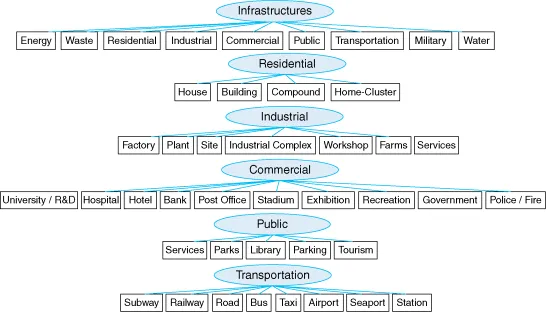
Energy use in infrastructures can be controlled and optimized based on the nature of loads and energy systems implemented in these infrastructures. For proper planning, design, and operation of energy systems to support these infrastructures, it is important to analyze the classifications of infrastructures. Figure 1.1 shows hierarchical classification of infrastructures based on nature, type, use, function, and energy requirements. There are interrelations among these infrastructures, for example, water infrastructures are linked to residential, industrial, and commercial. Similarly, energy and waste are linked to all other infrastructures.
FIGURE 1.1 Infrastructure classifications.
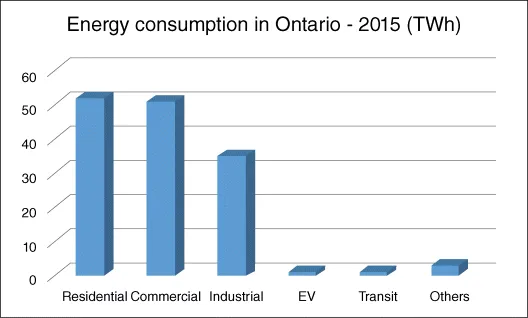
In order to understand energy consumption in different regions, power consumption in Ontario has been selected, as presented in Figure 1.2, where it shows the consumption in residential, commercial, industrial, electric vehicle, transit, and others. Power consumption in residential is very close to that consumed in commercial, while industrial is the third dominating sector for power consumption.
FIGURE 1.2 Power consumption in Ontario – 2015.
1.1.2 Infrastructure Systems
Infrastructure system includes technical and technological infrastructures to support all functions and the management of life cycle activities in infrastructures including flow and control of information across all elements of the infrastructure systems. Modeling of processes of infrastructure systems includes players, roles, physical systems, functional modeling, financial modeling, planning, engineering design, operation, and management practices. One major component of infrastructure systems is the safety and protection systems to ensure the resiliency against hazardous, emergencies, and disaster situations and to sustain the stated target functions from the infrastructure systems.
1.2 Energy Systems in Residential Facilities
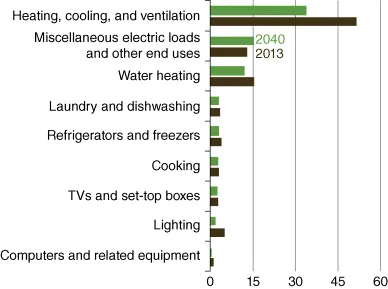
Energy consumption in residential facilities constitutes one of the largest consumption of energy in cities and communities in Canada and worldwide. In 2015, energy consumption in residential facilities in Ontario is 52 TWh, which represents 36% of total energy consumption. Energy consumption in residential facilities include heating/cooling, electric loads, water heating, laundry, dishwashing, refrigerators and freezers, cooking, TV, lighting, and computer-related equipment, as shown in Figure 1.3. The highest energy use is in heating and cooling and ventilation, where it is clear the reduced use from 2013 to 2040. This can be justified by improved heating and cooling technologies and efficiencies. Electric loads and water heating are second largest energy use in the residential sector. Energy conservation strategies are widely adopted by utilities to reduce energy demand from utilities in residential facilities. Typically, utility grids supply energy to residential facilities. Energy conservation can represent around 1–3% of total energy demand in residential facilities. With the penetration of local distributed generation, energy can be supplied by renewable energy technologies such as PV, energy storage, wind, gas generators, fuel cells, and geothermal systems.
FIGURE 1.3 Residential sector delivered energy intensity for selected end uses in the Reference case, 2013 and 2040 (million Btu per household per year) [2].
There are a number of energy systems and technologies that are adopted in residential facilities, such as gas-fired water heaters, oil-fired water heaters, electric water heaters, heat pump water heaters, instantaneous water heaters, solar water heaters, gas-fired furnaces, oil-fired furnaces, gas-fired boilers, oil-fired boilers, room air conditioners, central air conditioners, air-source heat pumps, ground-source heat pumps, gas-source heat pumps, electric resistance furnaces, electric resistance unit heaters, cordwood stoves, wood pellet stoves, refrigerators-freezers, freezers, natural gas cooktops and stoves, clothes washers, clothes dryers, and dishwashers. Among the factors that are used to evaluate these energy systems are capacity, efficiency, energy factor (EF), combined energy factor (CEF), annual energy use, annual water use, average life, retail equipment costs, installation costs, and maintenance costs. These factors are used to evaluate the different energy systems in residential facilities to ensure most effective technology that can be applied in different regions and weather conditions.
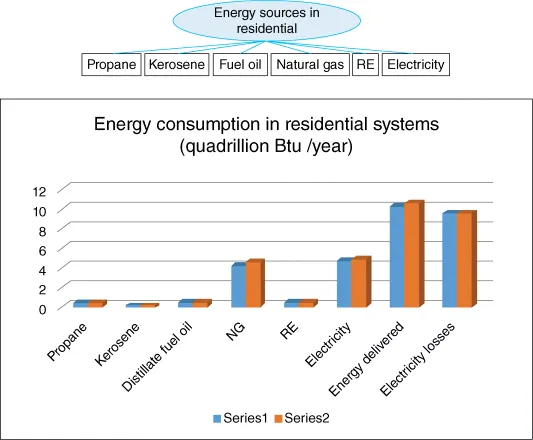
Energy consumption in residential facilities can be viewed as in Figure 1.4, where it shows different types of energy sources, such as propane, kerosene, distillate fuel oil, natural gas, renewable energy, and electricity.
FIGURE 1.4 Energy consumption in residential systems, quadrillion Btu per year in the United States, 2012: gray, 2020: dark gray [2].
It is clear that electricity and natural gas represent the highest consumption from 2012 and projected till 2040. It is also noted that losses are quite high and energy conservation strategies will be essential for effective savings.
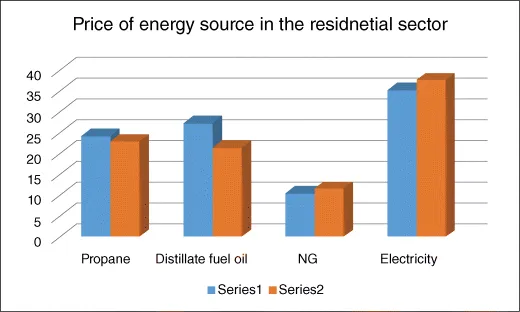
Energy prices for residential use are shown in Figure 1.5, which shows price of natural gas (NG) is the lowest, while electricity price is the highest.
FIGURE 1.5 Energy prices in the residential sector, dollars per million Btu in the United States, 2012: gray, 2020: dark gray [2].
1.3 Energy Systems in Commercial Facilities
Energy consumption in commercial facilities, as stated by Depart...
Table of contents
Cover
Series Page
Title Page
Copyright
Dedication
Preface
Authors' Biography
List of Contributors
Acknowledgments
Part I: Energy Infrastructure Systems
Part II: Energy Systems
Part III: Energy Conservation Strategies
Index
End User License Agreement
Trusted by 375,005 students
Access to over 1.5 million titles for a fair monthly price.
Study more efficiently using our study tools.
Frequently asked questions
Yes, you can cancel anytime from the Subscription tab in your account settings on the Perlego website. Your subscription will stay active until the end of your current billing period. Learn how to cancel your subscription
No, books cannot be downloaded as external files, such as PDFs, for use outside of Perlego. However, you can download books within the Perlego app for offline reading on mobile or tablet. Learn how to download books offline
Perlego offers two plans: Essential and Complete
Essential is ideal for learners and professionals who enjoy exploring a wide range of subjects. Access the Essential Library with 800,000+ trusted titles and best-sellers across business, personal growth, and the humanities. Includes unlimited reading time and Standard Read Aloud voice.
Complete: Perfect for advanced learners and researchers needing full, unrestricted access. Unlock 1.5M+ books across hundreds of subjects, including academic and specialized titles. The Complete Plan also includes advanced features like Premium Read Aloud and Research Assistant.
Both plans are available with monthly, semester, or annual billing cycles.
We are an online textbook subscription service, where you can get access to an entire online library for less than the price of a single book per month. With over 1.5 million books across 990+ topics, we’ve got you covered! Learn about our mission
Look out for the read-aloud symbol on your next book to see if you can listen to it. The read-aloud tool reads text aloud for you, highlighting the text as it is being read. You can pause it, speed it up and slow it down. Learn more about Read Aloud
Yes! You can use the Perlego app on both iOS and Android devices to read anytime, anywhere — even offline. Perfect for commutes or when you’re on the go. Please note we cannot support devices running on iOS 13 and Android 7 or earlier. Learn more about using the app
Yes, you can access Energy Conservation in Residential, Commercial, and Industrial Facilities by Hossam A. Gabbar in PDF and/or ePUB format, as well as other popular books in Physical Sciences & Energy. We have over 1.5 million books available in our catalogue for you to explore.