eBook - ePub
Computing the Environment
Digital Design Tools for Simulation and Visualisation of Sustainable Architecture
- English
- ePUB (mobile friendly)
- Available on iOS & Android
eBook - ePub
Computing the Environment
Digital Design Tools for Simulation and Visualisation of Sustainable Architecture
About this book
Computing the Environment presents practical workflows and guidance for designers to get feedback on their design using digital design tools on environmental performance. Starting with an extensive state-of-the-art survey of what top international offices are currently using in their design projects, this book presents detailed descriptions of the tools, algorithms, and workflows used and discusses the theories that underlie these methods. Project examples from Transsolar Klimaengineering, Buro Happold´s SMART Group, Behnish Behnisch Architects, Thomas Herzog, Autodesk Research are contextualized with quotes and references to key thinkers in this field such as Eric Winsberg, Andrew Marsh, Michelle Addington and Ali Malkawi.
Information

1 Earthrise image of Earth, photographed by astronaut Bill Anders during a 1968 Apollo mission, the first manned voyage to orbit the Moon
This photograph is renowned as an influential environmental image, sparking people's impression of Earth as vulnerable and small in a large expansive universe. Looking back on Earth, it seems potentially fragile, a finite, closed-loop system.
1. Introduction—Computing the Environment:
Design Workflows for the Simulation of Sustainable Architecture
That's here. That's home. That's us. On it everyone you love, everyone you know, everyone you ever heard of, every human being who ever was, lived out their lives. ... There is perhaps no better demonstration of the folly of human conceits than this distant image of our tiny world.(1)—Carl Sagan
Architects design for the future. The act of drawing is a predictive act of experimenting with possible futures. The buildings architects design today form the cities of the future. Necessary optimists, architects design to achieve better ways of living—turning ‘existing situations into preferred ones'.(2) In architecture, the vast majority of projects are now designed in virtual environments; and, beyond architecture, in almost all sciences, we are seeing the rise of computer simulations as more and more experiments are carried out ‘in silico'.(3) Simulation is a way in which designs can be tested for their future performance. In architecture, ‘while simulation once pertained to modes of presentation, it now connects architecture to the natural sciences and to a methodological and strategic instrument, a tool of knowledge'.(4)
A ‘model' is an approximation of the real world, and following the building of models, simulations are repeated observations of models that enable analysis and visualisation of behaviour.(5) Architects have always used simulations—tools to forecast a range of behaviours in buildings. Yanni Loukissas suggests that this way of working is not new in architecture—Filippo Brunelleschi invented linear perspective to simulate the perception of space, Pierre Patte used ray diagrams to simulate sound and Antoni Gaudí used graphic statics to simulate structural performance. While in today's practice, numerical methods have overtaken graphical techniques in the domains of visualisation, sound and structural performance, what remains constant is the notion of simulation—the desire to get feedback from the design environment.(6)
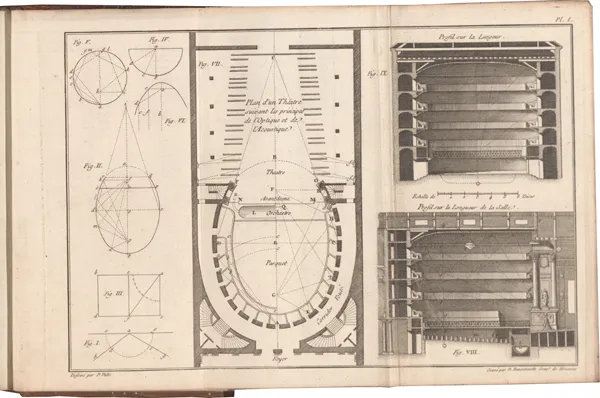
2 Pierre Patte, acoustic ray-tracing theatre design diagrams, 1782
This drawing of sound paths and their reflections off interior surfaces was used as a way of understanding acoustic performance. This is an early example of performance analysis. Architects have always been interested in this, but digital simulation tools offer more sophisticated and precise options for computing performance, including sound, light and airflow.
Like many architects, Bjarke Ingels designs by imagining a whole new world from scratch. Discussing the work of science fiction author Philip K Dick, Ingels says: ‘the whole story is a narrative pursuit of the potential of the idea or innovation; he writes about what unfolds as a result: problems, conflicts, possibilities, freedoms … it's almost like unleashing a whole new universe based on a single triggering idea'.(7) Ingels describes his design process in a similar way: ‘as soon as I discover some kind of innovation that has altered the game, making the project is like pursuing the consequence of these changes—at that point, I don't have to come up with lots of new ideas; I just have to work with the consequences of a single innovation'.
Simulation is what allows architects to ‘work out the consequences' of their innovations.
Data, Drawing and Simulation
Now these simulations are carried out using computers—and have become part of the (almost) everyday practice of architecture. Simulations transform quantitative models of building physics into qualitative sensory experiences. Internally, these simulations are purely numerical, but through visualisation (and auralisation) can create convincing sensorial events for architects and clients to consider. ‘In sustainable terms, the complexity and inefficiencies of buildings present the most challenging environmental problem. Simulation remains the primary tool for the designer to develop intuitions and analysis of performance,' Azam Khan and Andrew Marsh explain. The software developers say: ‘simulation is about complex relationships and time. Complexity can be defined in many ways, however, put most simply it describes a system in which unspecified emergent behaviour can be observed'.(8)
The digital has been accused of ‘losing its materiality' and it has been said that it ‘edges out the real' by the psychologist Sherry Turkle.(9) However, this book can be seen as an extended argument that the use of computational design tools now enables critically important aspects of environmental performance to become part of the architectural design process; and that through computation designers can better predict what is real and measure the impacts of materials and energies. Aspects of design that were previously impossible or difficult to design for, can now be incorporated into the architectural design process.
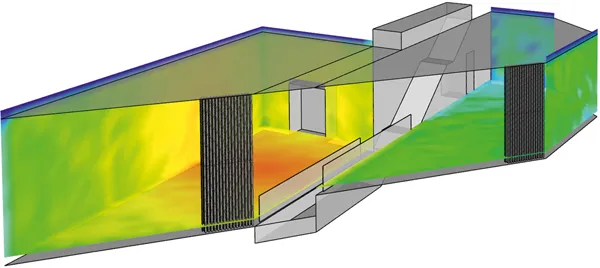
3 BIG, Mexico City Villa, 2016, acoustic simulation
This simulation uses Pachyderm, developed by Arthur van der Harten, a plug-in for Rhino that is used for acoustical analysis and simulation. Simulation can be used to understand how material and geometry impact acoustical performance, and this study looks into how the main stair could work as a sound absorber.
Designers are adopting a new generation of accurate and specific simulation tools. Khan and Marsh predicted in 2011: ‘[the] future of simulation lies in three areas: more detailed modelling, building integration and becoming an indispensable part of any design process; that is, simulation as a design tool'(8). Through the use of design simulation, building performance can be predicted. Early geometries can be compared for energy use, daylight, shading, airflow, comfort, sunlight and other parameters. Kjell Anderson writes: ‘simulations provide immediate feedback about the consequences of design decisions, continued use of simulation software validates and hones an individual's intuition'.(10) He further explains that simulation itself can be a highly creative act, it helps designers develop intuitions on real performance, as ‘play leads to understanding'.
Computation in Practice
The contemporary concepts and workflows in Computing the Environment have roots in earlier design experiments and technological advancements, and a path can be traced from early parametric modelling to current advances in custom tool development. In 1963, Ivan Sutherland created the first computer program to design architecture. He created a program that could not only draw geometry, but also create relationships between different elements in the design (associative modelling), and compute basic structural performance analysis.(11) However, when design software was introduced to architectural practice, it only functioned as a virtual drafting board; the important ‘computed' aspects of parametric relationships and performance were not included. Starting in the early 1980s, 2D drafting continued the practice of representing buildings as multiple 2D drawings. 2D drafting technology could be retrofitted to existing design practice, using existing skills without challenging established professional methods and conventions.(12)
Robert Aish sees the history of computer-aided design (CAD) as being divided into three eras: the 2D drafting era, the building information modelling (BIM) era and the design computation era. The BIM era actually started before the 2D drafting era in the 1980s, and is based on the idea that buildings are assemblies of components, but that does not necessarily imply that a designer conceives of a building in terms of such assemblies. This ‘component' assumption forces the designer to think about micro ideas (the components) before macro ideas (the building form). The design computation era introduced the distinction between a generative description of a building and the resulting generated model, and introduced a process where the designer no longer directly models the building, but instead develops an algorithm whose execution generates the model. There are two ways in which this enables a completely different kind of architecture to be created: first, it enables a move away from manual modelling and encourages the adoption of generative design tools; and second, it allows the designer to create his or her own components and, more importantly, to define a building and its components in terms of its behaviour.(12)
A Deeper Way to Think
In the late 1990s, in response to the lack of functionality in available programs, a few architects began to borrow technology from other industries: physics engines in game software, and parametric and fabrication abilities in industrial and aerospace software. Perhaps now we are beginning to re-establish the vision of the original innovators (such as...
Table of contents
- Cover
- Title page
- Copyright
- Foreword
- 1. Introduction—Computing the Environment: Design Workflows for the Simulation of Sustainable Architecture
- 2. New Dialogues About Energy: Performance, Carbon and Climate
- 3. Parametric Environmental Design: Simulation and Generative Processes
- 4. Designing Atmospheres: Simulating Experience
- 5. Use Data: Computing Life-cycle and Real-Time Visualisation
- 6. Near Future Developments: Advances in Simulation and Real-Time Feedback
- 7. Designing Environments and Simulating Experience: Foster + Partners Specialist Modelling Group
- 8. Maximising Impact Through Performance Simulation: The Work of Transsolar KlimaEngineering
- 9. Designers Need Feedback: Research and Practice by KieranTimberlake
- 10. Architecture Shapes Performance: GXN Advances Solar Modelling and Sensing
- 11. Bespoke Tools for a Better World: The Art of Sustainable Design at BuroHappold Engineering
- 12. Big Ideas: Information Driven Design
- 13. Simulating the Invisible: Max Fordham Designs Light, Air and Sound
- 14. White Architects: Build the Future
- 15. Core: Integrated Computation and Research
- 16. SuperSpace: Computing Human-Centric Architecture
- 17. Zhacode: Sketching With Performance
- 18. WeWork: Building Data for Design Feedback
- 19. Global Environmental Challenges: Technology Design and Architectural Responses
- Index
- EULA
Trusted by 375,005 students
Access to over 1.5 million titles for a fair monthly price.
Study more efficiently using our study tools.
Frequently asked questions
Yes, you can cancel anytime from the Subscription tab in your account settings on the Perlego website. Your subscription will stay active until the end of your current billing period. Learn how to cancel your subscription
No, books cannot be downloaded as external files, such as PDFs, for use outside of Perlego. However, you can download books within the Perlego app for offline reading on mobile or tablet. Learn how to download books offline
Perlego offers two plans: Essential and Complete
- Essential is ideal for learners and professionals who enjoy exploring a wide range of subjects. Access the Essential Library with 800,000+ trusted titles and best-sellers across business, personal growth, and the humanities. Includes unlimited reading time and Standard Read Aloud voice.
- Complete: Perfect for advanced learners and researchers needing full, unrestricted access. Unlock 1.5M+ books across hundreds of subjects, including academic and specialized titles. The Complete Plan also includes advanced features like Premium Read Aloud and Research Assistant.
We are an online textbook subscription service, where you can get access to an entire online library for less than the price of a single book per month. With over 1.5 million books across 990+ topics, we’ve got you covered! Learn about our mission
Look out for the read-aloud symbol on your next book to see if you can listen to it. The read-aloud tool reads text aloud for you, highlighting the text as it is being read. You can pause it, speed it up and slow it down. Learn more about Read Aloud
Yes! You can use the Perlego app on both iOS and Android devices to read anytime, anywhere — even offline. Perfect for commutes or when you’re on the go.
Please note we cannot support devices running on iOS 13 and Android 7 or earlier. Learn more about using the app
Please note we cannot support devices running on iOS 13 and Android 7 or earlier. Learn more about using the app
Yes, you can access Computing the Environment by Brady Peters,Terri Peters in PDF and/or ePUB format, as well as other popular books in Architecture & Sustainability in Architecture. We have over 1.5 million books available in our catalogue for you to explore.