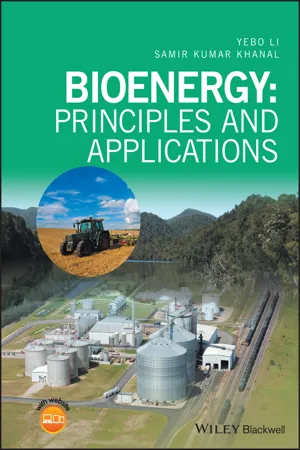
Bioenergy
eBook - ePub

Bioenergy

Principles and Applications

  1. English
  2. ePUB (mobile friendly)
  3. Available on iOS & Android
eBook - ePub

Bioenergy

Principles and Applications

About this book

BIOENERGY:
PRINCIPLES AND APPLICATIONS

BIOENERGY: PRINCIPLES AND APPLICATIONS

With growing concerns over climate change and energy insecurity coupled with dwindling reserves of fossil energy resources, there is a growing search for alternative, renewable energy resources. Energy derived from renewable bioresources such as biomass (energy crops, agri- and forest residues, algae, and biowastes) has received significant attention in recent years. With the growing interest in bioenergy, there has been increasing demand for a broad-ranging, introductory textbook that provides an essential overview of this very subject to students in the field. Bioenergy: Principles and Applications offers an invaluable introduction to both fundamental and applied aspects of bioenergy feedstocks and their processing, as well as lifecycle and techno-economic analyses, and policies as applied to bioenergy.

Bioenergy: Principles and Applications provides readers with foundational information on first-, second-, and third-generation bioenergy, ranging from plant structure, carbohydrate chemistry, mass and energy balance, thermodynamics, and reaction kinetics to feedstock production, logistics, conversion technologies, biorefinery, lifecycle and techno-economic analyses, and government policies. This textbook gives students and professionals an incomparable overview of the rapidly growing field of bioenergy.

Bioenergy: Principles and Applications will be an essential resource for students, engineers, researchers, and industry personnel interested in, and working in, the bioenergy field.
Frequently asked questions

Yes, you can cancel anytime from the Subscription tab in your account settings on the Perlego website. Your subscription will stay active until the end of your current billing period. Learn how to cancel your subscription.
No, books cannot be downloaded as external files, such as PDFs, for use outside of Perlego. However, you can download books within the Perlego app for offline reading on mobile or tablet. Learn more here.
Perlego offers two plans: Essential and Complete
  • Essential is ideal for learners and professionals who enjoy exploring a wide range of subjects. Access the Essential Library with 800,000+ trusted titles and best-sellers across business, personal growth, and the humanities. Includes unlimited reading time and Standard Read Aloud voice.
  • Complete: Perfect for advanced learners and researchers needing full, unrestricted access. Unlock 1.4M+ books across hundreds of subjects, including academic and specialized titles. The Complete Plan also includes advanced features like Premium Read Aloud and Research Assistant.
Both plans are available with monthly, semester, or annual billing cycles.
We are an online textbook subscription service, where you can get access to an entire online library for less than the price of a single book per month. With over 1 million books across 1000+ topics, we’ve got you covered! Learn more here.
Look out for the read-aloud symbol on your next book to see if you can listen to it. The read-aloud tool reads text aloud for you, highlighting the text as it is being read. You can pause it, speed it up and slow it down. Learn more here.
Yes! You can use the Perlego app on both iOS or Android devices to read anytime, anywhere — even offline. Perfect for commutes or when you’re on the go.
Please note we cannot support devices running on iOS 13 and Android 7 or earlier. Learn more about using the app.
Yes, you can access Bioenergy by Yebo Li,Samir Kumar Khanal in PDF and/or ePUB format, as well as other popular books in Biological Sciences & Biology. We have over one million books available in our catalogue for you to explore.

Information

SECTION III
Biological Conversion Technologies

CHAPTER 12
Pretreatment of Lignocellulosic Feedstocks

Chang Geun Yoo and Xuejun Pan

What is included in this chapter?

This chapter covers various pretreatment methods for lignocellulosic feedstocks. Discussion of common pretreatment methods, the mechanism, representative conditions, effects on plant cell wall structure and composition, enzymatic digestibility of pretreated substrates, formation of fermentation inhibitors, and co‐products potential are covered. Pertinent examples and calculations are also included.

12.1 Introduction

Lignocellulosic feedstocks are the most abundant renewable resource on Earth, with an availability of approximately 200 billion dry metric tons per year (Zhang et al., 2007). Examples of lignocellulosic feedstocks include crop residues, such as corn stover, wheat and rice straws, and other crop stalks; forest residues, such as forest thinnings and sawmill residues; and energy crops, such as switchgrass, miscanthus, sweet sorghum, energy cane, Napier grass, and fast‐growing trees (e.g., poplar, eucalyptus, and willow). Compared to starch‐rich feedstocks, these bioresources are cost competitive and do not directly compete with food and feed. Lignocellulosic feedstocks have thus been considered the most promising and sustainable resources for bioenergy, chemicals, and other value‐added products.
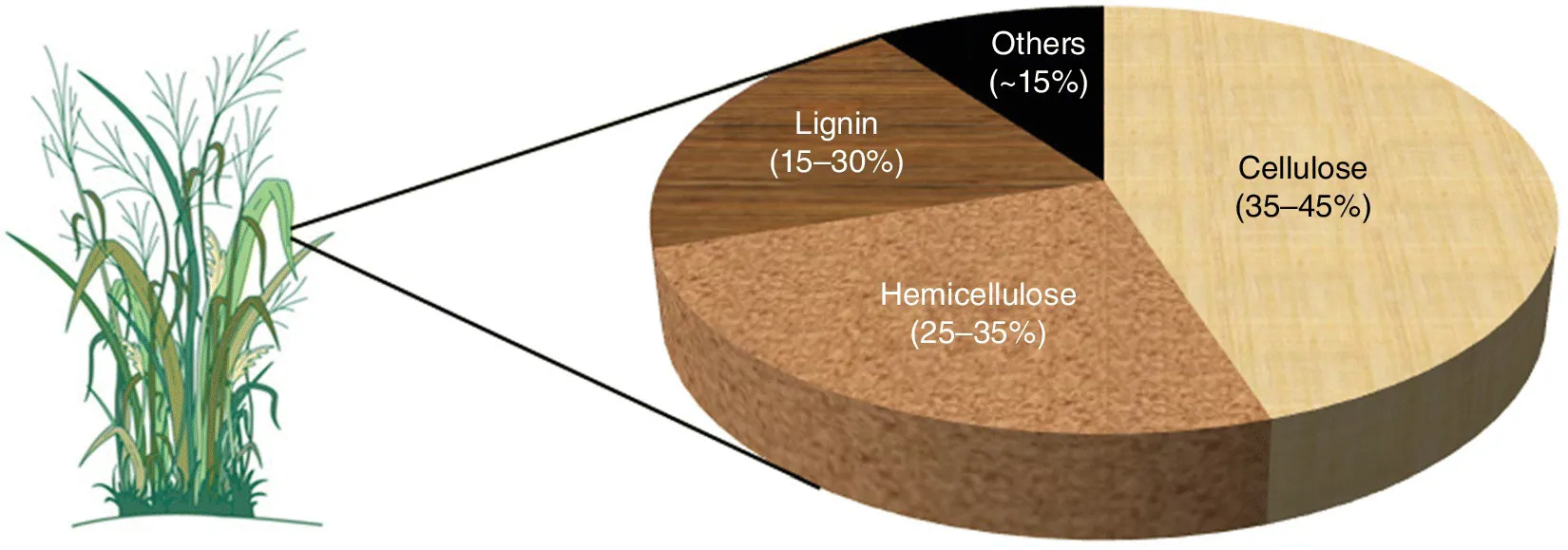
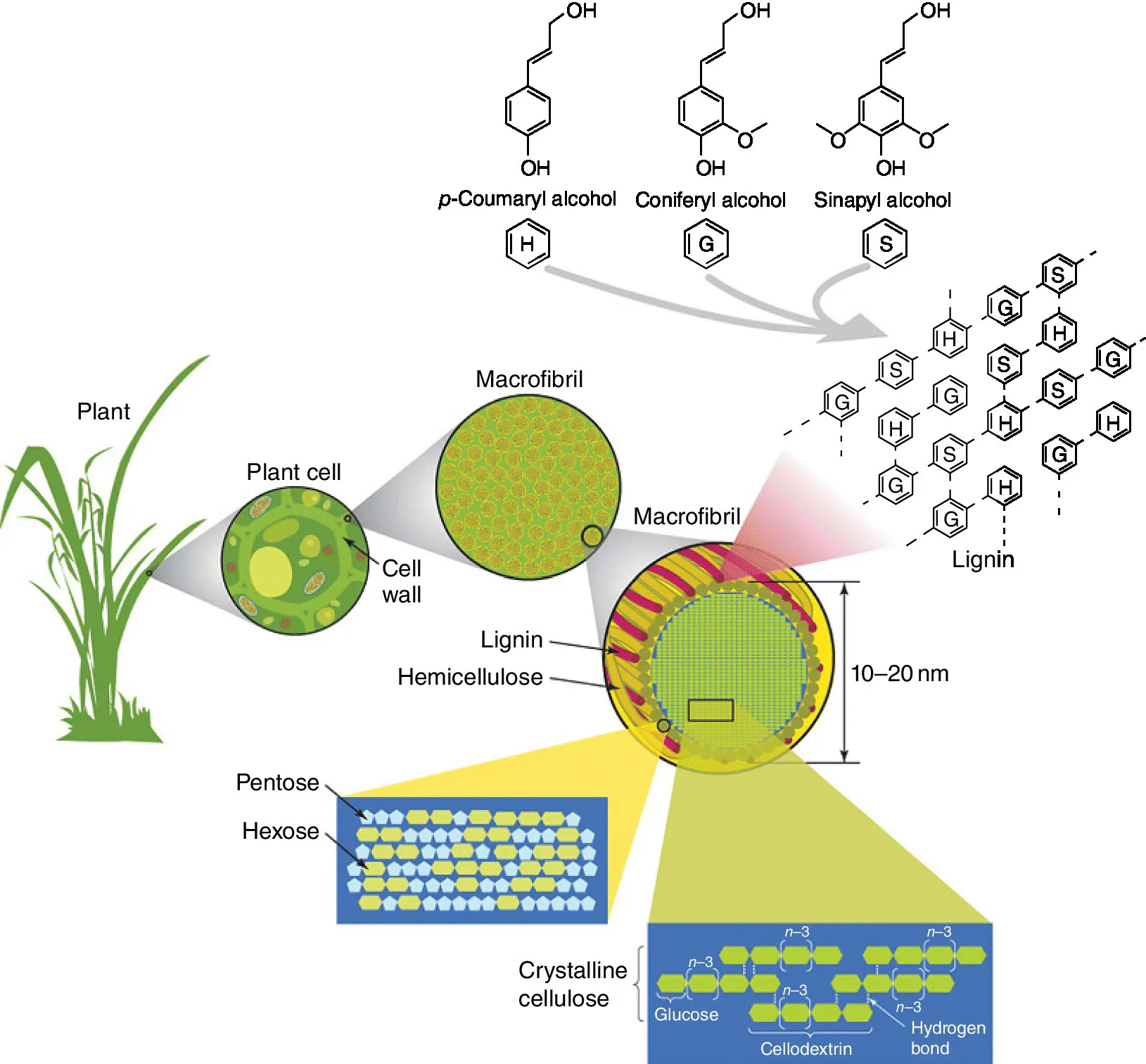
Chemically, lignocellulosic biomass is composed of three major components (cellulose, hemicellulose, and lignin) and minor substances (e.g., extractives and ash). These components coexist in the cell wall of plants. In general, lignocellulosic biomass contains approximately 35–45% cellulose, 25–35% hemicellulose, and 15–30% lignin, depending on plant species, age, and tissue type (Figure 12.1). Cellulose is a linear polymer of glucose linked together by β‐1,4 glycosidic bonds; hemicellulose is a group of branched co‐polymers of multiple sugars (e.g., xylose, mannose, arabinose, galactose, glucose, and uronic acids); and lignin is a three‐dimensional aromatic polymer of phenylpropane units (coniferyl, sinapyl, and p‐coumaryl alcohols), cross‐linked primarily through ether and carbon–carbon bonds (Figure 12.2).
3-Dimensional pie chart of chemical composition of lignocellulosic biomass consisting of lignin (15 to 30%), hemicellulose (25 to 35%), cellulose (35 to 45%), and others (15%).
Fig. 12.1 Chemical composition of lignocellulosic biomass.
Schematic of structural organization starting from plant, to cell, to macrofibril, to crystalline cellulose, with structural formula illustrating lignin as coniferyl, sinapyl, and p-coumaryl alcohols.
Fig. 12.2 Structural organization of the plant cell wall.
Source: Rubin, 2008. Reproduced with permission of Nature Publishing Group.
Current bioconversion of lignocellulosic feedstocks to liquid fuels and chemicals is primarily based on a carbohydrate (or sugar) platform, also known as a biochemical platform. Specifically, the sugar (primarily glucose) is first extracted from lignocellulosic biomass by either enzymatic or chemical (acidic) hydrolysis of cellulose, and then fermented into target products such as ethanol, butanol, propanediol, succinic acid, and lactic acid. Therefore, the hydrolysis of cellulose to glucose (saccharification) is considered to be the most critical and important step of the bioconversion process. However, because of the physical and chemical recalcitrance of the biomass to cellulose hydrolytic enzymes (cellulases), effective saccharification of lignocellulosic feedstock continues to be a technical challenge.

12.2 What Does Pretreatment Do?

In the cell wall, cellulose is surrounded by hemicellulose and lignin, so the cellulose is not readily accessible to enzymes or cellulases (Figure 12.2). In addition to acting as a physical barrier, lignin is a natural inhibitor of biodegradation of cell wall components, thus contributing to the self‐defense system of plants against attacks by insects, bacteria, and fungi. Minor components of the cell wall, such as extractives, also retard the enzymatic hydrolysis of cellulose. The tough and rigid structure and poor permeability of plant cell walls form another barrier to cellulases. Also, the particle size (surfa...

Table of contents

  1. Cover
  2. Title Page
  3. Table of Contents
  4. List of Contributors
  5. Preface
  6. Acknowledgments
  7. About the Companion Website
  8. SECTION I: Bioenergy Fundamentals
  9. SECTION II: Bioenergy Feedstocks
  10. SECTION III: Biological Conversion Technologies
  11. SECTION IV: Thermal Conversion Technologies
  12. SECTION V: Biobased Refinery
  13. SECTION VI: Bioenergy System Analysis
  14. Index
  15. End User License Agreement