
Although most people are aware of the value of developing new energy technologies, the importance of assessing such technologies is only just beginning to be recognized in full.
This book, illustrated by real-life examples, fulfils two main objectives. Firstly, it provides an in-depth summary of energy system evaluation methods, the result of decades of work in this area, for the use of researchers, engineers and anybody else interested in the energy sector. Secondly, the vicious cycle of neglect towards in situ evaluation is broken. This neglect is due to its unjust reputation for being "thankless work": longwinded, expensive, difficult to exploit and undervalued.
By scientifically organizing experience acquired over more than 30 years, Energy Transition highlights the considerable usefulness of the approach, not only economically, but also from a human standpoint.
eBook - ePub
Energy Transition
About this book
Information
Part 1
The Context of Case Study Feedback (CSF)
1
Energy Transition
The human problem has always been not to create energy, but to transform in a more or less rational way the energy resources available for use. Unlike other natural resources, the Earth is an open system in terms of energy: it receives a permanent and enormous flow of solar energy. This incidental solar radiation is intrinsically a good quality source since it comes from a 6,000 K thermal source; it could therefore be transformed into energy that can be used for our various uses with high efficiency. However, natural annual yields (photosynthesis) are generally well below 1%, and are at most 2.5% for the best plants, such as maize.
At the biological level, human energy needs are covered exclusively by solar energy through photosynthesis – 2,500 kcal per day, or 10.5 MJ, which corresponds to an average power of about 120 W. The conversion efficiency of the human “machine”, despite being one of the highest in the animal kingdom, does not exceed 20%: a human therefore has relatively little power biologically and is constantly seeking additional energy (see Figure 1.1, the evolution of world energy consumption since 1800 [MAR 03]).
1.1. The global energy system and its evolution
Each year, humanity consumes nearly 15 billion tons of1 oil equivalent, a quantity contained in a cube of about 2.5 km of ridge. This represents approximately 1.8 tons per inhabitant or 2,000 W of continuous power. The price of energy, which has remained relatively stable over the past few decades, although things are beginning to change, can be described as low since heating oil has the same price as bottled mineral water, which is a renewable, abundant and regional resource. The inhabitants of the countries of the North therefore very easily have all the necessary energy at their disposal and do not deprive themselves of what is superfluous. For citizens who are unfamiliar with the realities of energy problems, this may seem to indicate a very high abundance of energy, while nearly 85% of the resources used are not renewable (Figure 1.1).
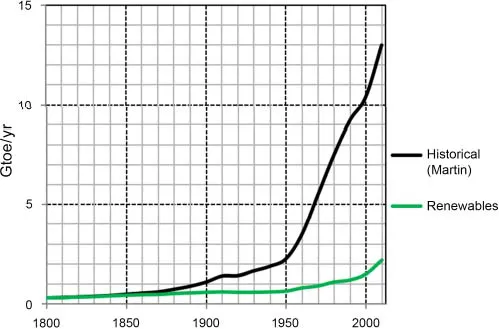
Figure 1.1. Evolution of world energy consumption, according to [MAR 03]
This first observation must be put into perspective by the deep inequalities between the consumption of individuals on different continents. Thus, an average American will consume 8 tons of fuel oil per year compared to 0.3 tons for the citizens of some African or Asian countries. This is an average; we should not compare the energy consumption of the richest 5% of the world with that of the poorest 25%. An estimated 2 billion people live without electricity.
The current trend in energy consumption is worrying: a headlong rush at a rate of about 2% per year of growth, i.e. a doubling of this consumption every 35 years and its multiplication by seven times every century. However, we must be careful not to extrapolate this observation too far into the future: in a finite world, growing exponentials also have an end!
Table 1.1 shows the world energy balance in 2015. The figures come from the International Energy Agency and have been adapted to account for hydropower in the same way as nuclear power.
Table 1.1. World primary energy in 2015, according to [INT 16]
| Resources | Gtoe | % |
| Petroleum | 4.38 | 30.3% |
| Coal | 3.66 | 25.3% |
| Gas | 3.21 | 22.2% |
| Fossils | 11.21 | 77.8% |
| Nuclear power | 0.59 | 4.1% |
| Hydro | 0.91 | 6.3% |
| Other renewables | 0.50 | 3.5% |
| Traditional biomass | 1.20 | 8.3% |
| Renewable | 2.62 | 18.1% |
| Total | 14.45 | 100.0% |
The energy sources are distributed as follows:
- – fossil fuels provide nearly 80% of the world’s energy (30.5% oil, 25.5% coal and 22% gas);
- – the nuclear sector (4%) only plays a modest role in global energy supply;
- – the renewable total is approaching one-fifth (18%), hydropower (6.5%) and especially other renewable energy sources (3.5%) are slowly but surely emerging, while traditional biomass (8%) is largely managed as a non-renewable resource (desertification problem).
1.2. The necessary transformation of the global energy system
Several elements show that the current energy system is not sustainable in the long term and that it must evolve.
1.2.1. Fossil fuels: planned scarcity upstream and environmental problem downstream
Fossil fuels have exceptional qualities: low extraction prices, ease of exploitation, very easy storage, very easy transport for oil and gas (which does not prevent bad practices, which can be disastrous for the environment). They have major shortcomings (non-renewable resources, emission of various pollutants), but they have been and still are ideal energies for many countries for economic take-off. Their exhaustion will therefore pose problems that must be anticipated at all costs.
On the available reserves, controversies are raging. For the pessimist, there are still enough fossil fuels to disturb the climate but never enough to satisfy all the desires of the inhabitants of this planet. For the optimist, and provided we also believe that we are collectively reasonable, there are plenty of them for basic needs and to develop a sustainable energy system, while limiting climate disruptions. The truth is probably in between.
In addition to the problem of climate change, following the emission of greenhouse gases, a limitation of fossil fuel consumption can only be beneficial in view of other problems such as urban pollution, the geopolitical risks associated with the depletion of oil resources outside the Middle East or the economic consequences of high energy prices for developing countries.
1.2.2. Nuclear energy: environmental and accessibility issues
With regard to uranium reserves, we must be very cautious about the figures for the following reasons [FIN 98]:
- – these are highly diluted deposits (< 1%), with poorly defined formation conditions;
- – uranium is a highly strategic raw material and reserve data is often considered a military secret;
- – many actors are inclined to underestimate these figures: those who are anti-nuclear in order to devalue the entire supply chain, and some pro-nuclear to promote other supply chains (breeder reactors that use 70 times more uranium than conventional reactors, thorium reactors or fusion).
Nevertheless, with current technology, uranium resources are a definite limitation to a significant increase in the number of power plants. Several constraints weigh on the development of nuclear energy:
- – social acceptability. The specific nature of nuclear risks – very low probability but very high consequence accident risk, long-lived waste management risk spread over an intergenerational period, risk of military proliferation – makes collective preference formation difficult and scientific consensus impossible. However, these two conditions are necessary for a technology to develop;
- – economic constraints. These include the inadequacy of nuclear technology with the competitive organization of the electricity industries, competition from combined cycle gas turbines and financing constraints in emerging countries.
1.2.3. An overall inefficient system
One-third of primary energy is degraded during successive transformations mainly due to electricity production via heat (two-thirds of the losses), the other major losses being the transformers’ own energy consumption and losses during transport and storage. All of these losses will end up as heat.
Final energy is often grouped into three uses: mobility (about 30%), electricity (just under 20%) and heat (a g...
Table of contents
- Cover
- Table of Contents
- Foreword
- Preface
- Acknowledgments
- Part 1: The Context of Case Study Feedback (CSF)
- Part 2: CSF Tools: Operation and Envisaged Uses
- Part 3: The Practice of CSF
- Part 4: Towards Involved Research?
- References
- Index
- End User License Agreement
Trusted by 375,005 students
Access to over 1.5 million titles for a fair monthly price.
Study more efficiently using our study tools.
Frequently asked questions
Yes, you can cancel anytime from the Subscription tab in your account settings on the Perlego website. Your subscription will stay active until the end of your current billing period. Learn how to cancel your subscription
No, books cannot be downloaded as external files, such as PDFs, for use outside of Perlego. However, you can download books within the Perlego app for offline reading on mobile or tablet. Learn how to download books offline
Perlego offers two plans: Essential and Complete
- Essential is ideal for learners and professionals who enjoy exploring a wide range of subjects. Access the Essential Library with 800,000+ trusted titles and best-sellers across business, personal growth, and the humanities. Includes unlimited reading time and Standard Read Aloud voice.
- Complete: Perfect for advanced learners and researchers needing full, unrestricted access. Unlock 1.5M+ books across hundreds of subjects, including academic and specialized titles. The Complete Plan also includes advanced features like Premium Read Aloud and Research Assistant.
We are an online textbook subscription service, where you can get access to an entire online library for less than the price of a single book per month. With over 1.5 million books across 990+ topics, we’ve got you covered! Learn about our mission
Look out for the read-aloud symbol on your next book to see if you can listen to it. The read-aloud tool reads text aloud for you, highlighting the text as it is being read. You can pause it, speed it up and slow it down. Learn more about Read Aloud
Yes! You can use the Perlego app on both iOS and Android devices to read anytime, anywhere — even offline. Perfect for commutes or when you’re on the go.
Please note we cannot support devices running on iOS 13 and Android 7 or earlier. Learn more about using the app
Please note we cannot support devices running on iOS 13 and Android 7 or earlier. Learn more about using the app
Yes, you can access Energy Transition by Bernard Lachal in PDF and/or ePUB format, as well as other popular books in Physical Sciences & Energy. We have over 1.5 million books available in our catalogue for you to explore.