Disaster Risk Reduction for the Built Environment
eBook - ePub

Disaster Risk Reduction for the Built Environment

  1. English
  2. ePUB (mobile friendly)
  3. Available on iOS & Android
eBook - ePub

Disaster Risk Reduction for the Built Environment

About this book

Disaster Risk Reduction for the Built Environment provides a multi-facetted introduction to how a wide range of risk reduction options can be mainstreamed into formal and informal construction decision making processes, so that Disaster Risk Reduction (DRR) can become part of the 'developmental DNA'.  The contents highlight the positive roles that practitioners such as civil and structural engineers, urban planners and designers, and architects (to name just a few) can undertake to ensure that disaster risk is addressed when (re)developing the built environment. The book does not set out prescriptive ('context blind') solutions to complex problems because such solutions can invariably generate new problems. Instead it raises awareness, and in doing so, inspires a broad range of people to consider DRR in their work or everyday practices.

This highly-illustrated text book provides a broad range of examples, case studies and thinking points that can help the reader to consider how DRR approaches might be adapted for differing contexts. 
Frequently asked questions

Yes, you can cancel anytime from the Subscription tab in your account settings on the Perlego website. Your subscription will stay active until the end of your current billing period. Learn how to cancel your subscription.
No, books cannot be downloaded as external files, such as PDFs, for use outside of Perlego. However, you can download books within the Perlego app for offline reading on mobile or tablet. Learn more here.
Perlego offers two plans: Essential and Complete
  • Essential is ideal for learners and professionals who enjoy exploring a wide range of subjects. Access the Essential Library with 800,000+ trusted titles and best-sellers across business, personal growth, and the humanities. Includes unlimited reading time and Standard Read Aloud voice.
  • Complete: Perfect for advanced learners and researchers needing full, unrestricted access. Unlock 1.4M+ books across hundreds of subjects, including academic and specialized titles. The Complete Plan also includes advanced features like Premium Read Aloud and Research Assistant.
Both plans are available with monthly, semester, or annual billing cycles.
We are an online textbook subscription service, where you can get access to an entire online library for less than the price of a single book per month. With over 1 million books across 1000+ topics, we’ve got you covered! Learn more here.
Look out for the read-aloud symbol on your next book to see if you can listen to it. The read-aloud tool reads text aloud for you, highlighting the text as it is being read. You can pause it, speed it up and slow it down. Learn more here.
Yes! You can use the Perlego app on both iOS or Android devices to read anytime, anywhere — even offline. Perfect for commutes or when you’re on the go.
Please note we cannot support devices running on iOS 13 and Android 7 or earlier. Learn more about using the app.
Yes, you can access Disaster Risk Reduction for the Built Environment by Lee Bosher,Ksenia Chmutina in PDF and/or ePUB format, as well as other popular books in Technology & Engineering & Construction & Architectural Engineering. We have over one million books available in our catalogue for you to explore.

Section IV

Key Considerations and Ways Forward

Chapter 5
Earthquakes

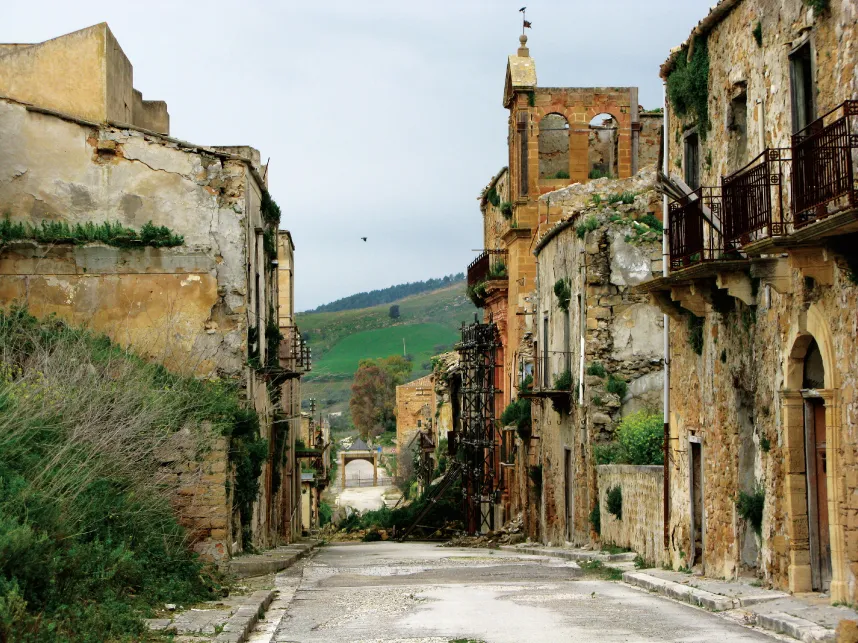
Opening image: A deserted village, abandoned after the 1968 Belice earthquake in Sicily
(Source: Lee Bosher, 2014).
Image described by caption.
We can do little to reduce the hazard embodied in an active fault or a major earthquake, but we can do a lot about the risk to the structures that we design and build. It is important to remember the frequently quoted observation that earthquakes do not kill, but collapsed buildings and facilities do.
Professor Thomas O’Rourke, Cornell University
Ancient texts, ruined former settlements and damaged historical buildings have provided sufficient evidence that earthquakes have blighted the development of some human habitations for thousands of years. More recent data suggests that earthquakes typically account for the highest proportion of deaths per year than any other types of geophysical or hydrometeorological hazards. Some of these deaths are caused directly by the earthquake but others are caused by the knock-on impacts of the earthquake, such as tsunamis (discussed in this chapter) and landslides (to be discussed in Chapter 7).

LEARNING OBJECTIVES

By the end of this chapter you will learn:
  • What are the main causes of earthquakes?
  • What are the typical impacts of earthquakes?
  • How to identify seismic risks and assess vulnerabilities?
  • How to reduce the impacts of earthquakes using structural and non-structural measures?

5.1 Living with Earthquakes

Historical records have proven testament to the long-term fragile relationship between the establishment of human settlements in earthquake prone locations and the impacts of seismic activity. For instance, highly developed ancient centres of scholarship and industry, such as Troy, Mycenae and Knossos, are reported to have been severely affected (if not actually destroyed) by earthquakes over 3,000 years ago. In more recent years (Table 5.1), high profile earthquakes have devastated regions of Haiti, China, Pakistan and Indonesia, and while the most prominent impacts reported in the media tend to be the physical impacts, the socio-political and economic impacts also play an important role in how nations and communities cope with, and recover from, such events.
Table 5.1 The 10 Most Deadly Earthquakes in the Last 50 Years.
Country Magnitude Year Total deaths
China 7.5 1976 242,000
Haiti 7.0 2010 222,570
Indonesia 9.1 2004 165,708
China 7.9 2008 87,476
Pakistan 7.6 2005 73,338
Peru 7.9 1970 66,794
Iran 7.4 1990 40,000
Sri Lanka 9.1 2004 35,399
Iran 6.6 2003 26,796
Iran 7.8 1978 25,000
Note: some deaths may have been caused by tsunamis and landslides generated by the earthquake
There is, however, interesting evidence suggesting that historically people living in seismically active regions have found ways to adapt to the threat of earthquakes and some of these approaches will be discussed in this chapter.

5.1.1 Overview of the Typical Impacts of Earthquakes

According to records compiled by EM-DAT (Table 5.2), in the 50 years between 1964 and 2013 there were 998 major earthquakes globally, that killed a total of over 1 million people, affected 174 million people and caused an estimated US$534bn in damages.
Table 5.2 Earthquake Averages Per Year Between 1964 and 2013.
Earthquake events 20
Deaths 21,490
Total people affected 3,487,384
Total economic damages (US$) 10.7bn
The primary effects of earthquakes include loss of life, damage to buildings and other structures, including bridges, power and water distribution systems, roadways, and canals.
Secondary effects include economic hardship due to a temporary decline in business transactions, reduced revenues from tourism and rebuilding costs. The impact on those affected may cause psychological damage, in particular where deaths, serious injuries and loss of property occur; these fears can be exacerbated in areas where earthquake ‘aftershocks’ are experienced. This can also lead to the evacuation of long-established habitations with residents (sometimes forcibly) being relocated elsewhere (see Case Study 5.1). Severe earthquakes can lead to a varying degree of damage, from structures that are entirely destroyed to others that may look safe and functional but in fact may not be structurally sound. Fires can spread due to gas pipe explosions and landslides may also occur. Tsunamis may cause extensive flooding in coast...

Table of contents

  1. Cover
  2. Title Page
  3. Copyright
  4. Table of Contents
  5. List of Figures
  6. List of Tables
  7. Note on the Authors
  8. Foreword
  9. Acknowledgements
  10. List of Acronyms
  11. List of Case Studies
  12. List of Thinking Points
  13. Section I: Introduction to Book and Concepts
  14. Section II: Hydro-Meteorological Hazards
  15. Section IV: Key Considerations and Ways Forward
  16. Section III: Geological Hazards
  17. Index
  18. End User License Agreement