Computational Liquid Crystal Photonics
eBook - ePub

Computational Liquid Crystal Photonics

Fundamentals, Modelling and Applications

  1. English
  2. ePUB (mobile friendly)
  3. Available on iOS & Android
eBook - ePub

Computational Liquid Crystal Photonics

Fundamentals, Modelling and Applications

About this book

Optical computers and photonic integrated circuits in high capacity optical networks are hot topics, attracting the attention of expert researchers and commercial technology companies. Optical packet switching and routing technologies promise to provide a more efficient source of power, and footprint scaling with increased router capacity; integrating more optical processing elements into the same chip to increase on-chip processing capability and system intelligence has become a priority.

This book is an in-depth look at modelling techniques and the simulation of a wide range of liquid crystal based modern photonic devices with enhanced high levels of flexible integration and enhanced power processing. It covers the physics of liquid crystal materials; techniques required for modelling liquid crystal based devices; the state-of-the art liquid crystal photonic based applications for telecommunications such as couplers, polarization rotators, polarization splitters and multiplexer-demultiplexers; liquid core photonic crystal fiber (LC-PCF) sensors including biomedical and temperature sensors; and liquid crystal photonic crystal based encryption systems for security applications.

Key features

  • Offers a unique source of in-depth learning on the fundamental principles of computational liquid crystal photonics.
  • Explains complex concepts such as photonic crystals, liquid crystals, waveguides and modes, and frequency- and time-domain techniques used in the design of liquid crystal photonic crystal photonic devices in terms that are easy to understand.
  • Demonstrates the useful properties of liquid crystals in a diverse and ever-growing list of technological applications.
  • Requires only a foundational knowledge of mathematics and physics.
Frequently asked questions

Yes, you can cancel anytime from the Subscription tab in your account settings on the Perlego website. Your subscription will stay active until the end of your current billing period. Learn how to cancel your subscription.
No, books cannot be downloaded as external files, such as PDFs, for use outside of Perlego. However, you can download books within the Perlego app for offline reading on mobile or tablet. Learn more here.
Perlego offers two plans: Essential and Complete
  • Essential is ideal for learners and professionals who enjoy exploring a wide range of subjects. Access the Essential Library with 800,000+ trusted titles and best-sellers across business, personal growth, and the humanities. Includes unlimited reading time and Standard Read Aloud voice.
  • Complete: Perfect for advanced learners and researchers needing full, unrestricted access. Unlock 1.4M+ books across hundreds of subjects, including academic and specialized titles. The Complete Plan also includes advanced features like Premium Read Aloud and Research Assistant.
Both plans are available with monthly, semester, or annual billing cycles.
We are an online textbook subscription service, where you can get access to an entire online library for less than the price of a single book per month. With over 1 million books across 1000+ topics, we’ve got you covered! Learn more here.
Look out for the read-aloud symbol on your next book to see if you can listen to it. The read-aloud tool reads text aloud for you, highlighting the text as it is being read. You can pause it, speed it up and slow it down. Learn more here.
Yes! You can use the Perlego app on both iOS or Android devices to read anytime, anywhere — even offline. Perfect for commutes or when you’re on the go.
Please note we cannot support devices running on iOS 13 and Android 7 or earlier. Learn more about using the app.
Yes, you can access Computational Liquid Crystal Photonics by Salah Obayya,Mohamed Farhat O. Hameed,Nihal F. F. Areed in PDF and/or ePUB format, as well as other popular books in Technology & Engineering & Electrical Engineering & Telecommunications. We have over one million books available in our catalogue for you to explore.

Part I
Basic Principles

1
Principles of Waveguides

1.1 Introduction

A waveguide can be defined as a structure that guides waves, such as electromagnetic or sound waves [1]. In this chapter, the basic principles of the optical waveguide will be introduced. Optical waveguides can confine and transmit light over different distances, ranging from tens or hundreds of micrometers in integrated photonics, to hundreds or thousands of kilometers in long-distance fiber-optic transmission. Additionally, optical waveguides can be used as passive and active devices such as waveguide couplers, polarization rotators, optical routers, and modulators. There are different types of optical waveguides such as slab waveguides, channel waveguides, optical fibers, and photonic crystal waveguides. The slab waveguides can confine energy to travel only in one dimension, while the light can be confined in two dimensions using optical fiber or channel waveguides. Therefore, the propagation losses will be small compared to wave propagation in open space. Optical waveguides usually consist of high index dielectric material surrounded by lower index material, hence, the optical waves are guided through the high index material by a total internal reflection mechanism. Additionally, photonic crystal waveguides can guide the light through low index defects by a photonic bandgap guiding technique. Generally, the width of a waveguide should have the same order of magnitude as the wavelength of the guided wave.
In this chapter, the basic optical waveguides are discussed including waveguides operation, Maxwell’s equations, the wave equation and its solutions, boundary conditions, phase and group velocity, and the properties of modes.

1.2 Basic Optical Waveguides

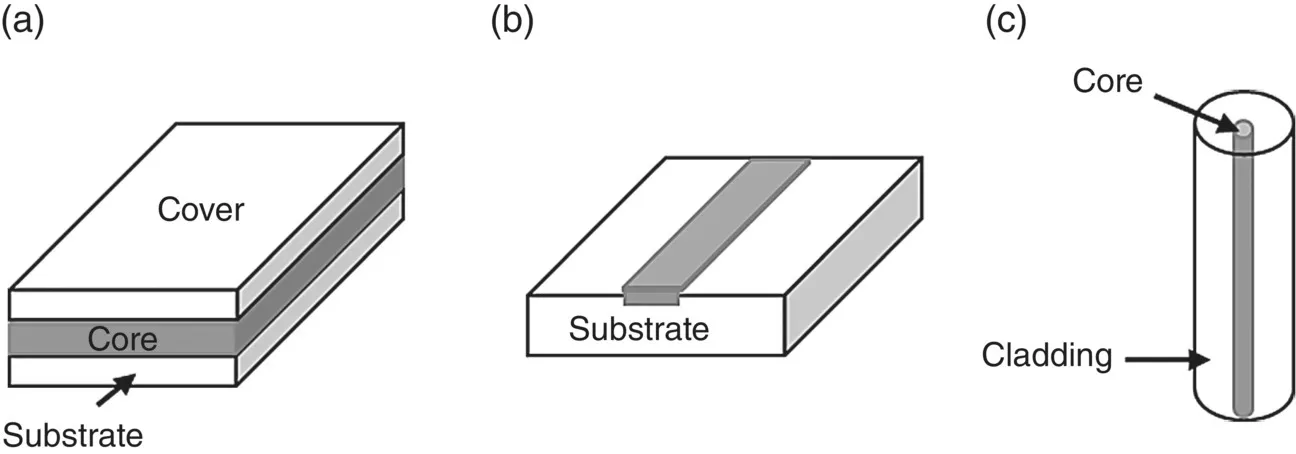
Optical waveguides can be classified according to their geometry, mode structure, refractive index distribution, materials, and the number of dimensions in which light is confined [2]. According to their geometry, they can be categorized by three basic structures: planar, rectangular channel, and cylindrical channel as shown in Figure 1.1. Common optical waveguides can also be classified based on mode structure as single mode and multiple modes. Figure 1.1a shows that the planar waveguide consists of a core that must have a refractive index higher than the refractive indices of the upper medium called the cover, and the lower medium called the substrate. The trapping of light within the core is achieved by total internal reflection. Figure 1.1b shows the channel waveguide which represents the best choice for fabricating integrated photonic devices. This waveguide consists of a rectangular channel that is sandwiched between an underlying planar substrate and the upper medium, which is usually air. To trap the light within a rectangular channel, it is necessary for the channel to have a refractive index greater than that of the substrate. Figure 1.1c shows the geometry of the cylindrical channel waveguide which consists of a central region, referred to as the core, and surrounding material called cladding. Of course, to confine the light within the core, the core must have a higher refractive index than that of the cladding.
Three schematics of the common waveguide geometries, namely, planar depicting the cover, core, and substrate (a), rectangular depicting the substrate (b), and cylindrical depicting the core and cladding (c). schematics of the common waveguide geometries, namely, planar depicting the cover, core, and substrate (a), rectangular depicting the substrate (b), and cylindrical depicting the core and cladding (c).
Figure 1.1 Common waveguide geometries: (a) planar, (b) rectangular, and (c) cylindrical
Figure 1.2 shows the three most common types of channel waveguide structures which are called strip, rip, and buried waveguides. It is evident from the figure that the main difference between the three types is in the...

Table of contents

  1. Cover
  2. Title Page
  3. Table of Contents
  4. Preface
  5. Part I: Basic Principles
  6. Part II: Numerical Techniques
  7. Part III: Applications of LC Devices
  8. Index
  9. End User License Agreement