With the idea of "deep learning" having now become the key to this new generation of solutions, major technological players in the business intelligence sector have taken an interest in the application of Big Data. In this book, the author explores the recent technological advances associated with digitized data flows, which have recently opened up new horizons for AI. The reader will gain insight into some of the areas of application of Big Data in AI, including robotics, home automation, health, security, image recognition and natural language processing.
Before we start discussing Business Intelligence (BI) and Artificial Intelligence (AI), let us begin by reviewing what we mean by “intelligence” (in a non-philosophical context).
1.1. Intelligence
Etymology.– The word “intelligence” comes from the Latin intelligentia meaning “faculty of perception”, “comprehension”. It is derived from intellĕgĕre (“discern”, “grasp”, “understand”), which is composed of the prefix inter-(“between”) and the verb lĕgĕre (“pick”, “choose”, “read”). Etymologically speaking, intelligence consists of making a choice, a selection.
We could therefore say that intelligence is defined as the set of mental faculties that make it possible to understand things and facts, and to discover the relationships between them in order to arrive at a rational understanding (knowledge) (as opposed to intuition). It makes it possible to understand and adapt to new situations and can therefore also be defined as adaptability. Intelligence can be seen as the ability to process information to achieve an objective. In this book, we are particularly interested in the latter definition: projecting intelligence in the digital world of the Internet where information travels at the speed of light. Our digitalized world continuously generates information (the Internet never sleeps) and does so in various forms (transactions, texts, images, sounds, etc.), which is what we call “Big Data1”. Since the dawn of time, “man seeks to know how to act” and he has used all the information at his disposal, learning from past experiences and using it to project himself into a more or less immediate future. The challenge for companies is to make this information “intelligent”: intelligible, diffusible and understandable by those who will have to transform it into an action plan (“know how to act”), which is the fundamental principle of BI (see section 1.2 for more details).
1.2. Business Intelligence
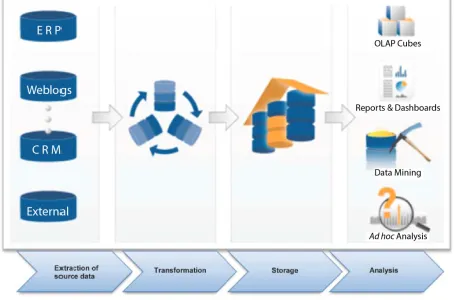
BI could be defined as a data principle that is “augmented” by a certain amount of computer tools (database, dashboards, etc.) and know-how (data management, analytical processes, etc.). Its objective is to help “decision-makers” (both strategic and operational) in their decision-making and/or management of their activities. One of the most important principles of this is that operational decisions must be made as closely as possible to their implementation based on indicators that are directly linked to the operational processes they control. Their aim is to make the right decision at the right time (timing has become a key word in BI) in order to limit the risks of deceleration between the operational situation and the indicators that reflect it. BI platforms have had to adapt to this new situation. In the mid-2000s, this led to the creation of a new architecture called Operational BI2. This was aimed more at “field” players, in other words operational staff who managed their activities in near-real time, although BI had historically been more of a decision-making tool aimed at analysts and strategic decision makers (who are not at all or not very well “connected” to the field). On a technical level, BI consists of acquiring data from various sources (varied both in terms of content and form), processing it (cleaning, classifying, formatting, storing, etc.), analyzing it and then learning from it (scores, behavioral models, etc.). This will then feed into the management, decision-making and action processes within companies. It requires data management platforms (continued use of IT tools for processing and publishing data) and also an organization (BI competence center) that will be in charge of transforming these data into information and then into knowledge. These Business Intelligence Competency Centers (BICCs3) produce analyses, reports and business activity monitoring tables to inform decision makers, regardless of whether they are strategic or operational.
Figure 1.1.Diagram showing the transformation of information into knowledge
Companies (mainly large companies, given the costs associated with implementing such solutions and processes) have acquired real know-how in terms of data processing and its transformation into knowledge. They have equipped themselves and organized themselves around competence centers, the BICCs (often large vertical business units: Marketing & Sales, Finance, Logistics, HR, etc.) and are backed by tools available on the market (publishers of BI solutions are quite numerous). But it has to be said that the continuous flow of information generated in a world that is becoming more and more digital every day has become a real problem for companies (in the early 1990s, the world was producing less than 100 gigabytes4 of data per second. By 2020, we will exceed 50,000 according to the IDC International Data Corporation). Companies are finding it increasingly difficult to cope with this continuous flow of information, as the time frame for decision-making and therefore ultimately for taking action in our connected world is now just milliseconds. The processes, tools and staff (which are increasingly scarce resources) required to run BI departments are no longer sufficient. Companies are forced to make choices (in terms of analysis, and/or the ability to interact in real time); however, “choosing is depriving oneself”. The advent of connected devices is accelerating this “analytical rupture5”, as BI must reinvent itself and find new ways to process these data. Perhaps Artificial Intelligence is part of the answer.
1.3. Artificial Intelligence
There are many definitions for Artificial Intelligence. Wikipedia has one too (which I will let you look up in your own time). In this book, and in order not to get lost along the way, we will focus solely on the “learning” dimension for decisions and actions. We will look at how Deep Learning and/or Machine Learning, which will be described in detail in the next section, are becoming more and more common in companies to complement existing BI tools and processes. The main advantage of Artificial Intelligence versus BI is undoubtedly its ability to analyze and make decisions in a few milliseconds within a context of very complex analyses. Its raw material is Big Data and it takes just a millisecond (or even less in some cases) to make a decision. Another advantage is its ability to learn, or the ability of Artificial Intelligence tools to learn from their experiences (analyses, decisions, actions): “there is no good or bad choice, there are only experiences”. This is how Artificial Intelligence approaches human intelligence, learning from experience and remembering it (one way or another). This digital memory, which gets enriched as different experiences occur and develop, will be the keystone of decision-making processes, and over time it will constitute the company’s memory.
Thus, we refer to Tom Mitchell’s (1997) definition of Machine Learning:
A computer program is said to learn from experience E with respect to some class of tasks T and performance measure P if its performance at tasks in T, as measured by P, improves with experience E.
In other words, a self-learning process of decision-making and action is linked to one or more objectives to be achieved. The result of this decision/action will be measured relative to the objective and will be propagated back into the model in order to improve the probability that the decision/action will be able to achieve its objective (each new iteration will be seen as a new experience, which will enable the process to quickly adapt to changing situations).
1.4. How BI has developed
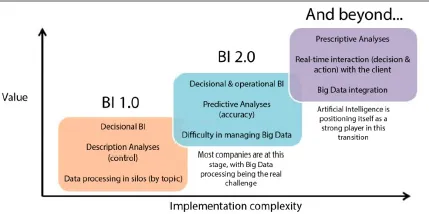
BI, like most disciplines with a strong adherence to technology, evolves with technological progress (of which there have been many in recent years). BI has experienced many of these in less than 20 years, which is summarized in Figure 1.2.
Figure 1.2.Business Intelligence evolution cycle
1.4.1. BI 1.0
In the late 1990s and early 2000s, companies organized themselves around BICCs to streamline and optimize their reporting activities. At this stage, BI was mainly decisional6 and organized in silos (by subject such as marketing, logistics and finance). No or few management indicators (updated in “real time”, or more precisely, aligned with the temporality of operational processes) were available for operational actors; this was still very much a world for experts, where BI (through its tools) had some difficulty in spreading itself throughout a company (for both technical and “political” reasons). Most of the solutions were subject-oriented, and data were organized and stored by type of activity (marketing data, HR data, financial data, etc.) with no or few possible crossovers between the different silos. The methods of analysis are said to be “descriptive”, which involves drawing up a picture of a situation (for example managing a sales activity) as it appears subsequent to following the compilation and classification of data. It allows the data to be managed, monitored, classified, etc., but provides little or no information on situations to come.
1.4.2. BI 2.0
In the mid-2000s, operational needs became more prevalent, thus operational decision-makers saw the arrival of a new generation of tools that enabled them to manage and optimize their operational processes in real time: operational BI was born and with it, the temporality of information and its processing became the key point. BI platforms have been integrating more and more prediction functions, and BI has been becoming increasingly more democratic as communication technologies (table...
Table of contents
Cover
Table of Contents
Title
Copyright
List of Figures
Preface
Introduction
1 What is Intelligence?
2 Digital Learning
3 The Reign of Algorithms
4 Uses for Artificial Intelligence
Conclusion
APPENDICES
Bibliography
Glossary
Index
End User License Agreement
Trusted by 375,005 students
Access to over 1.5 million titles for a fair monthly price.
Study more efficiently using our study tools.
Frequently asked questions
Yes, you can cancel anytime from the Subscription tab in your account settings on the Perlego website. Your subscription will stay active until the end of your current billing period. Learn how to cancel your subscription
No, books cannot be downloaded as external files, such as PDFs, for use outside of Perlego. However, you can download books within the Perlego app for offline reading on mobile or tablet. Learn how to download books offline
We are an online textbook subscription service, where you can get access to an entire online library for less than the price of a single book per month. With over 1.5 million books across 990+ topics, we’ve got you covered! Learn about our mission
Look out for the read-aloud symbol on your next book to see if you can listen to it. The read-aloud tool reads text aloud for you, highlighting the text as it is being read. You can pause it, speed it up and slow it down. Learn more about Read Aloud
Yes! You can use the Perlego app on both iOS and Android devices to read anytime, anywhere — even offline. Perfect for commutes or when you’re on the go. Please note we cannot support devices running on iOS 13 and Android 7 or earlier. Learn more about using the app
Yes, you can access Artificial Intelligence and Big Data by Fernando Iafrate in PDF and/or ePUB format, as well as other popular books in Computer Science & Artificial Intelligence (AI) & Semantics. We have over 1.5 million books available in our catalogue for you to explore.