The book is a comprehensive treatment of the field, covering fundamental theoretical principles and new technological advancements, state-of-the-art device design, and reviewing examples encompassing a wide range of related sub-areas. In particular, the first area focuses on the recent development of novel wearable and implantable antenna concepts and designs including metamaterial-based wearable antennas, microwave circuit integrated wearable filtering antennas, and textile and/or fabric material enabled wearable antennas. The second set of topics covers advanced wireless propagation and the associated statistical models for on-body, in-body, and off-body modes. Other sub-areas such as efficient numerical human body modeling techniques, artificial phantom synthesis and fabrication, as well as low-power RF integrated circuits and related sensor technology are also discussed. These topics have been carefully selected for their transformational impact on the next generation of body-area network systems and beyond.

eBook - ePub
Electromagnetics of Body Area Networks
Antennas, Propagation, and RF Systems
- English
- ePUB (mobile friendly)
- Available on iOS & Android
eBook - ePub
Electromagnetics of Body Area Networks
Antennas, Propagation, and RF Systems
About this book
Information
1
Textile Antennas for Body Area Networks: Design Strategies and Evaluation Methods
Ping Jack Soh1 and Guy A. E. Vandenbosch2
1 Advanced Communication Engineering Centre, School of Computer and Communication Engineering, Universiti Malaysia Perlis, Arau, Perlis, Malaysia
2 ESAT-TELEMIC Research Division, Department of Electrical Engineering, KU Leuven, Leuven, Belgium
1.1 Introduction
Due to the increasing demand for multi-functional, multi-band wireless operation and consumer-centric technology, textile antennas have been receiving growing attention [1]. Future wearable systems should be unobtrusive, flexible, and operating with minimal degradation in proximity to the human body. These antennas have to meet the bandwidth, efficiency, and safety requirements, while being consistent with low-cost manufacturing techniques. Moreover, in wearable applications, flat surfaces cannot be guaranteed. Thus, an important antenna requirement is its ability to work with good robustness against environmental, positional, and location changes when being worn, besides complying with medical and safety regulations.
Body-centric antennas are crucial in catering for various current and future wireless standards. Among others, wearable antennas could assist medical monitoring for hospitalized, homebound, or outpatients [2, 3]. They could be applied in emergency service communication and public safety support (e.g., firefighters) [4-6]. They could also provide flexibility in assisting communication in search, rescue, and location-tracking alerts, especially in hazardous environments [7, 8]. There is also the possibility that they will become popular in consumer electronics in the near future, applied for communication [9], positioning, and navigation for recreational purposes [10].
Wearable antennas are electrical radiators being made flexible enough to be worn and to work in the proximity of a user's body. Since it is ergonomically more suitable that a wearable antenna for Wireless Body Area Networks (WBAN) applications is flexible and made to conform to the body, it is only natural that textiles be used to achieve these requirements compared to conventional metallic structures, for example, rigid copper plates or tapes which are worn. However, degradation of the antenna performance when worn on the human body has been one of the major deterrents in its successful implementation, be it in terms of frequency detuning, bandwidth reduction, and efficiency degradation or radiation distortion [11]. In other words, ideally, a wearable antenna must be designed to be immune enough for an on-body operation. Moreover, a flexible antenna made from textile is regarded as a realistic candidate due to the advancements in conductive textiles and the ergonomic properties that it is able to offer. Since these textiles are either newly introduced or have been traditionally used for other purposes, for example, electromagnetic interference (EMI) shielding or grounding, one of the important and yet challenging aspects of this work is to properly characterize their electrical properties at the intended frequencies.
In this chapter, firstly, a brief overview of the types of textiles (conductive and non-conductive) is given. Next, the characterization procedure using a commercial setup is explained prior to the proposal of a systematic antenna fabrication procedure. Finally, this chapter also describes the evaluation methods used for the fabricated antenna prototypes, that is, in terms of reflection coefficient, radiation characteristics, efficiency, and specific absorption rates (SAR).
1.2 Textile Materials and Antenna Fabrication Procedure
Textile antenna prototyping materials generally consist of two textile types, conducting and non-conducting. The former is typically used to form antenna conductive elements (radiator, ground plane, shorting wall, etc.), whereas the latter is used to form the substrate, spacer, etc. For example, in the case of a Planar Inverted-F Antenna (PIFA) topology, conductive textiles are used as its radiator, ground plane, and shorting wall, whereas felt or fleece is used as the substrate. The properties of several popular commercial off-the-shelf textiles can be found in [4] and [12-14], and will be explained in the following sections.
1.2.1 Conductive Textiles/Foils
Initially, flexible antennas are prototyped using copper foil, as this is flexible and a rough representation of a textile antenna. However, the introduction of electrically conductive acrylic adhesives which are reasonably homogeneous in terms of surface resistivity/conductivity and mechanically stable has eased the fabrication of antennas made using commercial off-the-shelf textiles. These materials can be used as the radiating or grounding element for a textile antenna, and are required to be highly conductive, with surface resistivities (Rs) of less than 0.05 Ω/sq.
Three of the more popular conducting materials for wearable antennas are described as follows and are shown in Figure 1.1
- Copper foil tape: a 0.035 mm thick foil, coated with a 0.03 mm thickness.
- ShieldIt Super [15]: a ripstop, woven polyester textile coated with copper and nickel. Its thickness is 0.17 mm and its estimated weight is 230 g/m2.
- Pure copper polyester taffeta fabric (PCPTF) [16]: plain woven and coated using pure copper. It has a thickness of 0.08 mm and an estimated weight of 80 g/m2.
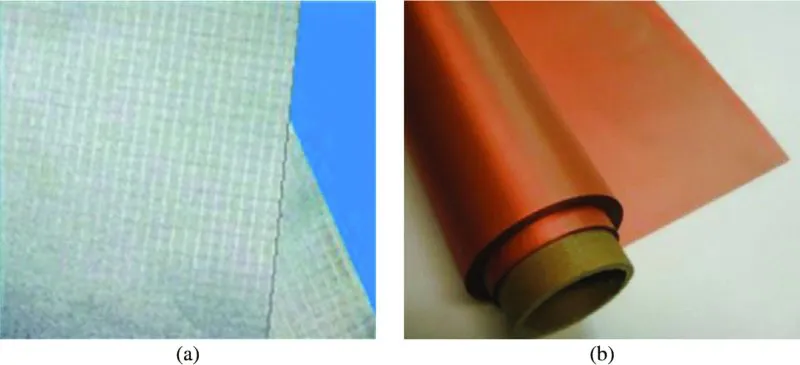
Figure 1.1 Conductive textiles: (a) ShieldIt Super [15] and (b) PCPTF [16]. Used with permission from LessEMF.com.
The parameter of prime importance is the equivalent conductivity of the textile used. This parameter ultimately determines the losses, and consequently, the efficiency and gain of the antennas. The homogenized conductivities were calculated based on the surface resistances provided by the manufacturer. The thickness of the conductive textile can be chosen depending on the application and location of the on-body deployment. For example, if the antennas are needed for health monitoring of the aged, thinner and low-cost materials may be chosen as they might be less exposed to harsh environments compared to the use of such antennas in military applications.
1.2.2 Non-conductive Textiles
The substrates used to fabricate wearable textile antennas are generally chosen to enable ease of integ...
Table of contents
- Cover
- IEEE Press
- Title Page
- Copyright
- Dedication
- List of Contributors
- Preface
- Acknowledgments
- 1: Textile Antennas for Body Area Networks: Design Strategies and Evaluation Methods
- 2: Metamaterial-Enabled and Microwave Circuit Integrated Wearable Antennas for Off-Body Communications
- 3: AMC-Backed Flexible Near-Endfire Wearable Antennas for On-Body Communications
- 4: Novel Antenna Designs And Characterization Methodologies For Medical Diagnostics And Sensing
- 5: Basic Performance Characteristics of Wearable Antennas Over a Wide Frequency Range
- 6: Implanted Antennas and RF Transmission in Through-Body Communications
- 7: Antennas, Phantoms, And Body-Centric Propagation At Millimeter-Waves
- 8: Wearable Active Antenna Modules for Energy-Efficient Reliable Off-Body Communication Systems
- 9: More Than Wearable: Epidermal Antennas for Tracking and Sensing
- 10: Inkjet-Printed Smart Skins and Wirelessly-Powered Sensors for Wearable Applications
- 11: Circuits and Systems for Wireless Body Area Network
- 12: Ultra Low-Power MEMS-Based Radios for WBAN
- 13: Exploring Physiological Features From on-Body Radio Channels
- 14: Power/Data Telemetry Techniques for Implants or Wearable Systems
- Index
- EULA
Trusted by 375,005 students
Access to over 1.5 million titles for a fair monthly price.
Study more efficiently using our study tools.
Frequently asked questions
Yes, you can cancel anytime from the Subscription tab in your account settings on the Perlego website. Your subscription will stay active until the end of your current billing period. Learn how to cancel your subscription
No, books cannot be downloaded as external files, such as PDFs, for use outside of Perlego. However, you can download books within the Perlego app for offline reading on mobile or tablet. Learn how to download books offline
Perlego offers two plans: Essential and Complete
- Essential is ideal for learners and professionals who enjoy exploring a wide range of subjects. Access the Essential Library with 800,000+ trusted titles and best-sellers across business, personal growth, and the humanities. Includes unlimited reading time and Standard Read Aloud voice.
- Complete: Perfect for advanced learners and researchers needing full, unrestricted access. Unlock 1.5M+ books across hundreds of subjects, including academic and specialized titles. The Complete Plan also includes advanced features like Premium Read Aloud and Research Assistant.
We are an online textbook subscription service, where you can get access to an entire online library for less than the price of a single book per month. With over 1.5 million books across 990+ topics, we’ve got you covered! Learn about our mission
Look out for the read-aloud symbol on your next book to see if you can listen to it. The read-aloud tool reads text aloud for you, highlighting the text as it is being read. You can pause it, speed it up and slow it down. Learn more about Read Aloud
Yes! You can use the Perlego app on both iOS and Android devices to read anytime, anywhere — even offline. Perfect for commutes or when you’re on the go.
Please note we cannot support devices running on iOS 13 and Android 7 or earlier. Learn more about using the app
Please note we cannot support devices running on iOS 13 and Android 7 or earlier. Learn more about using the app
Yes, you can access Electromagnetics of Body Area Networks by Douglas H. Werner, Zhi Hao Jiang, Douglas H. Werner,Zhi Hao Jiang in PDF and/or ePUB format, as well as other popular books in Physical Sciences & Electromagnetism. We have over 1.5 million books available in our catalogue for you to explore.